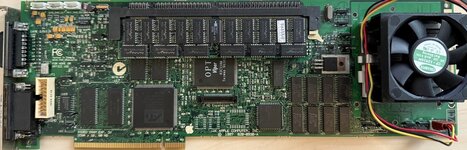
Its time for more PC card shenanigans! This time I've modded the final Apple PCI model card that shipped with a Pentium 166.
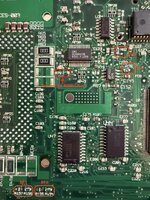
The first task at hand is a re-cap. The original capacitors on these cards leak like crazy (I've seen 5 so far, all 5 have had very leaky caps; especailly the ones near the VRAM). I got tantalum polymer caps to replace the originals, but the vias are so densely packed on these cards that the larger footprint on the tant-polys were shorting random things out and I ended up having to solder them on sideways (see photos at the end). If anyone else re-caps one of these, I'd recommend just sticking with can-style aluminum capacitors to keep things simple.
For mods, I started by de-soldering the original CPU and replacing it with a Socket 7 socket so I can easily swap CPUs and test others. There is also a convenient jumper location (J9) to get 12V for a fan. I confirmed that the Apple PC card does
not use split rail voltage and that the stock Core/IO voltage is set to a blistering 3.52V (likely a holdover from the Cyrix 6x86 models). Thankfully, the voltage regulator is adjustable. R62 and R76 form a voltage divider that controls the Core/IO voltage with a formula of VOUT = 1.21 * (1 + R76 / R62). By replacing the resistors with some that I harvested from dead hard drives, I got the core voltage down to ~3.3V to maximize the options that I have for replacement CPUs. The CPUs I tested are as follows:
- Working:
- Cyrix MII-300GP
- P54CS Pentium 200
- P55C Pentium MMX 233
- Pentium OverDrive MMX 200
- Not working:
- IDT WinChip 2 200 (Even set at 3.52v)
- AMD K6-233 (3.2v model)
By default, every one of the working CPUs (besides the OverDrive) operates at 166MHz because both BF pins are pulled low. After probing around, I discovered that the BF pins are strapped as follows:
This allowed me to set the CPU frequency easily for the Pentium CPUs; but to fully control the Cyrix chip, a bodge would need to be added to the BF2 pin to allow an external pull up/down. I believe that the Cyrix chip could be clocked to 266MHz, which would result in maximum raw integer performance. However, it already runs extremely hot at 3.3v 233MHz even with the "big" socket 370 cooler I have on it, so I think I'm personally sicking with the Pentium MMX 233 (R154 + R156 required to get 233MHz). It runs much cooler, even at 3.3V (its own datasheet specifies 3.7V as absolute max, it should be just fine). Even if you don't want to go through the trouble of installing a socket, just setting R157 and R154 is all you need to get the stock CPU running at 200MHz easily.
Finally, the bus can also be overclocked on these cards! The only higher setting than the default bus speed of 66.6MHz is 80MHz. This is achieved simply by removing R78. I was able to get my Pentium MMX running at 280MHz with this speed and it survived benchmarks and some light multimedia tasks without crashing. I didn't try this with the stock CPU, but it could be possible to get it running as fast as 240MHz (possibly assisted by the stock 3.52V Core/IO).