• Hello MLAers! We've re-enabled auto-approval for accounts. If you are still waiting on account approval, please check this thread for more information.

Three Slot Riser for 6400 - In search of the Mythical Slot C

Link above to Designing PCI Cards and Drivers for Power Macintosh Computers borked. If you haven't got it, I uploaded it over in the TD thread. It's so annoying that when I'm not logged in at work pics/attachments/links over here aren't available to non-members.

That's the 1999 revision though, so looks like I'll need to hunt down the 1995 first edition for the Alchemy/Gazelle docs for this project. :-/
 
Last edited:
Unfortunately, I've tried several "standard" PCI Riser boards such as you've ordered and none have worked.

I won't use it as is.
As the #INTA through #INTD lines, and what I'd guess are #REQ and #GNT lines are pulled from the other slots through the PCI fingers, I figure it's easy enough to just lob the connectors off, and rewire Slot B's #INTA to #INTD pins to the #PCI_SLOT2_INT signal on A9, Slot B's #REQ to B14, and #GNT to A14. Same deal for Slot C, just to the other reserved pins (#INTA to #INTD to A11, #REQ to B18, #GNT to A19).

For Slot A, all the wiring is basically already good to go. Otherwise, it's just a matter of removing any #IDSEL resistors that are wired up incorrectly, setting a 22 Ohm resistor between #AD14 and #IDSEL on Slot B, and #AD15 and #IDSEL on Slot C, with Slot A's #IDSEL already being handled on the logic board itself. If I'm not mistaken, that should get the riser to work on all three PCI slots.

It's funny, this whole thing came from me going "Could pulling the ATi chip on Gazelle free up a PCI slot?", as the board I did end up doing that to had damaged VRAM traces that cause graphical corruptions. I suddenly realized that yes, it's possible, and got the light bulb moment that that's why Alchemy has three PCI slots available :-)

And then @LightBulbFun pointed me to a treasure trove of Apple schematics on macdat.net the other week, and it all fell into place. As for the pulled ATi board, I think the Video In could be wired into the VESA Feature Connector of a suitable PCI GPU, too, which I'll have to experiment with later.

Theoretically, you could use the #IDSEL, #GNT, #REQ and #INT for the COMM Slot for a fourth PCI slot. Though, now the question arises, is O'Hare actually capable of even more slots? Certain Tanzania boards could take up to five PCI slots, next to onboard ATi PCI video, all on PSX + O'Hare. The Gazelle schematics don't list it, but perhaps it could be deduced from potentially unused pins in the schematic.

 
I won't use it as is.
As the #INTA through #INTD lines, and what I'd guess are #REQ and #GNT lines are pulled from the other slots through the PCI fingers, I figure it's easy enough to just lob the connectors off, and rewire Slot B's #INTA to #INTD pins to the #PCI_SLOT2_INT signal on A9, Slot B's #REQ to B14, and #GNT to A14. Same deal for Slot C, just to the other reserved pins (#INTA to #INTD to A11, #REQ to B18, #GNT to A19).
Indeed, didn't mean that you'd doing so. I was saying that I tried a few that had and a couple that did not have the slot tentacles. When I discovered that Apple had utilized RESERVED lines on the logic board connector to interface with the Riser, it didn't look like a good approach to cut and bodge traces on the Risers in hand.

Doing that on the straight thru cable based risers now. The INT lines appear to be a proprietary misuse of the PCI standard. In the last post before you joined in, trag had this to say:
In any given PCI slot, Apple has traditionally (in this generation, don't know about Intel and late PPC stuff) wired all four INTs together. So there's a single unique INT per PCI slot. Every slot has it's own unique INT. So, when the interrupt manager (e.g. Grand Central on X500/X600) receives an interrupt, it knows exactly which slot it came from. So, my guess is that your PCI header on the 6400/6500 logic board runs a unique INT to each of the four INT pins in the header slot, but then runs just one of those four to each PCI slot on the riser card. So each PCI slot on the riser card gets its own unique INT from the header slot and uses that one INT for all four INT pins in the slot.

They would still need to steal some unused pins in that PCI header to provide Bus Grant and Bus Request lines to each of the riser card slots.
That's why I'm drilling down to the Logic Board connector from all the pins of Slot B ATM. I should have a second 1U Riser in hand by next Saturday. Usint a pair of them does a 180. That places the Logic Board's soldertail nubbins on the same side as those of Slots A&B. That'll make buzzing connections in the search of any further Apple's PCI shenanigans a snap.

Found the '96 (Gazelle Architecture) PCI tome, will be looking at that in the meantime.
 
Last edited:
Doing that on the straight thru cable based risers now. The INT lines appear to be a proprietary misuse of the PCI standard. In the last post before you joined in, trag had this to say:

In any given PCI slot, Apple has traditionally (in this generation, don't know about Intel and late PPC stuff) wired all four INTs together. So there's a single unique INT per PCI slot. Every slot has it's own unique INT. So, when the interrupt manager (e.g. Grand Central on X500/X600) receives an interrupt, it knows exactly which slot it came from. So, my guess is that your PCI header on the 6400/6500 logic board runs a unique INT to each of the four INT pins in the header slot, but then runs just one of those four to each PCI slot on the riser card. So each PCI slot on the riser card gets its own unique INT from the header slot and uses that one INT for all four INT pins in the slot.

They would still need to steal some unused pins in that PCI header to provide Bus Grant and Bus Request lines to each of the riser card slots.

That's why I'm drilling down to the Logic Board connector from all the pins of Slot B ATM. I should have a second 1U Riser in hand by next Saturday. Usint a pair of them does a 180. That places the Logic Board's soldertail nubbins on the same side as those of Slots A&B. That'll make buzzing connections in the search of any further Apple's PCI shenanigans a snap.

Yup, @trag pretty much had it spot on that Apple wires all INT lines per slot to a singular, slot specific INT line, rather than follow the PCI spec and have individual lines that get rotated between slots, alongside the slot specific GNT and REQ lines.

The INT for Slot C was confirmed per the 6500 schematic, as they left the connection to the PCI slot as well as the cache slot (again, curious what the idea behind that is), but removed the GNT and REQ and left those pins as reserved as the lines got repurposed for the ATi chip instead.

I basically theorized it, then followed up with actually buzzing it out on a 6400 board, which confirmed the GNT and REQ connection points. I don't think it should be too hard to solder some thin magnet wire to whatever bits of copper comes off the reserved PCI pins on the riser's PCI edge connector, and run them to the connector solder points for Slot B and C to wire them together.

EDIT: For example, a similar riser has the connectors wired up as such:

image(37).png

So, just a case of running the INT connections to pin 1 through 4, GNT to 6, REQ to 7, and a resistor to the right address line to IDSEL. The CLK could be connected from PCI1 to PCI2 and PCI3 with a single magnet wire across the PCI slot solder joints, soldered to all CLK pins.
 
Last edited:
So cool. Maybe I'll be able to convert one of my boards like that as well. That pulls the Mythical Slot C into the real world without doing a PCB.

Magnet wire = bodge wire = rework wire? Why the heck would they need to run a clock line from the tentacles?

Not a lot of use for it in an unmodified Mac case however. The 6360, its AIO offspring and the TAM have enough cubic available in the drawer above the single PCI Slot to do a setback TwinSlot Riser within the drawer. But the 6400/6500 two slot drawer has no cubic available above the top card in the drawer for that trick.


Interesting tangent: Checked out everymac's 1996 listing of Macs released and the six slot 9500 was appeared along with the Gazelle Architecture boxen. Its Tsunami architecture almost has to have adhered to PCI spec? I'll have to check the tentacled Riser on my crumbled case 9500 board. If it works as in Beige G3, it could prove very interesting indeed. ;)
 
Last edited:
Not a lot of use for it in an unmodified Mac case however. The 6360, its AIO offspring and the TAM have enough cubic available in the drawer above the single PCI Slot to do a setback TwinSlot Riser within the drawer. But the 6400/6500 two slot drawer has no cubic available in the drawer for that trick.

I think a novel way to implement it on the 6400, is to implement a PCI device on a new two card riser itself as the third PCI device. The riser could be horizontally elongated, to have some space for the circuitry. Then you could for instance make a riser with SiI3112 SATA on it, or even a PCI-PCI bridge and multiple devices like SiI3112 SATA + USB + FW, and still have two PCI Slots available for further expansion. With a CSII Ethernet NIC, that gives the machine quite a bit of upgradability.
 
Interesting, might work with SMT connectors on both sides using a lot of layers on the Riser PCB? IIRC, somewhere in my TwinSlot riser threads I have illustrations for implementing a MiniPCI connector on the solder side of the TAM's CSII riser.
 
Found a development platform . . .
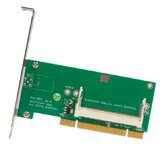
StarTech-PCI-2-MiniPCI-Adapter.jpg


Near full size PCI Card development/prototyping board expansion from that connector might prove fun for any type of card. There's cubic enough betwixt PCI Riser and CSII NIC for all kinds of fun for folks way above my meager pay grade.

Impossible Dream for that cubic would be a bootable SATA adapter for Old World/OS9.
 
HRMMM? Has anyone seen a RA PCI Connector?

Implementing MiniPCI on the 6500 Riser like that would be a slick mounting point for an adapter that would run a low profile or lopped off L-Shape adapter vertically in the cubic betwixt Riser and CSII NIC. Who needs FireWire these days anyway?
 
@Daniël the only one somewhat unrelated things I could wonder about is that if you manage to 'break' a comm.bus into a pci card slot instead, does that mean you also have an unused serial bus to pipe out to its own minidin port elsewhere as well or is that too dependant on the same one bus itself otherwise?
 
I think a novel way to implement it on the 6400, is to implement a PCI device on a new two card riser itself as the third PCI device. The riser could be horizontally elongated, to have some space for the circuitry. Then you could for instance make a riser with SiI3112 SATA on it, or even a PCI-PCI bridge and multiple devices like SiI3112 SATA + USB + FW, and still have two PCI Slots available for further expansion. With a CSII Ethernet NIC, that gives the machine quite a bit of upgradability.

First, I'm quite enjoying the progress you gentlemen are making on this project.

Second, the idea above is one I quite liked when I was considering adding back the 3 lower Bandit PCI slots to the Umax S900/J700.

The secondary CPU slot on both logic boards has (almost) all the connections needed for a Bandit chip. But how would one bring out three more slots without using some large modded case? Putting some largely internal functionality directly on the expansion card is at least a partial solution.
 
@Daniël the only one somewhat unrelated things I could wonder about is that if you manage to 'break' a comm.bus into a pci card slot instead, does that mean you also have an unused serial bus to pipe out to its own minidin port elsewhere as well or is that too dependant on the same one bus itself otherwise?
The serial bus for the Comm Slot and modem port are shared, so those connections are the same and thus already in use.
Breaking out the Comm Slot to a fourth PCI slot seems very possible though!
 
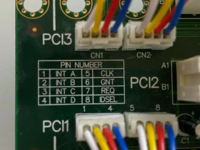
As of last week I'd identified the four lines I think would need to be jumpered from CSII to the breadboard planned for CableRiser shenanigans:
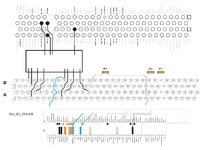
Slot_E1_014.JPG
I got farther along with the connections for Slots B and C that need to be added to and from the breadboard, but haven't doinked those scribbles into AI as yet.
 
@Daniël hm right I had thought it was a bit too long awhile, ah well..guess that indeed unless you really wanted to use megaphone/alike I guess theres no issue in kicking the modem outside (aka external) as to be able to thump in an another pci slot internally instead
 
I think a novel way to implement it on the 6400, is to implement a PCI device on a new two card riser itself as the third PCI device. The riser could be horizontally elongated, to have some space for the circuitry.
Was so jealous of this brilliant idea because your tricked out PCI/Riser wouldn't work in the 6360 or TAM which were the inspirations for the TwinSlot Project.

Well . . . Still no good for the TAM, but the 'ole bend back the harness brace and slide a full length PCI VidCard up under the Optical bay came to mind. Have been figuring on using the stock slot for that long card again. but decided a third card would be better!

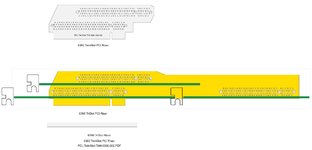
6360-TriSlot-Riser.JPG
I've left Apple's specified 7" card in the stock slot and have extended the 6360 "Riser" underneath the Optical Bay with cubic available for a 5.5" or 6.5" PCI Card in the all but wasted cubic of the speaker well. Bracket on Card in Slot_C is for reference only. Drawer will slide right in with three cards in that config just it did/does with the Full length Thunder Card in my Crescendo G3/L2 powered graphics workstation back in the day.

TwinSlot Riser works in TAM and 5400/5500 AIOs, but no room for my 6360 TriSlot insanity. 🤪
 
Heh, all this CommSlot II talk just reminds me what a waste of a PCI slot it was on the 4400. I like the idea of integrating a 3rd PCI device directly into the riser. Something like SATA and/or USB doesn't take up too much board space.
 
Yeah! SATA came immediately to mind because of the limited performance of IDE in Alchemy/Gazelle machines. Is IDE any better on the Tanzania Architecture 4400?

Was thinking more about it earlier and the TAM could employ an elongated PCI Riser with SATA on board as well. All would be even better on the proposed TwinSlot Riser. ;)
 
Heh, all this CommSlot II talk just reminds me what a waste of a PCI slot it was on the 4400. I like the idea of integrating a 3rd PCI device directly into the riser. Something like SATA and/or USB doesn't take up too much board space.

The European spec machines were actually fitted with triple PCI risers:

922-2656-00-800x600-product.JPG


As mentioned though, LPX-40, the Tanzania base design, allowed for up to five PCI devices next to the ATi Rage II:

Screenshot 2024-08-28 at 12-43-35 LPX-40 Dev Note(4400-).pdf.png

That's six PCI devices in total, versus the four on Alchemy (3 PCI slot, 1 CSII) and Gazelle (2 PCI slot, 1 CSII, ATi), while using the same PSX + O'Hare chipset.
Shame there's no LPX-40 schematics, I'd like to see how O'Hare is setup in a six PCI device setup.
 
@NJRoadfan well to be quickly honest about it theres two things I see here in name of 1. theres no AUII onboard for networking otherwise and 2. it being an apple system, many people in some countries probably expected it to be able to have a modem internally (last I know I still never have ever managed to track down the only one single pci modem from usr that was mac-compatible, meanwhile CS/CSII cards of many sorts seem to be always somewhere)
 
Back
Top