
I’m looking forward to your solution. Great that you took this on. Just wondering if you two were collaborating.

-
 Hello Guest! We're hosting a challenge to welcome vintage Intel macs to the MLA during the month of July! See this thread for more information.
 -
We've made some quality of life improvements to the Trading Post. More info here.
You are using an out of date browser. It may not display this or other websites correctly.
You should upgrade or use an alternative browser.
You should upgrade or use an alternative browser.
LCD Replacement for the Macintosh Portable
- Thread starter Froggy814
- Start date

Thanks! That would have been awesome to collaborate with him. He seems to have a lot of knowledge about the portable compared to me, but unfortunately I don't have a good way to contact him.I’m looking forward to your solution. Great that you took this on. Just wondering if you two were collaborating.
On a side note, do you have a good idea on what type of cable I should use to take the odd connector apple used to make it something else becuase the 2.54 spacing header and cable will just not fit inside the portable's LCD bezel, it's too tall. I was thinking maybe I should use a regular very small/thin flat flex cable like the ones you can find on basically every electronic that connect boards together. Do you have any ideas on that?
Yes. The flat flex cable is a good idea with a small zif style connector.
Great! It'll make the adapter PCB and the controller PCB much smaller too! I just wanted to know if it was a good idea.Yes. The flat flex cable is a good idea with a small zif style connector.
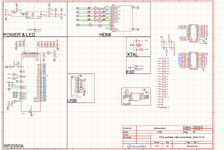
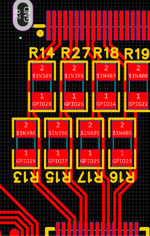
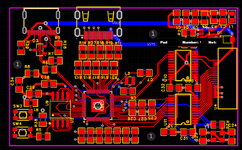
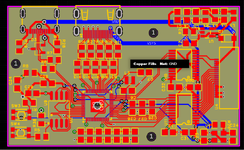
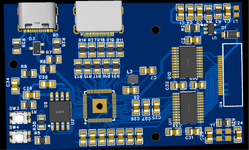
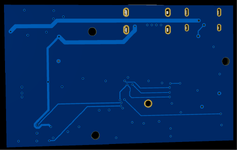


Off the cuff, some quick thoughts....
Decoupling capacitors must be as close to the RP2350 as possible and wired one per power pin on the chip. That advice goes for all other power pins on other parts too. Oscillator must be as close as possible to the chip and take caution with the grounding of the caps. Use an array of vias instead of one large plated hole under the RP2350. Trace clearance looks somewhat tight, suggest increasing it and using smaller passives to give you more flexibility. I didn't really look at the rest of the design - switching regulator in the corner looks a little odd, especially inductor - or validate the schematic.
My advice: consider using a pico module for v1 as that will eliminate much of the sensitive critical design work. But if you want to do the laid-down RP2350, I would recommend looking at some tested open source designs and borrowing as much as possible of the layout. Also read the design guide provided by Raspberry PI and take it as gospel, they provide a lot of excellent advice in there.
Decoupling capacitors must be as close to the RP2350 as possible and wired one per power pin on the chip. That advice goes for all other power pins on other parts too. Oscillator must be as close as possible to the chip and take caution with the grounding of the caps. Use an array of vias instead of one large plated hole under the RP2350. Trace clearance looks somewhat tight, suggest increasing it and using smaller passives to give you more flexibility. I didn't really look at the rest of the design - switching regulator in the corner looks a little odd, especially inductor - or validate the schematic.
My advice: consider using a pico module for v1 as that will eliminate much of the sensitive critical design work. But if you want to do the laid-down RP2350, I would recommend looking at some tested open source designs and borrowing as much as possible of the layout. Also read the design guide provided by Raspberry PI and take it as gospel, they provide a lot of excellent advice in there.
Thank you very much for the advice! It's hard to find sound advice, so I just followed the schematic for the Waveshare. Thank you soooooooo much!Off the cuff, some quick thoughts....
Decoupling capacitors must be as close to the RP2350 as possible and wired one per power pin on the chip. That advice goes for all other power pins on other parts too. Oscillator must be as close as possible to the chip and take caution with the grounding of the caps. Use an array of vias instead of one large plated hole under the RP2350. Trace clearance looks somewhat tight, suggest increasing it and using smaller passives to give you more flexibility. I didn't really look at the rest of the design - switching regulator in the corner looks a little odd, especially inductor - or validate the schematic.
My advice: consider using a pico module for v1 as that will eliminate much of the sensitive critical design work. But if you want to do the laid-down RP2350, I would recommend looking at some tested open source designs and borrowing as much as possible of the layout. Also read the design guide provided by Raspberry PI and take it as gospel, they provide a lot of excellent advice in there.

Same here!always frightened of tunnel vision
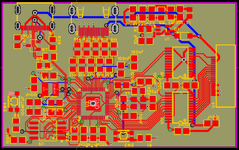
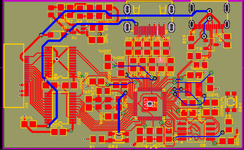
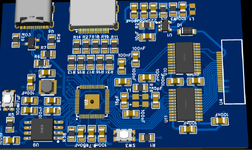
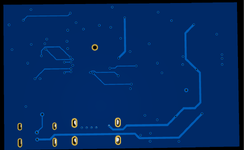

1. Add a pair of holes so that a loop of wire can be soldered in place for a ground test point. It will make oscilloscope/multimeter testing much easier.
2. If you have spare wires in the cable, bring those out to a header (along with +5 and ground) so that we can hack a brightness control via software.
Is this for both the M5120 and M5126? Do you still plan on a ribbon cable connector because it looks like you've switched to a flat flex.
2. If you have spare wires in the cable, bring those out to a header (along with +5 and ground) so that we can hack a brightness control via software.
Is this for both the M5120 and M5126? Do you still plan on a ribbon cable connector because it looks like you've switched to a flat flex.
Not quite sure what you mean by that?Is this for both the M5120 and M5126? Do you still plan on a ribbon cable connector because it looks like you've switched to a flat flex.
I don't have any spare wires in the cable, but i can make a pin header with gpio coming out for brightness modifying. I will do that thank you!2. If you have spare wires in the cable, bring those out to a header (along with +5 and ground) so that we can hack a brightness control via software

M5120 and M5126 are two models of Macintosh portable where the latter is backlit and the former is not.Not quite sure what you mean by that?
Ribbon cable and flat flex are two different types of cabling. What kind of cabling are you going to use? What is U4 going to be?
It looks like you made the decision to switch to flat flex at https://68kmla.org/bb/threads/lcd-replacement-for-the-macintosh-portable.52408/post-592677
Both! I am making an adapter hat that will go to the ribbon with a plug on the end for flat flex that you can buy readily at amazon.Ribbon cable and flat flex
If the pinout is the same then yes.M5120 and M5126 are two models of Macintosh portable where the latter is backlit and the former is not.

What inductor did you use on the RP2350's internal regulator? The RP2350 is very sensitive to what inductor is on the board and how it's arranged relative to the chip, to the point that Pi Foundation had a specific model of inductor custom manufactured with polarity markings so that people can make boards that run at max efficiency.
If you haven't verified your design against the official recommendations, you should. Also, make sure you have a pull-up on the RUN pin so that the chip isn't in reset all the time. This isn't really mentioned in that document and it matters (I learned the hard way).
I can see that you aren't using the recommended inductor layout. That may not be an issue but you should be aware of the potential for a non-functioning board.
If you've already ordered the boards, disregard this .
.
If you haven't verified your design against the official recommendations, you should. Also, make sure you have a pull-up on the RUN pin so that the chip isn't in reset all the time. This isn't really mentioned in that document and it matters (I learned the hard way).
I can see that you aren't using the recommended inductor layout. That may not be an issue but you should be aware of the potential for a non-functioning board.
If you've already ordered the boards, disregard this
.Similar threads

- Replies
- 2
- Views
- 511


- Replies
- 7
- Views
- 2K
