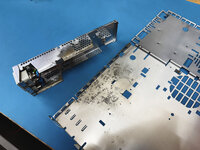
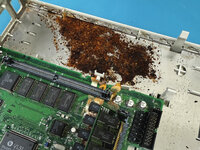
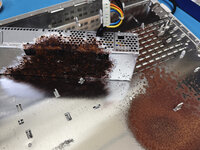
You know, there’s quite a variety of scotchbrite products, which type are you referring to here?The dark spots are the carbon residue after evaporust reacts with the rust. It comes off with scotchbrite.


You know, there’s quite a variety of scotchbrite products, which type are you referring to here?The dark spots are the carbon residue after evaporust reacts with the rust. It comes off with scotchbrite.

You know, there’s quite a variety of scotchbrite products, which type are you referring to here?

I would hang onto it; it might be fine. I was pretty lazy and didn't scrape off much of the battery residue. Just don't mix it back into a larger container. I'm actually interested to hear whether a similar reaction happens in your case.On a second look, I think it's fine... it's still the usual yellow color, it's just there's rust particles which is making things cloudy. I usually pour the stuff back into the bottle through a filter. But in this case, since I did use it on a battery bombed chassis, I'm going to take it to the hazardous disposal center and buy a new 1 gallon bottle.
I would hang onto it; it might be fine. I was pretty lazy and didn't scrape off much of the battery residue. Just don't mix it back into a larger container. I'm actually interested to hear whether a similar reaction happens in your case.
 elephantandchicken.co.uk
You probably could get away with just a sheet of aluminum to act as a heatspreader in order to get the low profile. 33mhz isn't asking much, around 3ish watts to dissipate on a L88M.

I need to get back to that LC III and the 840AV, but I have been distracted.
@cheesestraws pointed me at a writeup that @Phipli did on upgrading his Radius Rocket 25i to a Rocket 33:
Upgrading the Radius Rocket 25i
Upgrading the Radius Rocket 25i In the early 90s before Apple was able to release the first 68040 based Quadra system, Radius, mostly known for their video cards and monitors but also a manufacture…
Decided to give it a try.
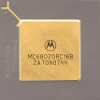
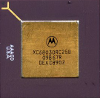
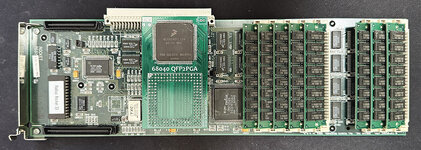
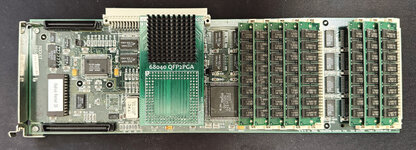
I didn't have any spare socketable full 68040s at 33MHz or higher lying around so I decided to use a QFP to PGA adapter designed by @zigzagjoe that I received from @croissantking in exchange for something recently. The adapter was already populated with a Freescale L88M mask 33MHz 68040 (QFP) that @croissantking had saved from death (it had lost some pins but he was able to save it by shaving some of the packaging in the corners - I think he mentioned it on one of his profile posts a few months back). I picked up a 66.666MHz crystal and burned a 27C256 EPROM with the ROM image for a Rocket 33 which @Bolle had provided in another thread (link here).
View attachment 88680
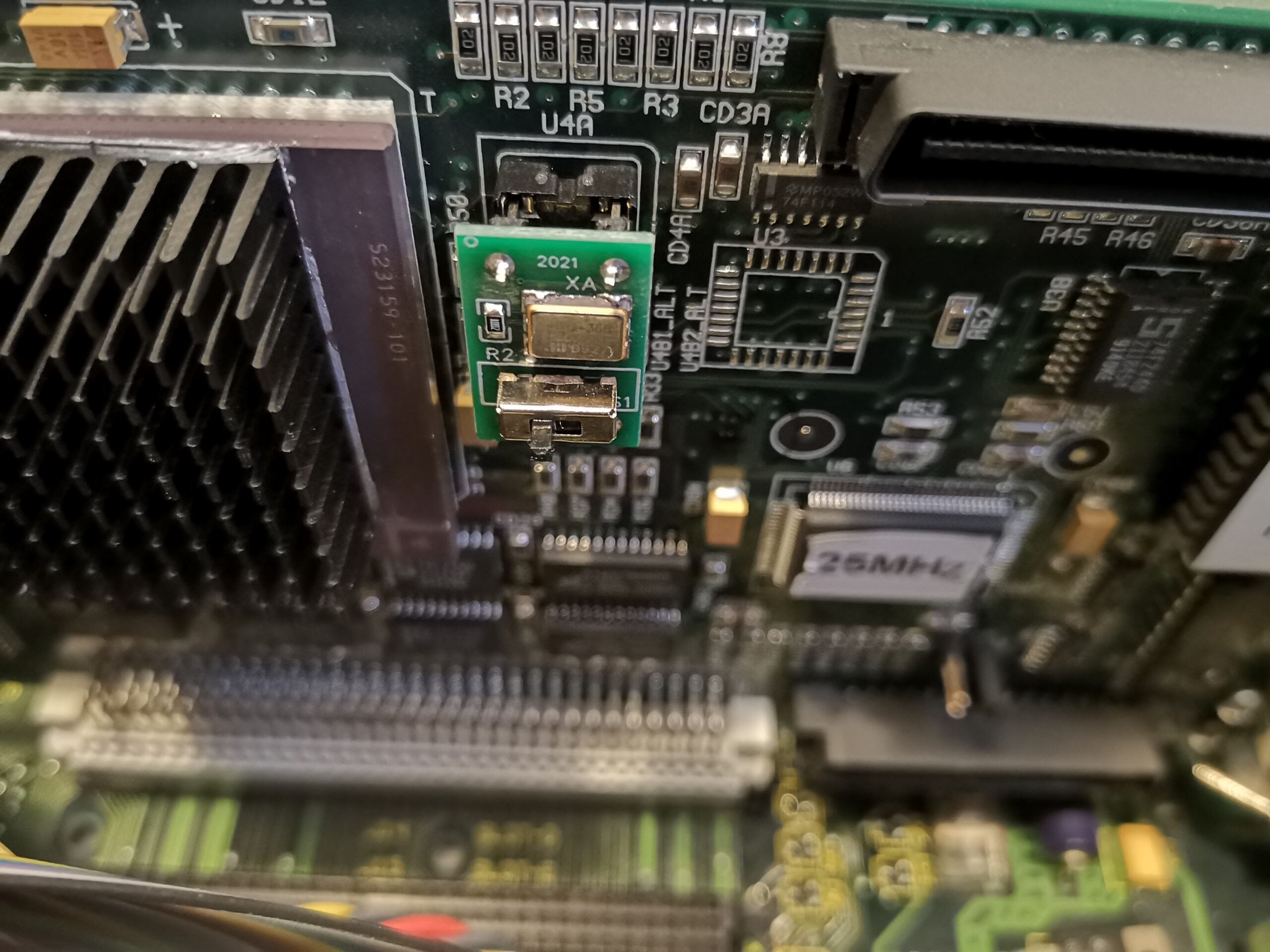
Here's the Rocket with new ROM, the adapter which amazingly fits (I think it will probably clear the add on cards too), and the new crystal (I added a socket so I can easily reverse the change). You can see the two corners that were modified by @croissantking to save the chip. And here with a heatsink added:
View attachment 88681
With the heat sink it will actually prevent the next Nubus socket from being usable. The Freescale chips run a bit cooler but I might add a fan as @zigzagjoe 's adapter conveniently has pads for providing 5V to a fan. I have a 40mm Noctua lying around which I can add once I design a clip that will secure it to the adapter board (I had a clip designed previously for socketed cpus, but since this one is not socketed, won't work).
The modification seems to work. The card does identify itself as a Rocket 33 and I was able to run System 7.1 on it via RocketShare. Seemed stable as I was messing with it. I did not benchmark to prove it's faster. But I assume with the new clock crystal and ROM, it's running at 33MHz.
I haven't decided whether to keep the adapter on there permanently or pick up a new 68040 chip. I kinda don't want to lose a Nubus slot. But then again, I have nothing else I want to put into my IIfx so maybe I'll just leave it for now.
Thanks to @cheesestraws, @Phipli, @zigzagjoe, @croissantking, and @Bolle for the pointers (and ROM image).

That was at my direction, C7 is for decoupling when the jumper above is cut for current measurements/3.3v operation/other shenanigans. As long as the bottom caps are populated it's not essential as there should also be plenty of capacitance near the 040 socket on the logic board.Very nice to see that chip being so proudly resurrected. And that is rather serendipitous regarding fitment!
BTW, I see that the decoupling cap at C7 is missing - I would suggest replacing that. I fitted 100nf passives on the backside so you’ll need something like a 100uf cap on the top.
That was at my direction, C7 is for decoupling when the jumper above is cut for current measurements/3.3v operation/other shenanigans. As long as the bottom caps are populated it's not essential as there should also be plenty of capacitance near the 040 socket on the logic board.


I need to get back to that LC III and the 840AV
Looking forward to seeing how you go with the 840AV. When I get back from holiday I’ll pick up on my PSU rebuild, quite excited to see how that turns out.

Very nice to see that chip being so proudly resurrected. And that is rather serendipitous regarding fitment!
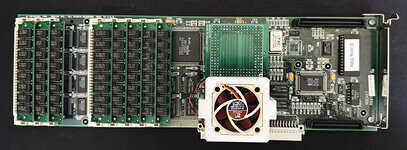 Next stop is 40MHz as I have an 80MHz crystal around here somewhere. I guess we'll see.
Looking forward to seeing how you go with the 840AV. When I get back from holiday I’ll pick up on my PSU rebuild, quite excited to see how that turns out.