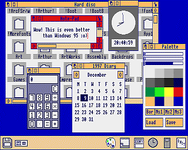
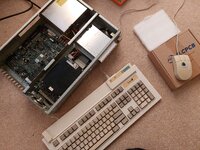
This one is a 24MHz Acorn A5000 I think, from about 1991. Showing full screen scrolling. It isn't mine (I was helping repair it for someone) and it is a while ago, so I might have some details wrong.
Nice. Here's my video of my PS/2 to Quadrature-Encoded mouse conversion that I did for my 12MHz A3020 (6 MIPS). It shows me moving the paint tools palette around the screen along with the contents.
You can also play with the Javascript multi-Archimedes machine emulator:
https://archi.medes.live. For example,
Choose Machine:A3000 and Risc OS 3 to see what an 8MHz ARM could do. The emulator aims to emulate in real-time. Then pick
Load Software:RISC OS 2 Application Disk (1) . You'll find that dragging windows with their contents and scrolling images works well.
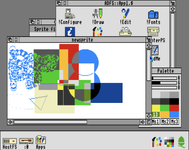
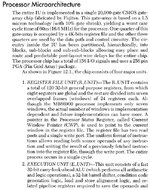
In many respects, an 8 MHz ARM2 shouldn't be able to compete with even early SPARC and MIPS RISCs, primarily because it has half the registers, had fewer instructions and no cache. Yet, in reality it's able to perform tricks that SunView, Solaris, Windows and Mac OS just couldn't do until about a decade later, with chips running into 100s of MHz, L1 and L2 caches and/or dedicated GPUs.
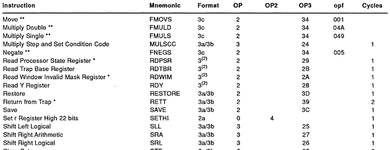
And this begs the question, how? The answers are, I think fairly obvious: RISC OS was written in Assembler. Also, its colour graphics routines were probably simpler than QuickDraw or its competitors. But also, ARM could do a few things optimised for DRAM, namely page-mode sequential access and conditional instructions which helps optimise for sequential access. Also, interestingly, ARM2 had a Booth-algorithm multiplier (and MAC instruction), which could perform multiplies twice as quickly as an unrolled SPARC MULSCC could.
Apart from the Icon-Bar though I find RISC OS pretty clunky. Its 3 button mouse system and UI conventions were overly technical for a computer aimed at kids, while the styling reminds me of GS/OS.
I would really like to see some direct proof of this <snip> Sapphire <snip> dock three years prior <snip> by timing alone, the Register article is wrong: <snip>
There are things that really irritate me about The Register article and the presentation it's derived from. The tone is very hacky. It's like, "Oh we just hacked a UI in a weekend that beat ARX, and it was just a demo in BASIC that displayed multiple clocks." "Arthur wasn't an OS, but the Sales guys put it in a ROM anyway - you know what marketing is like, hoho." and "Oh, we knocked up multitasking by jiggling with the MMU."
It's written as though Computer Science isn't a real thing at all and planning is for suits. Arthur actually took about 18 months+ to write and as a GUI is seemingly as capable as Windows 2 and no more clunky than Sun Tools. Its UI is reasonably well thought out and consistent. Sales people don't really make decisions about ROMs. Their description for managing multiple applications via the MMU in reality sounds entirely conventional: applications regardless of where they are in Physical RAM just get mapped to a standard Virtual address (on RISC OS, starting at 0x8000). The only weird thing about the MEMC MMU is that it's a Physical Page Table that maps to Virtual addresses rather than a Virtual Page Table that maps to Physical addresses. The chip has a CAM (Content Addressable Memory) that performs all the PPT scanning in parallel.
Thus, jiggling the MMU from app1 to app2 involves scanning through the PPT; and for any Physical address corresponding to a VA in app1's range, changed to invalid, and any PA for app2 changed to a VA in the right range. It sounds a lot like Switcher and Multifinder.
Anyway, my rant about the article I was citing, is now over.
<snip> Accent was a direct ancestor of Mach and therefore NeXTstep <snip> Avie Tevanian who I've mentioned was hired directly out of that lab by NeXT <snip> Anyone who would have worked in the workstation space would have been familiar with Accent, as it was discussed at symposia like
this one in Oxfordshire in 1985 <snip> can still be a UK connection: Accent ran on the PERQ,
And that's reasonable. I guess, Acorn could have derived the Icon Bar from Accent and then just hoped no-one remembered Accent. Not sure how to prove that.
Accent would run on my PERQ too if I could just figure out what to fix in it...)
Well, that would be a perk!