• Hello MLAers! We've re-enabled auto-approval for accounts. If you are still waiting on account approval, please check this thread for more information.

Clock Chipping the Quadra 630?

Trash80toHP_Mini

NIGHT STALKER
68040
There's no mention of it in the usual places because Clock Generator resistor tampering of the CPU's multiplier pretty much negates the need for chipping the system clock.

However  .  .  .  [}:)] ]'>

.  .  .  merely running the 40MHz 68040 from the cap-rotted 840AV board via resistor via the well documented resistor musical chairs routine seems a silly waste of very cool (also within thermal spec) resources. [:)] ]'>

What FDD?

Serial ports, don't plan on using them.

Is ADB one of the usual suspects in overclocking a board?

SCSI controller has its own crystal/timing setup, no? Zip drive required.

PDS NIC has its own crystal can for 10bT, how about my currently AWOL CS NIC?

Not all that concerned about the AV/Tuner Card, it has its own Crystal can for NTSC timings.

System video and how it will mesh with the blue screen system window of AVP with increased clock rate output of the video controller seems like it will be the sticky wicket?

Suggestions/ideas/guesses/further questions for pondering?

 
Failed to mention the convection cooling tower experiment:

/monthly_07_2017/post-902-0-93408500-1499665769.jpg">View attachment 13407

Venturi Effect CPU cooler setup coupled with vanilla convection running up the surfaces of logic board and across liberally applied heat sink menagerie might just keep the system shy of the ragged edge of the limits of convection cooling a fanless Compact Mac rides like a surfboard.

Pretty sure the setup will work with the 40MHz part runnin at its rated speed, but dunno about the clock chipped 50MHz summit expedition.

Venturi.gif.7d3bd7515dcc1f082105ac81c08606d8.gif


credit: Wikipedia

 
Last edited by a moderator:
Have solutions for this problem (which if I am remembering correctly is also really only on serial ports) on other machines been discovered/documented?

I'm aware that I'm badly out of the loop on this, but it really sounds like the only likely problem is going to be serial and possibly the comm slot. If you have LCPDS ethernet, you can use ethertalk or tcp/ip to connect to, say, printers hosted on the network or print queues hosted using grayshare or appleshare/asip on another machine, so some of the serial port usage is covered since you aren't using them for localtalk.

If serial ports are an unfixable problem because they're unstable when you overclock the system, and there's no way to return just the serial ports to a stable speed, then it seems like there are two options:

1) Do not overclock the system, or use faster CPUs in it.

2) Overclock or upgrade, but when you do, move peripheral devices to another system that isn't.

Out of curiosity, does anybody know what the state of this on the 650/800/950 is? Those would be other excellent candidates for installation of a 40MHz CPU and then perhaps even overclocking that chip. I know some people have gotten 40s out of 840s up to ~44-46MHz in Quadra 650 boards, and I believe those people are using NuBus cards in the system (mainly a video card for a second monitor) but I don't know about serial ports.

ADB is of course stable/usable in these configurations, or else nobody would ever do it.

 
Good point about ADB, makes a world of sense. I was half awake and trying to cover all bases before going to work. I was thinking about our Centris 650/Quadra 650/Quadra 800 differentiation discussion when I read this one:

C650 Serial Port ModificationVery neat stuff there!

As I was saying, my main concern would be the interaction of an overclocked Valkyrie ASIC(?) and the A/V card portion of the Tuner System for AVP display output. If the RoadApple PPC boards have the same Video ASIC on board, I'llt muck about using that system as a testbed. Pretty sure I can adapt the variable clock accelerator for the Quadra 950 for easily testing various system clock rates to get the 68040/40MHz part to throw off a bit more heat.  [:)] ]'> 

Time to hit the DevNotes again!

I eyeballed the ductwork sections for the Venturi effect cooling gambit. I've designed ductwork for cyclone dust collectors a couple of times. There the trick is to keep the area of each consecutive cross section optimized for ducting entering the the cyclone smoothly. Ductwork for this will be much the same. Cross sectional area at each transition will need to vary at a constant rate to and from the pinch bottle across the CPU heatsink.

Got no experience at all with pulling a cool air stream into the accelerating flow of air warmed by the PSU & CPU. With any luck at all I'll find an excuse to fab a NACA duct placed in the gentle airstream from the plain vanilla convection cooling system's inlet port. [:D] ]'>

 
if someone is overclocking an '040, taking the heatsink from the 840's 040 and putting it in on the destination machine is a wise idea, but in general I don't think the machine probably needs to be cooled more. It's not like the CPU is going to see its thermal output increase by like 400% when you're overclocking it by ~15%. (Admittedly, that's a big overclock, but.)

In terms of re-housing 475/630 boards, as I posted in bmow's case thread, really what I'd do is just add a little fan somewhere if there's any trouble.

It's not like you need to go engineer a BTX case or put a 650/800 board in the open-back-to-front case from something like an OptiPlex GX620 in order to cool a 15% overclock on an 040.

And to be honest if worst comes to worst, it won't be an issue of getting heat out of the enclosure. Most macs do that well enough(1). The issue will be getting heat out of the CPU and into the air, for which maybe something like the peltier cooler for the 601 chips would be worth looking at.]

EDIT: (1) Which is to say that dispersing 3w of heat instead of 2w of heat outside of a system isn't particularly difficult, either with just one fan or with a lot of open louvres on the top of a system. I'm personally convinced Apple considered this problem "solved" until the late G4 era at which point they floundered to figure out how to make enough air actually leave the system to count as real cooling.

 
Last edited by a moderator:
I put a note in the case thread. Wiki says that "heat was a problem" but doesn't give any numbers and the suggested solution is essentially "put a heatsink on it."

I don't think that designing a case using special physics to put more air near the CPU is going to help any more than just putting a bigger-than-average heatsink on it. At the time, "huge" was probably something with fins that were a half an inch tall. I've had Pentium CPUs with smaller heatsinks, so I don't think it will be a problem to find something appropriate and slap it on.

 
PDF datasheet courtesy of bhtooefr in #68kMLA.

Look for 11.4 Power Dissipation.

These are higher than I thought, but not too wild. I think that wikipedia's evaluation that you should put a heatsink on it is correct. I don't really know if the difference between the worst case scenarios at 25 and 40MHz is worth engineering a new case for.

 
You're entirely missing the point of this convection cooling exercise, why not just suggest I use a fan? ::)

The point of this thread is to figure out how hard I can push the Quadra 630's system board, forcing its Clock Generator to drive a 40MHz 040 as close to the 50MHz summit as possible or beyond without breaking AVP video output. This is not your garden variety 40MHz Quadra 630 resistor swap. That's no longer over the top, what fun would that be?

Punching a clock chipped Quadra 630 right through the vaunted Quadra 840AV's performance envelope while cooling it sufficiently using only convection enhanced by applying the principles of fluid dynamics is a journey well worth undertaking. Time to hit the DevNotes to look for indications of project feasibility.

Besides, all that clear plexi ductwork would look hella cool on the side of the MissileCommandMiniTower mj suggested. [:D] ]'>

 
LOL! On this scale we're talking MidTower, Anything shy of the 6400 form factor's height is gravy. Lego blocks of Missile's needle nose don't count.

It appears I may have been a bit cranky last night, sorry. Resistor swapping to the 40MHz level will definitely be fun What I meant to say was that I'm drawn by notion of a crystal driven supercharging challenge. The physics aspects add turbocharging to the convection cooling experiment for this hot rod. As Bigmessowires indicated, the fans on these cases output significant levels of noise moving quite a bit of air in an entirely different direction as compared their Quadra forbears.

Lets try to get that dB level down to less than a whisper. [:)] ]'>

 
Last edited by a moderator:
Step one complete: the first rev. Quadra 630 board boots AlSoft's DiskWarrior CD in the HDD deprived 6290/CD case! If ever there were an ESD victim candidate in my collection, it's this lil' thang. It's been kicking around in the hack bins bare@$ nekkid or almost so in the Sharp Typewriter knickers for the better part of 20 years!

Things look very promising on the DevNote front as well:

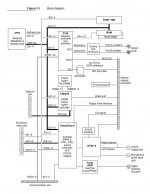
Q630-Block_Diagram.JPG

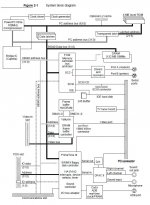
There's no mention of the system clock in the Quadra 630 DevNote Block Diagram because it has only the system bus oscillator running at 33MHz+-

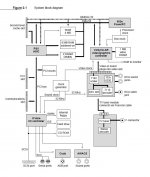
PM5400-Block_Diagram.JPG

The Alchemy architecture PM5400 DevNote Block Diagram shows the Quadra's Valkyrie ASIC updated to Valkyrie'AR and running happily alongside the AppleTV/Video System setup at a 40MHz System Bus clip. I've gotta fnd the 6360/6400 boards to make sure the Video Controllers ar pin compatible, just in case. [}:)] ]'>

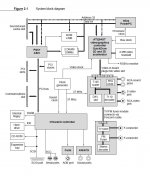
PM6500-Block_Diagram.JPG

Forgot about the ATI Chipset in the 50MHz system bus in the PM6500 Gossamer architecture. Block diagram included as a handy reference table for the entire AppleTV/Video System compatible series. 

Clock chipping the Quadra 630 by 11.1% appears to be the order of the day. :ph34r:

 
Last edited by a moderator:
Forgot the 6290 bits  .  .  .  [ :I ]

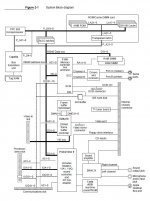
RoadApplePPC-Block_Diagram.JPG

Looks suspiciously like Apple implemented that 11.1% clock chip of the Quadra630 board already. The 21.2% Alchemy architecture Valkyrie-AR ASIC/40MHz System Clock speed bump possibility remains on the table, remote as it might be.

everymac xpecs opn 33MHz, 37.5MHz, 40MHz and 50MHz Architectures of the series:

http://www.everymac.com/systems/apple/mac_performa/specs/mac_performa_630.html

http://www.everymac.com/systems/apple/mac_performa/specs/mac_performa_6200cd.html

http://www.everymac.com/systems/apple/mac_performa/specs/mac_performa_5400cd.html

http://www.everymac.com/systems/apple/powermac/specs/powermac_6500_225.html

Not sure I'd try any of this with a 33MHz 68040 on the 40MHz clock multiplier.

But if things work out it sure would be fun to benchmark a 37.5MHz Quadra 630 system bus clock chip against the 40MHz CPU clock multiplier hack. The faster system bus probably puts you closer to Q840AV 40MHz System Bus performance levels than the 2.5 extra Mhz of the multiplier hack without ramping up the system board. Someone might try both after all, it's not like we don't have 33MHz 68LC040 parts to burn. }:)

 
Last edited by a moderator:
You're entirely missing the point of this convection cooling exercise, why not just suggest I use a fan? : :)
The 630 already has a fan.

Let's keep in mind here that the 840 itself has cooling that's essentially middling at best if you want to overclock the '040. In the '90s, the PC industry wasn't really looking seriously at cooling, because relatively few things in a PC needed to be cooled, and if they did, one fan in the PSU or just somewhere in the system was sufficient to do it.

I don't think I have missed the point of a convection cooling part of the thread. I think, and am saying, the convection cooling exercise is probably not going to net you the results you want.

 
Back
Top