• Hello MLAers! We've re-enabled auto-approval for accounts. If you are still waiting on account approval, please check this thread for more information.

Advice with SE30 restoration

Spacerog

6502
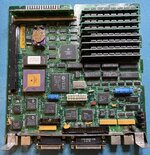
Need advice. Started with a working SE/30. Recapped the analog board and power supply. Both work find an SE logic board. Recapped the SE/30 board and ended up with a Simasimac screen. Reseated RAM and ROM. Still got Simasimac. Replaced two small chips that looked corroded (UE8 and UD8). Toned out all the traces, fixed a few, everything tones good. Now I get a black screen, nothing. Throughly washed the board. Meticulously Inspected front and back for shorts. No change, still black.

Verified that analog board and power supply and screen are still good with an SE board.

Debating whether to put the old chips I took off back on or replace them with new chips again. I have a multimeter but no oscilloscope. Anyway to test the chips, on or off the board?

I'm not ready to give up yet. What would you do next?
 
I've got zero ideas of what to look at and really don't want to just start randomly changing parts. Another set of eyes would be helpful. Thanks.

I know some of the trace repairs look a little dodgy but they tone out good with no shorts I can find.

IMG_6465.jpg
 
I had an SE/30 that I fixed by using a different ROM. I too replaced all of the caps and reseated RAM with known working and used 99% IPA on all socketed chips and slots, unfortunately always got Simasimac screen. Decided to try the ROM-inator II from my IIci and it booted. Not saying it is your problem, just what I did after spending a few weeks trying to figure out what was wring with mine.
 
If you are not getting any video output I would check the presence of a clock signal as generated by the canned oscillator at Y2. If you have a logic probe you can also see if it’s coming out of reset.
 
Do you hear any chime via the 3.5mm headphone jack? That was super helpful in troubleshooting two 'black screen' SE/30s I bought, because then you at least know if the CPU is executing code. And if you get a good chime sound, you know the ROM and RAM are OK.

I found this handheld oscilloscope invaluable in troubleshooting the three SE/30s I've acquired over the past 1.5 years - I bought the package with two probes:


Helped me check clocks, video signal, horizontal sync and vertical sync and really narrow down what what wrong. Its firmware upgradable and you can take screenshots for easy sharing on forums. Unfortunately, its ballooned in price due to tariffs - I bought mine for just $73.30 on November 22nd of last year from the above listing.

There are other inexpensive handheld scopes from Hantek, OWON, FNIRSI that are also well suited to fixing retro computers. Lots of videos online about these scopes or reviews on eevblog.com forums
 
Well after another day of troubleshooting, toning traces and just trying different stuff, I am still at no bong and no video. Reset button does nothing. I do get some static on the headphone jack but that's it. I guess I am going to buy a cheap oscilloscope and then figure out how to use it.
 
Might be the photo, but to me it looks like UE10 has a bridge between 40 and 41 (where the bodge wire is attached), and another between 42 and 43 (a solder blob).
 
This video was invaluable in helping me make the logic board accessible so I could use the oscilloscope:


I bought this extension cable:


If you have the later revision se/30 logic board with the cpu NOT in a socket, the 20-pin ATX cable I bought fits without modification.
 
I bought a cheap oscilloscope and am trying to figure out how to us it.

The fuse on the analog board is good. Are there fuses on the logic board? I don't see any on the schematic.

The bodges on UE10 look terrible I know but they tone out OK, no shorts.

I do have an ATX extension cable. Sure wished I knew that trick 30 years ago.

I haven't given up yet, several of the chips get warm, so something is going on, just a matter of finding out what.
 
I bought the FNIRSI DSS0152, it seems to be adequate for what I need. With it I can get voltages all over the board but I only get a wave pattern on pin 2 and 3 of UK4, the RTC, everywhere else is flat line. Does that mean my clock is bad or something it connects to? Or am I just using this wrong?
 
I bought the FNIRSI DSS0152, it seems to be adequate for what I need. With it I can get voltages all over the board but I only get a wave pattern on pin 2 and 3 of UK4, the RTC, everywhere else is flat line. Does that mean my clock is bad or something it connects to? Or am I just using this wrong?

The manufacturer website says this scope only has 200Khz of bandwidth - the clock signals on the se/30 are in the 16-32Mhz range. I would get a 50Mhz minimum bandwidth scope you don’t want what you are measuring to be right near the limit of the scope’s capabilities

 
That tool is good for giving you more information than a handheld digital meter can do at a price point that no oscilloscope can touch and it is easily portable.
 
I bought the FNIRSI DSS0152

Here is a video I recall using this scope to troubleshoot a 1Mhz commodore 64, and at 32:20 minutes into the video (link should go right there) you can see the issues using a 200kHz bandwidth scope on a 2Mhz signal on the commodore 64. The Mac SE/30 clock signals are a lot faster than that, so I'm not sure what if anything would appear on the FNIRSI DSO152 for a 16Mhz clock way outside its range.


Not to say the FNIRSI DSO152 isn't without its uses, in the video Adrian uses it to successfully troubleshoot a C64 and he does a good job going through how to use the FNIRSI. But due to faster signals on the SE/30 you will run into limitations.
 
Back
Top