• Hello MLAers! We've re-enabled auto-approval for accounts. If you are still waiting on account approval, please check this thread for more information.

2.5" SCSI SSD Project

Ya, i have one.

I pulled out my old PC AHA-2940U SCSI card, and cant get the damned thing to work in my PC. of course, its a core i7 so by any means, its probably too new and doesnt support the old school extensions that some of these cards used.

So... i cant compare apples to oranges. to make sure it isnt a mac issue, or my HW issue.

 
IIRC, I've got several PCI & ISA SCSI Cards cluttering up the Magic Boxen™!

Let me know what you need and PM your info so I can get a loaner or three off to you! ;)

 
Well, I tried the card i have in an OLD ass P2 and it worked. But same issue with the SCSI SSD, timeouts, and eventually PIA craps out and halts. Soo..... more work to do. its not a Mac problem, its MY problem. lol. of course....

 
ive hit a brickwall. and its not a code issue, its my half-ass board design because the 4-layer costs way too much. i screwed up. the signals are too fast for a 2 layer board, at least the way i have it setup. the SCSI instructions are not being understood properly at times.

I did fix the EE flood. i had the BSY and ATN signals shorted from a spec of left-over solder paste hidden underneath the IC. fixed that, and now the drive responds alot better, without timing out and crashing. but for some reason the initiator is closing the nexus before the target can respond anything. and sometimes the PIA just simply "dies out"

So the only thing left is just poor management of my traces and power lines in general. Ive had suggestions sent to me that my power connections are too small, i have loops where there shouldnt be, and my bypass noise suppression caps are too far away from the ICs.

Which is all true of course, so i need to figure out ways to patch up my board at least before i condemn this project and order a CORRECT board, which will cost way more than what this project is even worth taking forward.

So i am in a pickle, what should i do? Its one of those scenarios where i WISH i had a good logic analyser so i can see whats going on, maybe certain signals are not occurring when they are supposed to. Dont mind me, i am just ranting. frustrated that all this work i put into this, in the end, is wasted. maybe ill get it working one day. but this is a PITA.

But i did manage to enable FULL debug, and this is whats happening a few times as the utilities try to ID/access the drive:

Which it IS progress, because its alot more than what it was, but still not there.... yet..... I AM NOT GIVING UP...

Code:
[PIA] Get status ...

[PIA] Read STATUS register: (0x25) OK

[Task router] An initiator selects us

[PIA] Accept selection from initiator

[PIA] Get status ...

[PIA] Read STATUS register: (0x25) OK

[PIA] Check status: Ready and enabled

[PIA] Send ACCEPT_SELECTION command to PIA ...

[PIA] Write CONTROL register: (0x03) OK

[PIA] Wait for IRQ ... Got it

[PIA] Get status ...

[PIA] Read STATUS register: (0x41) OK

[PIA] Check status: Data available

[PIA] Read DATA register: (0x07) OK

[PIA] Wait for IRQ ... Got it

[PIA] Get status ...

[PIA] Read STATUS register: (0x05) OK

[PIA] Check status: Ready and enabled

[PIA] PIA has taken control over SCSI bus

[Task router] Connected to initiator with SCSI ID 7

[Task router] I_T nexus established

[PIA] Get status ...

[PIA] Read STATUS register: (0x05) OK

[Task router] Release SCSI bus

[PIA] Release SCSI bus ...

[PIA] Get status ...

[PIA] Read STATUS register: (0x05) OK

[PIA] Check status: Ready and enabled

[PIA] Send BUSFREE command to PIA ...

[PIA] Write CONTROL register: (0x0A) OK

[PIA] Wait for IRQ ... Got it

[PIA] Get status ...

[PIA] Read STATUS register: (0x05) OK

[PIA] Check status: Ready and enabled

[PIA] SCSI bus released

[Task router] Prepare for next task

[PIA] Get status ...

[PIA] Read STATUS register: (0x05) OK

[Task router] Idle
 
Well i disabled the parity checks in the AHA-2940 PC card, and it works!

it establishes full SCSI nexus and reports the vendor ID and stuff back to the initiator, it comes up in a SCSI scan list. Not on the mac yet. but it does on the PC.

Now i have to iron out why the parity is failing on the outbound commands. inbound commands are good. but the host reports parity error when i send a response to a CDB.

more work to do... :-)

 
I am going to work on it a bit more tomorrow, going to add some more bypass caps on all the ICs, and run thicker power wires. to get around some of my fumbles in the board design.

Maybe this solves my weird issues.

 
havent gotten much further with the drive yet.

I wrote new code for the PIA CPU to test all control lines and hardware sections. all passed with flying colors. i am thinking noise and termination issues.

SCSIProbe keeps saying bus not terminated, any time i have this thing hooked up. I have one of those black in-line terminators, made no difference.

And it locks up my AHA card with parity errors. parity control lines are working perfect with my test code. so its gotta be signal line noise, or termination problems.

any ideas? I am running out of them. and fast....

 
What's the spacing on your bus & control lines? :?:

If it's the same or 1/2 that of any internal "shielded" cable available.

The, incredibly ugly. paleolithic approach I'd take would be to:

find a cable of the proper, or 2x the proper pitch.

cut every other data/signal line at each end and patch each cut trace to ground.

slit the ends of each necessary jumper cable,

lift every other line on the cable and solder them to a heavy gauge grounding patch wire.

solder the ungrounded lines to your cut/grounded trace's nubbins, using one or two layers, as necessary, depending upon pitch.

fire it up and see if crosstalk was really your problem.

if it works, kick yourself inna' ( | ) & make a plaque for your wall. }:)

. . . and welcome to the fugly ( | ) ProtoBoadMaker's Club! :o)

p.s. better make that "neolithic" approach! :lol:

 
Disable every other trace of the top & bottom side bus lines on your PCB layout . . .

. . . by cutting them at each end within about 1/4" of their termii . . .

. . . solder a heavy grounding wire to each disabled portion of the signal traces . . .

. . . find the right size/pitch ribbon cable that'll be very close to the same spacing as your traces . . .

. . . slit the ribbon cable to the proper widths so that the outside legs and every other line will be grounded . . .

. . . and you've got a signal wire jumper for every cut trace . . .

. . . slit/splay out the proper length (equal to cut trace length) of ribbon cable so you can lift the ground lines . . .

. . . and solder the signal replacements down to that remaining 1/4" of PCB trace at both ends . . .

. . . solder the "lifted" alternating ground lines on the makeshift jumper cables to a heavy gauge grounding wire . . .

. . . test for continuity and patch it together until it's "right" . . .

. . . fire it up and see if the crosstalk has gone bye bye!

. . . now you'll know what it is to be a member of the fugly ( | ) ProtoBoardMaker's Club! :lol:

. . . but it just might WORK!!!! :approve: :o)

 
I tell ya, this brick wall is hard to push away. lol.

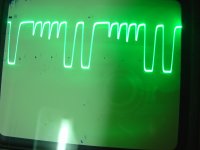
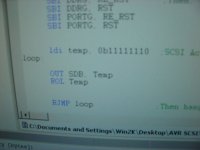
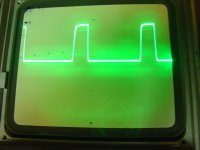
I am running some quick and dirty test code to check signal distortions, and I am finding none. Data signals look clear, not even cross-talking or ringing, or any other distortions. EXCEPT the parity signal. its "glitchy" Have to figure out whats going on there.

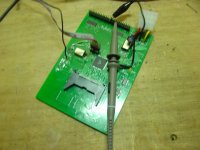
I posted the pics of my tests thus far. Computer tests have proven elusive and unreliable, so now barebones testing with the O-Scope.

DSC00012.JPG

DSC00011.JPG

DSC00014.JPG

DSC00015.JPG

 
I must say, your SSD project has been fun to watch. (Especially since you provide visual aid with pictures.) Wish I could help somehow. (Maybe buy one for my Classic II when you get to selling them. 8-) )

This is what I miss, the era of computers when they were for the tinkerers. An era that I never got to see because I was born in the 90s. It'd be cool if another "apple like" revolution happened. Some computer enthusiasts started building computers and became a company. I miss the artistic feel and color that was in the cases of the products themselves. But I digress.

That O-Scope is pretty cool. Have you used it for debugging other projects?

 
I cant live without an oscilloscope, I am electronics technician and engineer. its the second hand tool, alongside the DMM.

My good 100mhz digital one is at work. This is a crappy 10mhz one thats missing the CM scale on the face of the CRT (as seen). but it works for seeing waveshapes.

I was born in the 80s, 85 matter of fact. but i didnt start getting a memory until the 90s and didnt get my first computer until 96 so i missed out on all of that as well.

 
I'm quite a bit older, my dad was the youngest Mechanical Engineer, right out of school on his first "real" job, when I was in first grade. So he got to "play around with" the first computer his engineering company bought, I remember the blinking lights, the punchcards and the ultra-cool block of CORE memory (I saw it as a sculpture) he had at home after IBM recruited the crap outta' dad to be a Systems Engineer around the time Kennedy was assassinated.

We had all the Fortran, Cobol, etc. texts, THINK plaques, punch cards and all kinds of other neat stuff piled up and around the CORE memory while dad moonlighted, teaching programming at Ohio State, commuting from Springfield to IBM in Dayton in an old orange/black vinyl topped Karmann Ghia beater.

Later on, we had all the latest Very Large Scale Intgration texts laying around the house with the CORE, as the "crazy artist" firstborn, naturally I gravitated to the VERY 8-) "art projects" of the VLSI Revolution and never got past that into programming or electronics at all. I just liked to design an "make" all kinds of crap! [:D] ]'>

The Apple I came out at about the time I got out of college, where I hadn't even considered programming as I spent all my time in the printmaking shop, other fine arts classes or the darkroom.

I apprenticed at a Sign Shop while waiting for a Sales Position (adding machines!) at Burroughs where dad was at the time in Syracuse, NY after he'd done a stint at IBM's Glendale Labs in Endicott. He was on the team that developed the first 1 MegaBit Chip in the short range marketing group and my friend's dad ran IBM's "Xerox PARC" group in the same building . . .

< skips over stories about dad's leaving IBM because of political infighting and prescient observations >

. . . as I was sweeping the floor of the sign shop, bemoaning the fact that I was working for minimum wage, I realized that: They're going to automate this $^1+!

So after all that I, finally got interested in computers and the very first production machine, the Gerber Signmaker III hit the market after I'd moved to NYC to get married and finish my apprenticeship. After I became a partner in the business, we bought the Second Generation Gerber Sprint with the TTL Monitor for layout, the first Gerber had only an LED display and pen plots for design feedback. I insisted we get the "optional" 30" Plotter so that I could output entire signs or nested designs in one shot, when everyone else was outputting lines of text to "save vinyl & transfer tape" which, while expensive, cost a LOT less than the labor involved in prep & application.

Which leads to the next chapter: ( after skipping over the intervening years of my Trash-80, Commodore 64 and Tandy 1000sx intro to realcomputing )

There I was, at the very beginnings of the automation of an industry, with a GREAT education in MicroComputing (back then you could get one just by reading a year's worth of "Computer Shopper" articles and ads cover to cover with a few issues of BYTE, Popular Computing, Popular Science etc. thrown in for leavening!) I had Designers and Architects coming into my shop to do interactive design sessions on the screen of my Sprint! Not long thereafter, I bought a used FatMac for "home use" only because it was bundled with an ImageBanger WC, which I needed to run ThunderScan using the 15" Gerber Plotter Paper output as a carrier medium for artwork and misc. text, which was a novel "systems approach" for '87 and early '88, when Adobe Illustrator '88 was released I was all over it! I'd bought FatMac in advance of our purchase of the MacSignMaker System, which consisted of a Video Digitizer/B&W Security VidCam, a tripod and a just released Mac SE 1/20 with Radius16/CoPro pre-installed to drive a Plotter Interface wedged Stepper Driver Card.

To make a ludicrously looong post relatively OT and a bit abbreviated, I lived through the TTL CookBook/Printed Circuit Engineering, Digital Typeface Design and the PostScript (RGB?) Textbook era. While I was hooked up with a Hardware/Software Guy who did the Schematics & Code giving me the requirements upon which I designed, routed, and then plotted large scale revisions (highlighting them for clarity) on vellum for flip-charts I assembled for each incremental design revision.

I must've absorbed more from my dad's stories, his sharing his knowledge of computing and engineering with me, and "helping him with his homework" by copying the illustrations in his engineering texts from ages 3-5 as he studied on the floor of the living room of the farmhouse, than I'd ever imagined.

I wound up screenprinting the enamel resists onto CrapShack PCB Blanks, etching them, drilling them, bandsawing and filing the final shapes for my partner to solder all the TTL gate Logic, board interconnects and sockets onto the "Font Emulator" and ISA interface PCBs that I'd "made."

Now THAT was an exciting time, I was a year or more ahead of EVERYONE else in the Sign Industry, including Gerber Scientific, when I'd back-stepped into using Fontographer generated artwork and importing the PostScript Bezier Data into the MacSignMaker System as characters in a Type 3 Postscript Font, in order to get PostScript output from their Signmaker Series.

My visual thinkers representation of very large scale plotted output, graphing each step in a letter shape, led my partner to the breakthrough realization that the "code" for Gerber's first generation Font Cartridge Format was just a series of stepped vector changes. This led to "our own" PostScript Interpreter, which translated vector art into data, filling the Gerber Font Cartridge Memory Space for "Capital A," for output on the entire SignMaker Series Font Cartridges and Translating Type 3 and later Type 1 Postscript Fonts into Gerber Format Fonts for loading into the "Font Emulator."

It seems that I'd also come up with the notion for a ROM Emulator (four Font Cartridge ROMS at a time, with the fourth ZIF socketed 32k SRAM IC being removable to act as a ROM reading station, no less) about a year or so in advance of the electronics industry.

This side business, tech company, didn't go really go anywhere for various reasons, but it kept me in cooler and cooler toys that drove a wonderfull creative frenzy/ (Hypo to full-on Psychotic) Manic Episode lasting about six months! [:D] ]'> My electronics education topped out at the CMOS Cookbook and I didn't start playing around with, anything but a few custom PCBs for Plotter I/O and such, until I joined the 68kMLA.

The original mods were impressed with my knowledge of peripherals and pushing low-middle end Macs to the utmost in my business, due to financial constraints, and made me the mod of a new "Peripherals Forum."

When I started to break down mentally, it was the crazy hacking notion one-upsmanship over on 'fritter that kept me relatively functional and engaged in the virtual world as reality crumbled about me. It's been about ten years since then and I've got some of it together, after a new diagnosis, proper meds and the knowledge I need to live a relatively sane life, enjoying this wonderful, relatively inexpensive hobby of hacking purposely lamed PaleoMacs into the machines I'd wanted them to be back when they were all I could afford.

This place keeps the Wood Geared Analog Escapement Mechanism betwixt my old ears engaged! Thanks kids! And bless the people who've finally lubricated those Worn Wooden Wonders with the proper mixture of the right meds and saved my life!

I love this place, this hobby, and life in general, more than I ever have! :approve:

 
I think what I am going to do is replace the ATmega128 target MCU. i pulled it from an old board i didnt need anymore, so theres no tellin if there has been previous damage done to the MCU or not. Unsure.

Looking at scope shots, everything seems to be in order on the PIA side (which is where i am having my issues i thought). Only issue i am running into is parity glitching, but i think i can filter that out with a simple LPF circuit.

But yea, i "missed" the revolution, born too late into this world.

 
Sounds like a plan!

It's too bad you missed the Neolithic TTL, VLSI revolutions and the Paleolithic SMT/Die Reduction follow on, but you're smack in the middle of a new era of Design Change with the knowledge and Bronze Edged tools you'll need to be an actual contributor to this exciting transition into the Iron Age Revolution in Electronics Architecture.

Kids, 10 to 20 years from now, will bemoan the fact that they can't do the kind of thing your amazing project represents anymore, because their computers will have morphed into disposable bricks of All Silicon, PCB/Printed Display/Printed Battery Technology, Watch Pocketable Cell Phones (if not outright Implants . . .)

. . . that can't even be physically dis-assembled! :disapprove:

 
better scope than mine! Mine is full of vacuum tubes and doesn't like making nice straight square waves at all. :p Also takes up far too much space.

web.jpg


still, its better than nothing.

 
Back
Top