• Hello MLAers! We've re-enabled auto-approval for accounts. If you are still waiting on account approval, please check this thread for more information.

2.5" SCSI SSD Project

Well, the thing is, the more boards you order, the cheaper it is per board.

instead of ordering 1 board which would probably cost 200 bucks with setup fees and crap, order 10 boards which may cost 220 bucks, see where i am going with this?

I used expressPCB service one time and ordered 50 boards for a project that never materialized, a PC driven VFD VU meter. they discontinued 2 of my ICs that I need, LM9022 and A6810. and i invested 400 bucks worth in boards, and at the time, the parts were available during the design period.

Once i got the design completed, put in the order for the boards, it was time to round up the parts. guess what. they dropped the 2 main parts i needed. i was so mad it wasnt funny. But hey, you win some, you lose some. hehe.

Same scenario is setting up with this design, the comapct flash slot. Right now, sparkfun electronics has them as a surplus stock they got from ebay.

Once they run out, its gone. no more CF slots for that footprint. hehe. Unless i find another source for CF sockets. the AVRs i know will always be around. same with the logic ICs. :-)

But Rev 1 will be for SD cards anyway. Right now i am using CF so i can get used to the architecture. Once i get better at that, i will switch to SD cards. thus allowing me to keep things all on 1 board.

 
Tell me about it! ::) "Economies of scale" for third party developers was a concept beyond the ken of (or diabolically circumvented by) even the likes of the pre-iPoo Mac/PB era Apple! :disapprove:

We were ordering parts for a project and the hardware/software guy didn't notice that the supplier switched from LS to HCT on a few of the chips. So an incremental run of the Rev. 1 boards he assembled didn't work reliably and he couldn't figure it out. He finally realized that his the design had lines swaying with the electron breeze when populated with the newer HCT parts unless they were tied down. A few patch wires later and they worked again.

However, when he told me to lay the board's ribbon cable interface out any way that was easiest because it didn't matter, I got an abject lesson on the evils of crosstalk, (along with a lesson on not blindly following the advice of a guy who claims to do hardware AND software well) we scrapped what was left of the 40 ISA PCBs. A small "adapter card" on one end and a better ISA card's connector pinout on the new ProtoBoard later, we tested it over about 150' of Telco Cable and it worked fine! Luckily, I'd chosen Centronics 50 as the inter-board connectors!

Just like mentioning discrete zener diodes, I'm dating myself here, this must have been back around 1990! My brain shut down somewhere between the TTL Cookbook and the second edition of the CMOS Cookbook. Once "electronics" shifted over to FPGAs and CPUs running over serial connections, from Discrete ICs on a big 'ole PCB tied to a fat ribbon cable hanging off the back of an expansion card . . . I sorta lost interest.

After I could no longer visualize the flow of electrons as fluid running through a fancy glass valve & piping lab setup . . . :-/

. . . I switched over to hacking away at interfaces between entire board assemblies in Macs for fun . . . and my head stopped hurting! :o)

Moral of the story: Buy ALL your components for the initial run BEFORE contracting for the PCBs. :approve:

So figure me in for a pair of the REV 1 boards and I'll send you the $ that'll cover the initial run's ICs! [;)] ]'>

 
Yea, thats what I am planning to do this time around. and not screwing myself around.

I just need to get a final tally count of those interested so i can figure out what its gonna cost and divide it down.

But i need to find someone that will do the boards too.

 
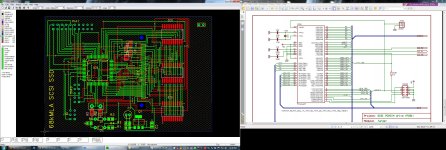
Finally got the top board finished. :-)

At least i think i do, I am going to have to go through it a couple more times to make sure i didnt miss anything.

Day4.jpg

 
No, I havent bothered yet. Reason being as I checked quotes from various PCB makers, its gonna cost anywhere between 40 to 80 bucks a board JUST for the board.

And if i get a 2-layer board, that price is cut almost in 1/4 of that. anywhere from 5 to 18 bucks a board.

So im going to have to redo it all for 2 layers.

I really need the 4 layers though. but it costs 4 times more expensive to make. its stupid.

 
It's not so stupid if you can make it all fit and use the card edge/header pin sandwich method for your cable interconnect!

That's how all the dirt cheap drive adapter cards are made! }:)

 
Ya, and they are 2 layer instead of 4 layer as well.

But the reason i chose 4 layer, is becuase i didnt have to route VCC/GND lines, and it serves as a capacitor for noise immunity.

So that means, if i go to 2 layer, ill have to put a bypass cap on every IC, then find room to make VCC/GND traces.

 
I thought you were talking about two-two layer boards with interconnects costing more than a single four layer board? I figured it was hard to find a board maker who still did a two layer board process in small quantities.

Whatever you do, either do a wire wrap test board or hand etch a mongo prototype board set (3.5" or even 5.25" form factor) with CrapShack available products. Testing and patch wiring goofs on an untested run of PCBs is just plain BAD JuJu, even back when everything was discrete ICs in thru-hole boards with or w/o sockets!

Besides there are lots of collectible Macs out there sporting SCSI HDDs with anemic specs too! ;)

 
Well, I am confident in the design :-)

But i can wire up a prototype. problem is, trying to get a compact flash slot that fits in a breadboard. LOL

 
Hence, the suggestion that you do a stretched out 3.5" home etched prototype to test your design. No sockets needed, lower cost and a real world test of your actual layout, albeit on a more workable scale, would make troubleshooting the inevitable boo-boos/patch wiring far easier. The full size SCSI header will make things easier too!

Testing for interference/crosstalk on a two layer prototype would be a good thing, proving that you don't NEED to do a four layer board with partial ground planes would be less anxiety inducing when doing the Rev 1 2.5" board run. Having a proven working prototype design might ensure more initial orders which could enhance economies of scale for parts and the PCB orders.

 
Ya. SparkFun has a service that will do up a single 2-layer board for 20 bucks.

I may go for that. just to see how it turns out. but regardless if the design works or not, Its impossible to fit everything on a single 2.5" board. i have to do a circuit board sandwich. hehe.

 
Stretch the whole thing out to a 3.5" HDD Form Factor and you can get it all on one board, with a full size .1 x .1 header, w/o ANY routing problems. There are lots of comrades that'd be willing to have a reliable, SILENT "SCSI" HDD. Heck, with a simple adapter cable or board, it'd work in a Portable! [;)] ]'>

If the 3.5" board works, you'll get orders for that and a LOT more up front orders for the 2.5" 4 Layer sandwich design! :approve:

 
or just use an adaptor to connect the 2.5" to a 3.5" SCSI connector, than you can have one design that will work in everything from 1xx powerbooks, to compact macs, to II series, etc. thus selling more to keep the cost down.

there is definitely a market for it, not a huge one, but it is there.

and I'll want two (CF ones not SD) depending on price of course... :)

 
You're right about using the 2.5" REV 2 board with standard adapters for 3.5" a/o 5.25" applications using the final product.

What we're trying to determine is the easiest, most cost effective way to do the prototyping, debugging & proof of concept of ANY viable design. The larger 3.5" form factor of a two sided prototype PCB design based upon a .1" header solves a lot of problems and would very likely be in enough demand, after proof of concept, to sell some copies of a finalized 3.5" revision, hopefully enough to defray the cost of development of the miniaturized CF version.

I "designed" the "artwork" used to cut silk screen stencils of a prototype back in the day. I printed the PCBs, etched them, drilled the thru-holes and cut the boards to shape for my hardware/software designer to populate, debug and program the two-sided ISA interface card and a pair of two-sided "full length" cards connected by header pins for a "font emulator/reader" system. That was all .1" socketed TTL ICs back in the day, but functionally parallel to the SMT Processor/VLSI logic. After proving the design concept and doing a demo, we got some (real $ [;)] ]'> ) investment capital, from another one of my friends, as a minor business management type partner.

Admittedly, the market for that project was much larger, but sweat equity and a minimal investment can get you places even for a limited market project.

 
Ya, i can do a 3.5inch board. it would all fit on then.

But still, it wont quite fit in a powerbook. which is the primary reason for me starting this project, i have NO PB SCSI HDDs.

But the 3.5" SCSI HDDs are failing now too so, i can see the point there too. ill make both. hehe.

I can do the 3.5 though and just pay the 30 or so bucks for a single board, and just hack it up as i need :-)

I know the PB SCSI headers are 2mm, what is the mm size of a standard header? ill just order a right-angle one of those from digikey or something. 50 pin. But then i need to find a molex plug too for power. sheesh... but those are EASY to come by :-)

 
Another nice thing about this setup, since compact flash is supported in alot of memory card readers, you could mount/format it as a standard HFS volume, put boot files on it, turn around and boot the mac

no more messin with floppies, heck you could boot an 800k SE from it, so you can write floppies for your 128/512k.

Possibilities are endless. Also CF is a disposable medium, if it goes bad, toss it and stick another one in it.

 
Last edited by a moderator:
"Standard" headers are .1" O.C. matching the .3" and .6" TTL Logic ICs from back in the day.

Depending on the thickness of the two-sided PCB, I still think using a straight header on edge card "teeth" is the easiest way to KISS! Unless of course, that's an additional cost on the ProtoPCB(s). [;)] ]'>

 
na, i can make an "edge" copper. no extra cost i guess.... But the thing is the board thickness. i probably would have to bend the pins to solder it down to the board.

 
Back
Top