Macintosh IIfx logicboard recreation

pezter22

Well-known member
Regarding the soft power problem: you have to place a jumper on either the ATX or the Mac setting next to the HC132s. (to match whatever power supply option you're using)
That's not going to solve your no chime issue though.
I'd start checking the usual... is everything coming out of reset? Does the CPU get a clock signal? (it looks suspiciously cold in that flir image)
Is the CPU walking the bus without a ROM installed?
Check all solder joints again at least 10 times 😅

Once you've got the board to chime a jumper should be installed at J103 to enable the external cache. J106 (forces the CPU to always operate at half clock speed) and J20 (disables internal CPU caches) should stay open.
Bolle, thank you. That is really helpful.

I did not add any of the ATX items because I am using the stock power supply. But that would explain a lot.

I am getting no response when I press the reset buttons. Possible it is the Sony Sound IC's? The Audio out plug?

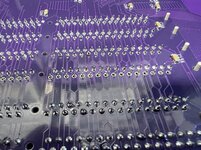
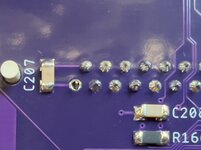
I did find a few pins that were not connected especially on those IC's with the small thin pins. I also had a few not connected on the PLCC type IC's. I checked again this morning and will recheck tomorrow. I think I am seven on my count of rechecking, so I have a lot more to go.

My donor boards are from two battery bombed boards. I have replaced some of the IC's that were damaged from the battery leakage. Like UC17 the Serial Communications Controller and UD16 which were both hit badly.

I also used all fresh resistors and capacitors when I prepped the board.

This is a great project of yours. I really appreciate being able to resurrect my damaged boards. I will continue to try to boot. I'm sure it's something that I missed.

Thanks for the response.
 

pezter22

Well-known member
Regarding the soft power problem: you have to place a jumper on either the ATX or the Mac setting next to the HC132s. (to match whatever power supply option you're using)
That's not going to solve your no chime issue though.
I'd start checking the usual... is everything coming out of reset? Does the CPU get a clock signal? (it looks suspiciously cold in that flir image)
Is the CPU walking the bus without a ROM installed?
Check all solder joints again at least 10 times 😅

Once you've got the board to chime a jumper should be installed at J103 to enable the external cache. J106 (forces the CPU to always operate at half clock speed) and J20 (disables internal CPU caches) should stay open.
I added the jumper to be able to boot from the power button.

I'm still getting a no boot chime, no video. It kind of reminds me of booting without a ROM SIMM installed or no RAM.

I checked the back of the board and found one pin not soldered on the ROM SIMM and a whole row of pins not soldered on the first RAM socket of bank B. (I soldered the NuBus slots, RAM sockets and ROM socket in one session).

I was hoping that would be my issue, but still same - no boot chime, no video. The reset buttons have no response as well.

I'll keep digging over the weekend.

Thanks again for the suggestions.
 

Attachments

  • IMG_5957 copy.jpg
    IMG_5957 copy.jpg
    1.3 MB · Views: 19
  • IMG_5989 copy.jpg
    IMG_5989 copy.jpg
    3.2 MB · Views: 19

pezter22

Well-known member
Thankfully I have a extra Mac IIfx board. I am going to power it up and check voltages and match what I have on the recreation board. I am not getting any viable voltages on UN10, the 120 pin Memory Controller IC. Or maybe something isn't starting it up and that is why it doesn't have any 5v pins active.
 

AquaAngel

Member
I've been working on recreating the IIfx logicboard on and off for quite a while.
Checking the date of creation of the schematics file it reaches back to September '21. I started by working my way through the BOMARC schematics and transcribing them into Eagle. Everyone who ever just looked at one of the BOMARC schematics knows how terrible they are to navigate through to find something.
I had a working board as well as a depopulated battery bombed board sitting next to me most of the time to compare against what's in the schematics or to fill gaps of things that did simply miss or didn't line up. That said, not blaming the poor soul who sat down and put those schematics down with just pen, paper, a multimeter and probably tons of datasheets for where they publicly existed back then which would mostly have been only standard chips.
The original IIfx board is a 6 layer board, with the majority of signals being routed on the internal layers, so it wasn't as "easy" as writing down what you see.
A few docs that @Arbee sent me later down the road did help verifying some of the custom chips pinouts and putting names to signals that just had placeholders.

With the schematics mostly done the project sat there for a good year and I didn't touch it until recently. After the sidequest of creating a LC475 board went through in two weeks I gained confidence that the IIfx can be done as well.
My own goal was to get it done on a 4 layer board instead of the original 6 layers they used back then.
On one hand to keep the costs down... (a 4 layer board of this size already cost me 180€ for a batch of 5 boards from JLC)
...on the other hand - well, because I can (probably I wasn't sure I could until I was halfway through)

After a day or to taking measurements and placing components ended up with some major ratsnest spaghetti:

View attachment 69682

Going through the 24 stages of determining if it's going to be possible to route while staying within the 4 layer goal. It looks possible at first, then impossible after running the first traces, it then looks more and more possible just until you run into roadblock already and issue ripup; to start over.
Once you actually make it through routing the major address and data bus signals without blocking yourself out it's coming to the point to tell if there's enough space to fit everything and if the (random) choice of horizontal vs. vertical traces on the top or bottom layers was the right one.

That's with Nubus, all three!!! data busses and the (not so critical regarding routing space because of the part layout) address busses laid down:
View attachment 69684

3552 airwires from 718 different signals connecting 563 components later...

View attachment 69689

Prove I wasn't cheating myself - only power traces (-5V and a filtered 5V supply to the SCSI controller) running through the internal layer that's otherwise mostly a huge 5V plane:
View attachment 69690View attachment 69691View attachment 69692View attachment 69693

While we're at it babbling about power rails... the SCSI controller receives a filtered 5V rail that runs through a ferrite before it's passed to the chip.
On the original board Apple nicely placed decoupling caps close to all the relevant 5V pins on the SCSI controller - they just forgot to connect them to the correct power rail so they ended up doing nothing because power for the chip was actually drawn from the main 5V plane several centimeters away where the ferrite is located.

After at least two weeks of staring at the supposedly finished board and finding another error every other day I finally pulled the trigger and ordered some boards.
And because I had to wait and you're probably waiting to see the final result as well if you're still reading what's written that far down here's the opportunity to stare at the beautiful renders that I stared at for at least an hour a day while waiting for the boards to arrive:

View attachment 69694View attachment 69695

Once the boards were here everything went down really quick - as quick as possible at least. I was working extremely careful to make sure there's no soldering mistakes at all, otherwise troubleshooting would become a nightmare on this board. Even more so because nobody knows how they actually work and there's no known troubleshooting procedures out there except the good old "stare at it until it starts working" method that I'll obviously have to talk about later. (not because of a soldering error - there was none)

Here come the PCBs...
View attachment 69705

Only the cleanest donor parts I had around found their way onto this board. The two battery bombed donor boards did still death chime so I knew they weren't completely dead
View attachment 69706View attachment 69702View attachment 69704View attachment 69703

Did I mention there's 282 passives on the bottom of the board?
View attachment 69700
Moved them all over from the donors to ensure I have the correct values for all of them. Nothing worse than having to find that one resistor that is pulling a signal up with 100ohms where it should have been 10k ohm.

Finally reaching the state where it should have death chimed:
View attachment 69698
... and it actually did after messing around with the jumpers on the board. @zigzagjoe sent me one of his blinkenSIMMs and it proved really useful right from the start. The board was just sitting there idling with random data on the databus and an address on the address bus that didn't make any sense.
After fiddling with the jumpers on the board I did get a deathchime but only when the jumper to disable the 32k cache was set.
I worked my way through the (visible to me) logic that interacts with the cache, mostly the address decoder PAL at UL6 that generates the enable signal for the four cache chips and the cache tag. It didn't make sense at first because it seemingly enabled the cache right from the start where you'd expect the 68030 to walk the bus in order to find code to run from the ROM.
After a few days of staring at the board (here we are) I found that I missed to hook up the reset line on the cache tag chip to the main system reset:

View attachment 69701

With that bodge in place the board did instantly chime (good chimes even without RAM, because everything up that this point seems to fit into the 32k of SRAM before it locks up)
Want to know how the Bomarc schematics indicate this should be hooked up to the main system reset? THEY FRIKKIN don't. Instead there's just a single line drawn to the parity generator. If they would have just let it out I would've investigated and noticed it while drawing the schematics.

View attachment 69710

After getting the happy chime I added the rest of the components, plugged in a video card and got no video output but I could see from the activity LED on the SD card adapter I had hooked up that it was booting.
That next mistake is actually on me... missed to connect the third Nubus slot ID bit to ground on all slots:
View attachment 69697
With that in place the board video came up, all slots work, SCSI, Floppy, Serial all the fancy IOP stuff in A/UX, everything just works.
I am still blown away that those two bodges was all it needed to get it working on a complex board like this with no proper schematics or documentation at all.

I'm incredibly proud of the final result:
View attachment 69699


With all the unused space I added an ATX power connector as well as the necessary resistors and a transistor to invert /PFW to have soft-power just work without modifying the power supply at all. There's also a jumper next to the two HC132s that control powerup/-down to feed 5Vsb from an ATX power supply to the poweron circuit so you don't need the second battery for soft-power when running an ATX PSU.
Obligatory coin cell and 1/2AA footprints for the batteries as well as footprints for both PLCC and through hole RTCs are modifications to the original design as well.
Parts layout around the poweron circuit isn't 100% the same as on the original either because otherwise there wouldn't have been enough space to fit the RAM data traces through the area.
The bottom layout is quite different but most parts did stay in the same area where it made sense. If you should find yourself in the situation to populate a board and can't find some parts you might have to flip the board because some passives went from top to bottom and vice versa also due to space constraints.

I reverse engineered the 6 PALs found on the board along the way, JEDEC files for GAL replacements as well as the gerbers for the board on github:

Very nice. Great work. Do you sell them? I also just finished rebuilding "original board" my IIFX as it had some trace damaged " no leaky batteries thank god" replaced all the capacitors and powersupply. booted first time, but i think i missed a trace as it doesn't seem to keep my settings. i am gonna have to take it apart again soon and see where the damage is. Batteries are new, so it shouldn't have a memory issue, but will see. Do let me know if you are selling the board or if you know where i can buy them as it is another project that i am looking forward to do
 
Top