

• Hello Guest! We're hosting a challenge to welcome vintage Intel macs to the MLA during the month of July! See this thread for more information.
  • We've made some quality of life improvements to the Trading Post. More info here.

68030 accelerator for the Macintosh Portable, redux.

if we leave out the VGA video interface. @Bolle already published the JEDEC files for the Vandal Extreme, which seems to be a clone of the Gemini Ultra/Integra.

From here, the main hurdles are reverse-engineering the schematics from the PCB and dumping the configuration PROM to figure out exactly how the Xilinx XC2018 handles host bus management. @Phiply mentioned that dumping that PROM should be possible.
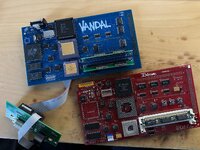
Oh, I built a proof of concept kind of clone thing a long time ago already but haven't pursued it any further because availability of those Xilinx chips and the clock generator IC they used for the pixel clock is meh...
Vandal.jpg

it is highly likely that the Xilinx XC2018 simply replaced the 74646 transceivers and their control logic

Indeed, that's what it does. Not sure why they choose to do that instead of properly driving the bus with actual bus drivers.
 
Oh, I built a proof of concept kind of clone thing a long time ago already but haven't pursued it any further because availability of those Xilinx chips and the clock generator IC they used for the pixel clock is meh...
View attachment 101352


Indeed, that's what it does. Not sure why they choose to do that instead of properly driving the bus with actual bus drivers.
Oh!, I also suspect you already did it ;). Of course you had a working prototype tucked away in a drawer somewhere!
 
Hmm, this seems like there are a lot of variables... Unfortunate nobody ever made one.

So I see the main problem is the clock timing. Then the other problem is making it compatible with the Power Manager. Is that really the big issues? Or is there more I am not seeing?
 
Hmm, this seems like there are a lot of variables... Unfortunate nobody ever made one.

So I see the main problem is the clock timing. Then the other problem is making it compatible with the Power Manager. Is that really the big issues? Or is there more I am not seeing?
The video buffer?

On the Portable, it's actually a fully asynchronous, on-demand handshake. The system completely decouples the CPU from the display refresh logic.

On early Macs, though, it’s a pretty synchronous operation. Because of that, there's really no easy way to make an existing 68030 accelerator compatible with the Portable.
 
Last edited:
Well, I guess it would be a good idea to make a list...
Or even better, take the challenge like a new hardware design from the scratch.

If someone wants to take on this challenge, they'd really need a deep, inside-out understanding of the Portable’s hardware. And honestly, just getting to that point is a huge challenge in itself
 
Regarding the Micromac Performer, I think there might be a good chance of making its handshaking with the host fully asynchronous, which could let us push the clock speed up to 33 MHz.
That'd all but make it all but a Performer Plus I think? I'm wondering if the asynchronous handshaking section of that upgrade could be reversed? Grafting that section into the low end Performer would cure what ails it? That's no a full card clone , but a hybrid might do?

Can't find the Performer family link, but main page is here. https://www.micromac.com/


Performer Plus is missing, but may only be for the Macintosh Plus according to a downloads page? That or the software/driver download is only for the Performer Plus? IIRC is sat between Performer and the Performer Pro on the comparison chart and had a higher clock than Performer and cache? At any rate, being for the Plus it may be early enough to crib the timing mechanism? Hopefully the Pro's handshaking mechanism can be reversed. Everything from there on is likely a no-go?
 
Last edited:
Back
Top