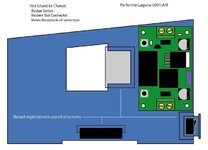
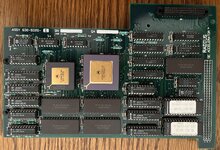
I gave up on this one, also running the16MHz reference clock on the SE PDS thru the Performer's speed doubling Gal to get 32MHz out of Performer/SE.
@Bolle tried it, but the timings wouldn't work so we stuck with the vanilla Performer clone. So it goes . . .
Dunno if it may be a better place to look, but the Radius 16 is the only other Accelerator I know of which might be cloned. The others that have been cloned are all for 68030 machines, no? Gemini and the like were of the CPLD scourge generation? ASICS?
Actually, I was just sharing some thoughts on this in another thread recently.
The Gemini Ultra/Integra and the Vandal Extreme seem like very promising candidates for a full clone, at least for the core accelerator logic, if we leave out the VGA video interface.
@Bolle already published the JEDEC files for the Vandal Extreme, which seems to be a clone of the Gemini Ultra/Integra.
From here, the main hurdles are reverse-engineering the schematics from the PCB and dumping the configuration PROM to figure out exactly how the Xilinx XC2018 handles host bus management.
@Phipli mentioned that dumping that PROM should be possible.
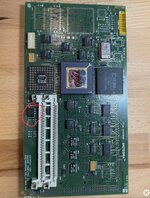
Circled is the XC1736A Xilinx configuration PROM. I've extracted the contents from similar chips using an Arduino to verify the contents. They just spit out the next bit after every clock if I remember. At least, the one I was looking at did.
My hunch is that we could translate that key host data bus management logic into a couple of standard PLDs and use 74646s for data bus isolation and buffering, similar to how previous TS 68030 accelerator boards before the Ultra did it, like the Gemini II.
Reverse-engineering the Gemini II itself is probably a dead end because its GAL22V10s can't be dumped. But since the Gemini Ultra is the natural evolution of the Gemini II, it is highly likely that the Xilinx XC2018 simply replaced the 74646 transceivers and their control logic to help reach higher clock speeds.
Regarding the Micromac Performer, I think there might be a good chance of making its handshaking with the host fully asynchronous, which could let us push the clock speed up to 33 MHz.
We could do this the hard way by redesigning the state machine logic from scratch and adding address and data transceivers on the host side.
Alternatively, and preferably, we might be able to adapt that key host bus management logic from the Gemini Ultra to upgrade the Performer’s logic instead.