• Hello Guest! We're hosting a challenge to welcome vintage Intel macs to the MLA during the month of July! See this thread for more information.
  • We've made some quality of life improvements to the Trading Post. More info here.

68030 accelerator for the Macintosh Portable, redux.

SE PDS cards run in an expansion chassis for the Portable, whose PDS is ostensibly the same as the SE PDS. I'm not lookin' as I'm a bit burned out with other projects ATM. If one of you guys want to take a look at the Luggable/SE PDS address ranges, finding them identical could be a big step forward I'd think?
There's a good chance the expansion chassis likely rewrote address access to PDS cards since the SE and Portable address spaces aren't quite the same. It's hard to say for sure because I've never seen one outside of a picture I have in a magazine.
There are some "free" address spaces that overlap between the Portable and SE, but those are in the Portable's upper RAM space, so if you use those you could end up limiting the Portable to 5-6MB of RAM rather than the full 9MB, unless you give the accelerator additional RAM. There are some Portable PDS cards around that do this since having that much RAM was uncommon at the time.
 
RAM would definitely great on-board if it was compatible with the original Apple-branded 1MB, (Kingston, I think) 4MB, and Androda/MacEffects 8MB and 7MB cards. If replaced with a BlueSCSI, would it still need an external PSU? Do we know around how much power the Portable provides, and how much the Accelerator PDS card would take?
 
If replaced with a BlueSCSI, would it still need an external PSU?
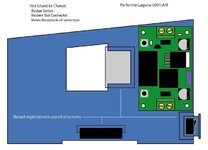
Battery only state vs. battery plugged in/charging state was a concern from the start. Wedging a circuit to hijack power from the battery/charger interface for running in that state, but leaving the accelerator somnolent in a battery only state was another idea as was straight up powering acceleration from a second wall wart plugged in when in charging state.

from upthread:
I'd figured that power to run an adapted SE Accelerator in the Portable would be harvested from a takeoff on the 12V rail available on the HDD connector. stepped down via Buck Converter. Dunno, at the time I'd figured the 5V rail would be more limited and SCSI2SD replacement of the HDD.

Manual switch for low power mode and 68000 specific boot partition option also considered:

PerformerLaguna-0001-AI9-c.jpg
 
I would love to be able to accelerate my backlit Mac Portable so I could run SSH. It’s just such a cool looking machine. I’d pay a pretty penny for an 030 acceleration path.
 
I would love to be able to accelerate my backlit Mac Portable so I could run SSH. It’s just such a cool looking machine. I’d pay a pretty penny for an 030 acceleration path.
The original Conner HDD draws about 35 watts at peak, if you integrate a scsi to SD solution ala BlueSCSI in the acceleratior that gives you some decent power to work with. Also I upgraded my battery to a lithium-ion battery with BMS built in and substantially extended the battery life while reducing weight so battery life wouldn’t be an issue.
 
The original Conner HDD draws about 35 watts at peak, if you integrate a scsi to SD solution ala BlueSCSI in the acceleratior that gives you some decent power to work with. Also I upgraded my battery to a lithium-ion battery with BMS built in and substantially extended the battery life while reducing weight so battery life wouldn’t be an issue.
You might have dropped a decimal point. Those drives do not pull 35w, around 10w peak on spin up and 2-4w in normal use is what you would see.
 
Last edited:
It’s not going to be a drop-in, plug-and-play situation, for sure.

The underlying 68030 architecture is there, but the devil is entirely in the details of how the two machines map their hardware and in the machine state synchronization.

To make it actually work, it would first require diving into the PLD logic and modifying how it handles address decoding. The Portable has a completely different memory map compared to the SE.

To give an example, signals like CIIN (Cache Inhibit Input) would need to be carefully adjusted so they align correctly with the host machine's layout.

Another big hurdle would be the state machine synchronization. The Macintosh Portable doesn't run at 8 MHz; it runs at 16 MHz (15.6672 MHz), meaning the state machine equations in PLDs U6, U5, and U4 would need to be completely recalculated to handle the faster host bus.

The state machine would likely need to be split across two PLDs running on opposite clock phases. That would give more granularity for the state transitions, allowing signals to be registered on the half-cycle of that 16 MHz clock. It would definitely be quite a challenge!
 
Last edited:
Back
Top