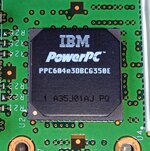
Testing 333MHz IBM 604ev 288in PGA module with G3 carrier for a PCI Mac

Another four PPC604E3DBCG350E are on the way on donor CPU cards (IBM dual CPU 332MHz slot-module with 2x256k inline cache).
These are 58€ for one card = $28ppp for the cpu itself (desoldering and cleaning is easy)
I recently bought another 375 MHz rated 604e3 with ZIF carrier (from an RS6000 p43 system).
The processor version is 10,1 like the Apple Mach5 CPUs and is visually identical 604e3/375, i bought earlier, which is a 9,31 version.

The 10,1 version will identify as a 604ev while the 9,31 version will identify as a 604e. Both CPUs are nearly identical in terms of speed. The only difference is that i get about 10% higher scores in some floating point calculations with the 9,31 version. (no cache/Kansas board)

I have also found that the 10,1 version does not play nicely with older systems (TNT for example) while the 9,31 works without a problem. Maybe the 10,1 604ev has some changes to the default values in the registers or something. I could use a Mach5-card that i modified with a 9,31 604e3 with a TNT board if i had the Kansas Rom installed. The 10,1 604ev Mach5 card would not work in the older machines, even with the Kansas Rom.
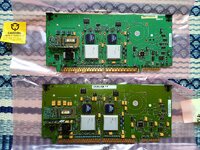
@stynx I recently found a decent deal on a pair of the same IBM dual CPU cards with 350MHz 604ev chips, so I bought them to play around with:IMG_20260420_164603_620.jpg

Do you remember whether the CPUs you got from these cards were version 10,1 or 9,31? I hope mine are 9,31 so I can use them on Kansas CPU cards with a Kansas ROM in my 7600. All four of my CPUs are labeled identically on the heat spreader:IMG_20260420_164728_240.jpg
 
>> Do you remember whether the CPUs you got from these cards were version 10,1 or 9,31?

They were the older CPU ID as far as I know. The IBM chips from the RS6000 dual CPU card were compatible with the x500 PCI PMac rom. The 10,1 need the Kanas Rom to work. All Motorola 604ev/604r are 10,1 while IBM produced both IDs.
The IBM 604ev 350 from the dual CPU card were easily overclockable to 400 MHz and even 420 were possible. The limiting factor is the FSB since the cpu only supports up to 7x (or 7.5x? … I forgot).
 
I have re-read some docs regrading the different versions of the PPC-604e CPU.

IBM used the following chip versions:
PID​
Codename​
Comment​
5V IO tolerant​
Technology​
Max power dissipation​
core Volt (max)​
PID10q-604eMach5before revision 1.1no0.25 µm CMOS, five-layer metal10.6W @266MHz2.0 (-0.3 - 2.8)
PID9q-604eMach5after revision 1.1no0.25 µm CMOS, five-layer metal10.6W @266MHz2.0 (-0.3 - 2.8)
PID9t-604eHelmwindredesignedyes0.35 µm CMOS 6S, five-layer metal13.3W @233MHz2.5 (-0.3 - 2.7)
PID9v-604eSiroccoyes0.35 µm CMOS, five-layer metal18.0W @233MHz2.5 (-0.3 - 2.7)

The part number for the Sirocco is MPC604e... for Motorola and PPC604e... for IBM
IBM's part number for the Helmwind is PPC604e2... while the Mach5 is typically PPC604e3...
Motorola never produced the helmwind and used MPC604r... for the Mach5

The Helmwind is an interesting model since it is a redesign of the Sirocco that reduced the die-size from 148 to 96 mm2 without a change in the production technology. The heat dissipation is about 30% lower and the overall specs stay the same. It is said that IBM tested the optimized masked for use in the later Mach5 which used the smaller 0.25µm technology. If the Sirocco and the Mac5 are compared, the Mach5 has about half the heat dissipation (another 30% lower than the Helmwind).

The transition to 0.25µm caused the Mach5 to no longer be 5V tolerant and strictly limits the I/O-voltage to a max. of 3.6V (abs. max 4.0V overshoot). I case of the Macintosh, this should not be a problem since the 604e CPU-cards typically have 3.3V transceivers.

The Mach5 as a 'drop-in' replacement:
My test have shown that the later IBM PID9q-604e has a "9,31" CPU-ID and is recognized by a 'PCI' Power Macintosh host even if the system ROM is not the Mach5 compatible 'Kansas'-Rom. The PID10q-604e on the other side seems to have some quirks that prevent it from being usable in a system prior to the Mach5 compatible Power Macintosh (even with a 'Kansas' ROM).
Motorola has only produced PID10q-604e (to my knowledge)

2.5V vs 2.0V Core Voltage:
The Mach5 is designed to run at 1.8V - 2.0V core voltage but the maximum ratings would allow up to 2.8V. In theory, this means that a Mach 5 could be installed on a Sirocco (2.5V core) CPU-card without modifications. The heat dissipation would rise while the overclocking potential would also be greater. I have not tried to push the core voltage beyond 2.2V since the maximum multiplier of 7x limits the reachable clock speed on older Power Mac computers to 420MHz@60MHz bus speed. 60MHz bus speed is not always stable and sometimes not reachable.

-Jonas
 
Last edited:
Back
Top