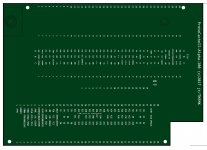
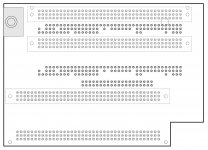
But what about the issue of resistance? I thought the purpose of the big board was to unify all the signals.
Resistance isn't an issue, as long as the daughter card is securely in its socket. The biggest issue is trace length matching, but as BMOW said, it's not a big deal. I suspected all along it wouldn't be a big deal, especially at 16MHz in the SE/30, but it's *really* nice that someone with more experience said that instead of me.
I wouldn't necessarily assume you need anything more than a 2-layer board here. Sure there are a lot of pins on those connectors, but I assume most of them are just connected straight to the matching pins on the neighboring connector, so it should be fairly easy to route the traces. It's probably at least worth a try. 2 layer boards will be a little cheaper, and are easier to debug than 4+ layer boards, since you can always cut a trace or add a patch wire if you find little mistakes in the PCB design.
I really like the idea of a 2-layer board, but, based on seeing all the other powercache adaptors out there, as well as JT mentioning how cheap a four-layer board is, I think it makes sense. I too want the simplest PCB, and even if you have only two layers of traces, that gives you internal power and ground planes on a four-layer board.
Plugging either a PDS or Cache card into the others slot releases the magic smoke. Power and Ground pins vary greatly across the two interfaces
While this is a prototyping project, the goal is to not let the magic smoke out of my SE/30 board, JT's SE/30 board, various IIsi boards, and of course the accelerator itself. It's really too bad that Apple speced physically identical connectors for both interfaces, I wonder how many people let the magic smoke out back in the day? It seems like a really easy to mistake, plugging in a 030 PDS card into the CI cache slot, or plugging a PowerCache board into a IIsi or SE/30 board. (Part of me wonders how many people on this board have let the magic smoke out of their PowerCache cards, but are too sheepish to admit it)
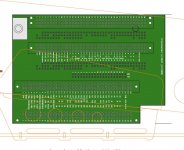
Your adapter will also have two separate PDS pass-through connectors on it, in addition to the Powercache connector.
As Trash pointed out, so far they all have a single PDS pass through. It would be fantastic to have dual PDS passthrough on the card, but some sort of buffer/line driver will have to be used, to not overload the PDS bus.
Anyway, thanks for showing up BMOW.
I'm off to vacation tomorrow, so I'll be AWOL for a little while, but that gives me some time to mull everything over.



 ] ]'>
] ]'>



 ] ]'>
] ]'>