• Hello MLAers! We've re-enabled auto-approval for accounts. If you are still waiting on account approval, please check this thread for more information.

My Mad B&W G3 Setup!

Classic development from Apple consisted of MPW and ResEdit. <snip>

https://en.wikipedia.org/wiki/Macintosh_Programmer's_Workshop
Didn't Apple release the last version for free too?
Here's a question for you MPW experts: did someone ever implement tab completion for MPW?
I was brought up on Sinclair ZX Basic, syntax-perfect, Single-Keyword-Entry editing in the early 1980s and after that, nothing else has come close ;) !
So many choices! I might go for a USB MidiSport 2x2 to begin with, alongside a micro arduino to experiment with as that seems a fairly cheap route.<snip>
And indeed I've already bought one, for just £11 (+P&P). The adventure begins! I realise I can't do any DV video editing until I get the SATA setup, because the 16MB/s limit on the other IDE bus won't be fast enough. However...

Prepare to be Dazzle*d! This thing can capture composite video via USB on an iMac/266!
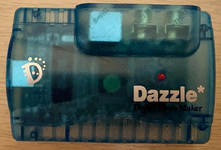
1761590458586.png
 
Didn't Apple release the last version for free too?

I was brought up on Sinclair ZX Basic, syntax-perfect, Single-Keyword-Entry editing in the early 1980s and after that, nothing else has come close ;) !

And indeed I've already bought one, for just £11 (+P&P). The adventure begins! I realise I can't do any DV video editing until I get the SATA setup, because the 16MB/s limit on the other IDE bus won't be fast enough. However...

Prepare to be Dazzle*d! This thing can capture composite video via USB on an iMac/266!

View attachment 91985
Ooh! I used to have one of those hooked up to my DV SE! And I had a HiFi VCR hooked up to the video out, which means I had an entire composite video pipeline. I found that the Dazzle* tended to blur the 320p signal a bit though; eventually, I replaced it with a Sony Digital8 handycam, which allowed me to use Firewire to stream 480p DV to/from the computer, and a high quality composite video I/O on the camera itself. It was more expensive of course, but the results were very much improved.
 
Ooh! I used to have one of those hooked up to my DV SE!
Unexpected, since it has FireWire!
And I had a HiFi VCR hooked up to the video out, which means I had an entire composite video pipeline. I found that the Dazzle* tended to blur the 320p signal a bit though;
I would expect so. Dazzle has to get the video data rate to somewhat below 12Mbits/s as it's a USB 1.1 device: pretty heavy compression.

And I have the original installation CD! It's Mac OS 8.6 compatible! Wooh!

eventually, I replaced it with a Sony Digital8 handycam, which allowed me to use Firewire to stream 480p DV to/from the computer, and a high quality composite video I/O on the camera itself. It was more expensive of course, but the results were very much improved.
Undoubtably! I do have a Canon MV500i DV Camera. I don't have an analog camera... aaah, but I think the Canon can output composite, so I might be in business ;-) !
 
Last edited:
I recommend the @dosdude1 patcher, see here.
Hi folks,

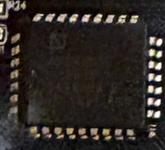
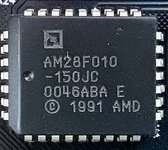
So, I have tried to use the dosdude1 patcher and of course, it hangs because it has an AM28F010, which, as per this comment, needs 12V to program it.

Gosh. I can't believe it's even possible to buy a flash chip that needs 12V any more and I had completely forgotten that the original Intel 28F010's needed 12V (is this +12V? or -12V?) despite having worked with them in the early 1990s on my first embedded programming job (we made ISA-card based SSDs that emulated hard disks (not floppy disks) via an Int 13h interface. Each card could take up to 24x 128kB chips and I think we could support 2 or 3 cards (or 4?) in a single system, providing 6MB to 12MB of Solid State Storage).

Wow. I guess this means I'm going to have to build a programmer. How can I do that? Well, I have a Maplin bench power supply which can generate 12V (or -12V I guess if I swap polarity) and I have an arduino MEGA 256 which works at 5V and has lots of pins. I suspect this means I have to do it the hard way:

  1. Desolder the flash chip (PLCC I think so at least the pins are big enough).
  2. I have a socket for a PLCC that might be the right size. I'll need to build an arduino shield to program it. Except that, of course, I'll only have stripboard to interface the PLCC socket with the shield, that's going to be interesting.
  3. Write some arduino code to program it. The Arduino has 256kB of flash space, so it should be possible to just embed the whole of the ROM in the sketch without a serial download. Fun! I'll program it slowly, because my rats nest of wires from (2) won't take high frequencies.
  4. Program the chip - here I'm assuming the address pins and data pins match the card? Of course, Address and Data could be in any order!
  5. Solder the ship back in the SATA card.
  6. Reboot.
Does this sound correct? One more question. There's two header pins on the top-left of the card (if you hold the card with the logic facing you and the PCI bracket on the left). What's that for?
 
Hi folks,

So, I have tried to use the dosdude1 patcher and of course, it hangs because it has an AM28F010, which, as per this comment, needs 12V to program it.

Gosh. I can't believe it's even possible to buy a flash chip that needs 12V any more and I had completely forgotten that the original Intel 28F010's needed 12V (is this +12V? or -12V?) despite having worked with them in the early 1990s on my first embedded programming job (we made ISA-card based SSDs that emulated hard disks (not floppy disks) via an Int 13h interface. Each card could take up to 24x 128kB chips and I think we could support 2 or 3 cards (or 4?) in a single system, providing 6MB to 12MB of Solid State Storage).

Wow. I guess this means I'm going to have to build a programmer. How can I do that? Well, I have a Maplin bench power supply which can generate 12V (or -12V I guess if I swap polarity) and I have an arduino MEGA 256 which works at 5V and has lots of pins. I suspect this means I have to do it the hard way:

  1. Desolder the flash chip (PLCC I think so at least the pins are big enough).
  2. I have a socket for a PLCC that might be the right size. I'll need to build an arduino shield to program it. Except that, of course, I'll only have stripboard to interface the PLCC socket with the shield, that's going to be interesting.
  3. Write some arduino code to program it. The Arduino has 256kB of flash space, so it should be possible to just embed the whole of the ROM in the sketch without a serial download. Fun! I'll program it slowly, because my rats nest of wires from (2) won't take high frequencies.
  4. Program the chip - here I'm assuming the address pins and data pins match the card? Of course, Address and Data could be in any order!
  5. Solder the ship back in the SATA card.
  6. Reboot.
Does this sound correct? One more question. There's two header pins on the top-left of the card (if you hold the card with the logic facing you and the PCI bracket on the left). What's that for?

I had the same issue, but used a T48 to program it.
 
So, I have tried to use the dosdude1 patcher and of course, it hangs because it has an AM28F010, which, as per this comment, needs 12V to program it.

Gosh. I can't believe it's even possible to buy a flash chip that needs 12V any more and I had completely forgotten that the original Intel 28F010's needed 12V (is this +12V? or -12V?) despite having worked with them in the early 1990s on my first embedded programming job (we made ISA-card based SSDs that emulated hard disks (not floppy disks) via an Int 13h interface. Each card could take up to 24x 128kB chips and I think we could support 2 or 3 cards (or 4?) in a single system, providing 6MB to 12MB of Solid State Storage).

Wow. I guess this means I'm going to have to build a programmer. How can I do that? Well, I have a Maplin bench power supply which can generate 12V (or -12V I guess if I swap polarity) and I have an arduino MEGA 256 which works at 5V and has lots of pins. I suspect this means I have to do it the hard way:

  1. Desolder the flash chip (PLCC I think so at least the pins are big enough).
  2. I have a socket for a PLCC that might be the right size. I'll need to build an arduino shield to program it. Except that, of course, I'll only have stripboard to interface the PLCC socket with the shield, that's going to be interesting.
  3. Write some arduino code to program it. The Arduino has 256kB of flash space, so it should be possible to just embed the whole of the ROM in the sketch without a serial download. Fun! I'll program it slowly, because my rats nest of wires from (2) won't take high frequencies.
  4. Program the chip - here I'm assuming the address pins and data pins match the card? Of course, Address and Data could be in any order!
  5. Solder the ship back in the SATA card.
  6. Reboot.
Does this sound correct? One more question. There's two header pins on the top-left of the card (if you hold the card with the logic facing you and the PCI bracket on the left). What's that for?

Read the chip first in your programmer and compare with a ROM dump from Open Firmware.
This will verify the address and data lines are correct.

I just finished adding emulation of flashable ROM chips (AMD Am28F020 or Intel 28F020) to my fork of DingusPPC (code not committed yet). These are chips used for the ROM SIMM slot of PowerSurge/TNT/Apple Network Server machines. Apple made a utility to flash these chips in Mac OS.
https://tinkerdifferent.com/threads/apple-network-server-macos-based-roms-found.4756/post-41630
https://68kmla.org/bb/index.php?threads/apple-prototype-rom-flasher-utility.45480/page-3#post-511697
 
Back
Top