Hi folks,
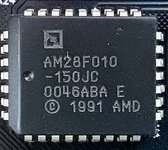
So, I have tried to use the dosdude1 patcher and of course, it hangs because it has an AM28F010, which, as per
this comment, needs 12V to program it.
Gosh. I can't believe it's even possible to buy a flash chip that needs 12V any more and I had completely forgotten that the original Intel 28F010's needed 12V (is this +12V? or -12V?) despite having worked with them in the early 1990s on my first embedded programming job (we made ISA-card based SSDs that emulated hard disks (not floppy disks) via an Int 13h interface. Each card could take up to 24x 128kB chips and I think we could support 2 or 3 cards (or 4?) in a single system, providing 6MB to 12MB of Solid State Storage).
Wow. I guess this means I'm going to have to build a programmer. How can I do that? Well, I have a Maplin bench power supply which can generate 12V (or -12V I guess if I swap polarity) and I have an arduino MEGA 256 which works at 5V and has lots of pins. I suspect this means I have to do it the hard way:
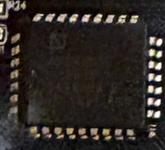
- Desolder the flash chip (PLCC I think so at least the pins are big enough).
- I have a socket for a PLCC that might be the right size. I'll need to build an arduino shield to program it. Except that, of course, I'll only have stripboard to interface the PLCC socket with the shield, that's going to be interesting.
- Write some arduino code to program it. The Arduino has 256kB of flash space, so it should be possible to just embed the whole of the ROM in the sketch without a serial download. Fun! I'll program it slowly, because my rats nest of wires from (2) won't take high frequencies.
- Program the chip - here I'm assuming the address pins and data pins match the card? Of course, Address and Data could be in any order!
- Solder the ship back in the SATA card.
- Reboot.
Does this sound correct? One more question. There's two header pins on the top-left of the card (if you hold the card with the logic facing you and the PCI bracket on the left). What's that for?