
-
 Hello Guest! We're hosting a challenge to welcome vintage Intel macs to the MLA during the month of July! See this thread for more information.
 -
We've made some quality of life improvements to the Trading Post. More info here.
You are using an out of date browser. It may not display this or other websites correctly.
You should upgrade or use an alternative browser.
You should upgrade or use an alternative browser.
Macintosh SE/30 M5119 - Restoration
- Thread starter GreenBar0n
- Start date


Yep, that's what I typically use.Is 30 AWG Kynar wire sufficient, or what would you recommmend?

You're absolutely correct, those pads were burned off, before I started digging at the board looking for copper under there. Should've left it like this:When I say I think they're gone, I mean it looks to me like the pads came off with the part. I hope I'm wrong!
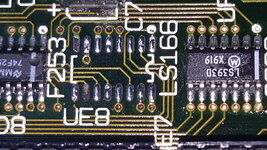
But I watched a YT video where the guy explains you just need to scrape away that black layer to get to the copper below.
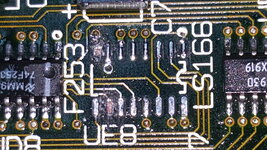
Well, not if the copper traces are completely gone! He could've mentioned that. So bummed I scraped the board, that's 1mm below the exterior. I know it will be covered with the new chip, and I have UV solder mask to fix all of that, I just wanted this to be as clean as could be.
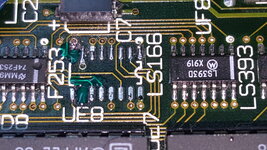
UE8 LS166 pins, missing or damaged.
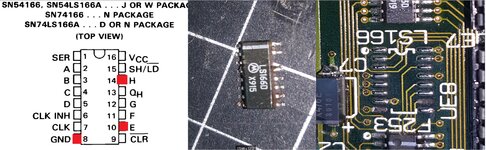
With the GND gone, there was nothing happening there.
I looked all through the SE/30 schematics, and could not find UE8 listed, in order to determine where pin 8, 10, and 14 were supposed to connect to.
macse30mlb/hardware/pcb/mlb/output/Individual Pages at master · mishimasensei/macse30mlb
Macintosh SE/30 Main Logic Board Schematic Drawings - mishimasensei/macse30mlb
 github.com
Yep, that's what I typically use.
Will do, thanks!
Looks like the bodges won't be difficult to get connected again. The red line is GND, and can be patched in to the via above it, tested and proven. The green bodge doesn't have far to go either.
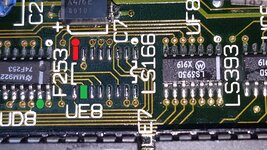
Will get the parts ordered and get back to this soon.
Will get the parts ordered and get back to this soon.
I have the same simasimac pattern. I also ordered new RAM from OWC but that didn't fix the problem. Might just send it to someone who can take a look and troubleshoot it.
Everything was going really well, until I plugged it in.
Seems I've joined the simasimac club, except I get no chime, just an opening pop/crack as if a sound might begin to play (very brief pop/click), and then only this.
View attachment 81914
The chains.
View attachment 81915
Do you get the chime at least? I used the zoom feature on my ancient phone, to take those close up pics of the UE8 chip. Can you get some good pics of your row of Uxx chips, that UE8 is in? You're welcome to post some pics in here, if you feel like it.I have the same simasimac pattern. I also ordered new RAM from OWC but that didn't fix the problem. Might just send it to someone who can take a look and troubleshoot it.
The new LS166 UE8 8-bit shift register will be here Saturday. If this isn't the entire problem, it's a good place to start with.
These simasimac failures must have a high probability of occurrence due to the corrosion of the old caps in the surrounding areas of the leaks. I'll be putting that hypothesis to the test, beginning this Saturday, hopefully.
Last edited:
Looks like only the tube packaging has gone obsolete; the LS166 in 16-SOIC is still available in tape packaging, in quantities down to 1. Eventually the day will come for all these SOICs, but it hasn't come for this one yetEDIT: Just now received an email from DigiKey, telling me the UE8 I ordered, is now obsolete - get them while you can.
SN74LS166AD | DigiKey Electronics
Order today, ships today. SN74LS166AD – Shift Shift Register 1 Element 8 Bit 16-SOIC from Texas Instruments. Pricing and Availability on millions of electronic components from Digi-Key Electronics.www.digikey.com

Yes, noticed there was a substitute still available, and deleted that edit.Looks like only the tube packaging has gone obsolete; the LS166 in 16-SOIC is still available in tape packaging, in quantities down to 1. Eventually the day will come for all these SOICs, but it hasn't come for this one yet
I looked all through the SE/30 schematics, and could not find UE8 listed, in order to determine where pin 8, 10, and 14 were supposed to connect to.
Its on page 5 of the schematics - the page is titled "Video Interface". UE8 is kinda hard to find because its the only chip whose label is to the right of the pinout versus the top. Its the chip labeled "Shift Register" on the far right of the page, halfway down - its section "B5" of the page.
Do you get the chime at least? I used the zoom feature on my ancient phone, to take those close up pics of the UE8 chip. Can you get some good pics of your row of Uxx chips, that UE8 is in? You're welcome to post some pics in here, if you feel like it.
The new LS166 UE8 8-bit shift register will be here Saturday. If this isn't the entire problem, it's a good place to start with.
These simasimac failures must have a high probability of occurrence due to the corrosion of the old caps in the surrounding areas of the leaks. I'll be putting that hypothesis to the test, beginning this Saturday, hopefully.
No chime. But I did get a chime prior to recap. Here's a photo of UE8.
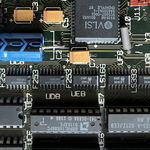
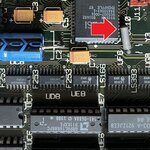
Its on page 5 of the schematics - the page is titled "Video Interface". UE8 is kinda hard to find because its the only chip whose label is to the right of the pinout versus the top. Its the chip labeled "Shift Register" on the far right of the page, halfway down - its section "B5" of the page.
Thanks for that! The LS166 should be here Saturday, I'll get those traces checked.
About to mount the new UE8 chip.
But first had to clean up the scraping of the board.
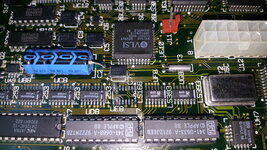
Did find copper under there, but below the top layer. Not good.
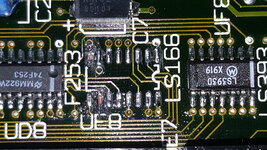
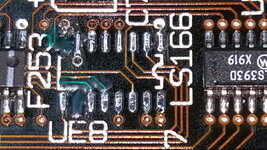
UV solder mask not yet cured.
May have made it too thick to dry properly. Should know soon.
But first had to clean up the scraping of the board.
Did find copper under there, but below the top layer. Not good.
UV solder mask not yet cured.
May have made it too thick to dry properly. Should know soon.
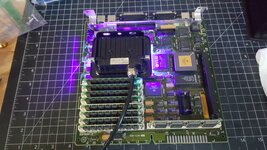
Can't tell if this is dry, exactly, but after 30 minutes under the UV, I'm wondering if it can get any better.
Might give it another 30 minutes under the UV, to see if anything changes.
Might give it another 30 minutes under the UV, to see if anything changes.
That's a very clean looking board. I'm a little worried about Y3, though. Are its leads intact? Is it touching UE10?
Not touching UE10.
Learned that UV light can sunburn a PCB, this one upset me pretty good, had to walk away from this for a bit.
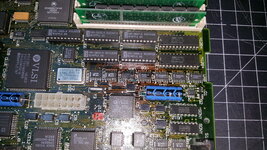
Broke the leg off the the replacement LS166, and had to order a new one, and clean the old one off, and start over. It's not pretty, but it's connected to where it should be on both sides of the board.
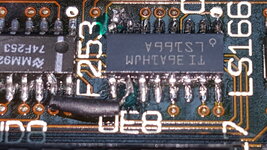
It changed the screen by adding a vertical row of chains on the far left side, but still simisimac.
Upon inspecting the board for more corrosion, I found another problem.
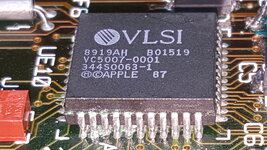
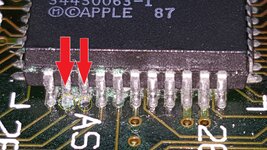
Wondering if this is where my chime went, those two pins are disconnected from the via's, downstream. Going to repair these and see what that brings, tomorrow.
Broke the leg off the the replacement LS166, and had to order a new one, and clean the old one off, and start over. It's not pretty, but it's connected to where it should be on both sides of the board.
It changed the screen by adding a vertical row of chains on the far left side, but still simisimac.
Upon inspecting the board for more corrosion, I found another problem.
Wondering if this is where my chime went, those two pins are disconnected from the via's, downstream. Going to repair these and see what that brings, tomorrow.

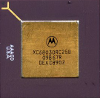
You have an early board with a socketed ‘gold-top’ CPU. For some reason, the PCBs on those are really sensitive to heat as well (I didn’t know about UV). I’ve worked on those carefully with a solder iron and sadly couldn’t avoid discolouring them.Learned that UV light can sunburn a PCB, this one upset me pretty good, had to walk away from this for a bit.
View attachment 82532
With the amount of corrosion you can see underneath the pins it'd probably be a good idea to just remove the entire chip from the PCB and give it a good cleaning underneath.
I was thinking that too, but removing that entire chip feels like serious business. Is the VLSI chip impossible to find an NOS replacement for? Can that be socketed?
Good to know. If you look at Post #74, above, you can see the traces have changed to an amber color immediately following the extended UV treatment, the UV could've heated the board too I guess.You have an early board with a socketed ‘gold-top’ CPU. For some reason, the PCBs on those are really sensitive to heat as well (I didn’t know about UV). I’ve worked on those carefully with a solder iron and sadly couldn’t avoid discolouring them.


