• Hello MLAers! We've re-enabled auto-approval for accounts. If you are still waiting on account approval, please check this thread for more information.

Cracking open some old ones

So, I'm back to some old Mac stuff, in no small part because I'm cleaning my lab before possibly moving (partner has applied for a new job a few hundred miles away).

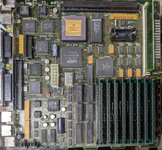
This is an SE/30 Board, from a system in seemingly great condition, that's been sitting on a shelf for... A very long time.

Happy to say the lithium battery hadn't leaked, so that's been pulled.

The board looked good to start, but it seems I've had some capacitors leak. Particularly C7, and that's impacted the surface mounted F253 ICs next to it.
I've never had to do that kind of repair on anything before.
 

Attachments

  • PXL_20241010_133621999~2.jpg
    PXL_20241010_133621999~2.jpg
    3.1 MB · Views: 24
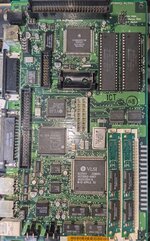
This is the Classic II board I pulled.
Again, no battery leak. Battery pulled (I've ordered some purple MacBatt replacements already)

But again... Capacitor leaks. Guess my soldering skills are going to get better over time.
Maybe only by the serial ports, which I don't need....
 

Attachments

  • PXL_20241010_134618348~2.jpg
    PXL_20241010_134618348~2.jpg
    2.9 MB · Views: 23
First, I would try a search in the forums for re-capping help (or recapping help) (recapping assistance) something like that to find links that can help (you may have already done that or may be in the process and be overwhelmed, but if not...)
And here are a few to get you started:

This is for the easy way, if you decided to do it yourself (safe source for caps)
https://68kmla.org/bb/index.php?threads/looking-for-advice-on-recapping.42199/

This is a general thread on why people put off recapping (maybe read this later, after you have put this off for several months);)
https://68kmla.org/bb/index.php?threads/recapping-avoidance-theories.7626/#post-89470
I felt that you were already hinting at this with the Classic II board - Don't do it, these boards are insidious and will degrade from cap juices!

I know there are some better links out there, but I could not find them quickly, so I will look for them and post back here when I find a couple, but the general flow is:
- others have already done this, watch LOTS of videos, learn from them
- don't learn to recap on a board that is important to you e.g. (the SE/30 board above ), find a scrap board to practice on
- this is a point of contention, but for removal, twist method is probably best, especially for the boards shown, do not
(especially for a novice, but as above, it is a learned behavior, so find scrap boards to practice on and watch the videos)
- get the best soldering equipment you can afford (use solder that has the right mix for you, a fume extractor, no-clean-flux, wick)
- clean the board thoroughly, however you do it - there is cap exudate underneath the chips on that board, I guarantee it!
- buy caps from a reputable source and either note the location/polarity/sizes/voltages (good to do anyway) or use a website that documents it
- if you can't do the job yourself, find someone reputable to do it - (check their references thoroughly !)

And good luck, you have an excellent socketed SE/30 board there and that is definitely worth doing a good job on! Good luck on the Classic II as well and don't overlook the Analog board on that one (I recently had to do the AB board on my Classic I).

 
From someone whos soldering skills were entry level when i began , all I can say is the difference between going in blind with little to no understanding of soldering - to a few boards later , a few instructional videos later and better equipment , the difference is massive , beyond critical .

I did more damage on my first attempt ( a classic logic board ) than i care to mention - I did however at a later date come back to that board and 'undid' the mess I made the first time and got it working.

The main things I did not understand when I began were

keeping the soldering iron tip clean - a bit of steel wool - wipe the tip all the time

a good flux - critical to get good shiny , solid solder joint

correct solder

clean surfaces to solder to

correct preparation when soldering in new caps

Those were the most important things I had to learn before any of my soldering was even starting to look right.

None of it is hard or complicated

As Juror22 said above , get some junk board of anything , start on that - remove old caps , radials and smt's , try putting them back

Do NOT dive straight in on an se/30 board ......... you will be kicking yourself for a long time

You need decent equipment before you start

the minimum starters approach :

desoldering gun ( cheap plastic spring loaded one is a great start )
steel wool - I found mine under the kitchen sink
flux - i use a liquid flux - many out there
decent soldering iron - i use a digital one from china - cheap and works great

watch a few videos ( many out there ) , have a go on a junk board and see how fast you get it

One of the most important things is patience - its slow , methodical work. If you are in a hurry leave it till you have time.
If you are getting stressed in any way , run away from it and try the next day.

Frustration almost always leads to disasters and im sure many on here would agree

Watch vids before you do anything
 
Back
Top