A journal of two SE/30s

Friends,

I found on my storage shelf two SE/30s! Not switched on for at least ten years, will have to hunt more to see if they have keyboards, mice. I've had the cases open and didn't look terrible, but I'll start taking a proper look soon. I have a set of new capacitors, will check if I've got the right ones. (Am looking at archive of recapamac.com.au.)

My basic plan is: open, photograph, inspect, remove logic board, recap, power up with VGA converter and modern PSU, then review. Times two.

I'm good with logic boards, static precautions, hand soldering, inexperienced with CRT voltages but knowledgeable enough to keep myself safe. I have microscopes, voltmeters, oscilloscopes, temperature controlled iron etc., but no hot air tools or cleaning baths.

It would be great to run some variety of BSD, but first steps first.

Any tips, tricks, suggestions gratefully received. Is there a well-known list of What To Look For on this model?

Jonathan.
1776093643305.png
 
crack them open and check for leaked batteries, then you can work out where to go from there.

watch out for the crt neck board when working in the case... it's a tight squeeze in there.
make sure you're not removing the rear bucket at an angle. if you're not careful, you can bump the neck board and your crt will be toast.
 
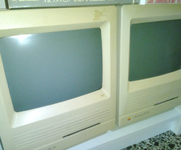
As ever, when you actually look for trouble, you find it.
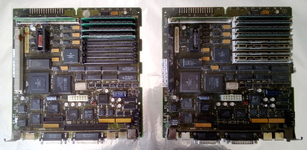
  • Mac SE/30 Number One has slightly more faded case, more dust, but better logic board.
  • Mac SE/30 Number Two has cleaner case, generally cleaner inside, but bad corrosion/rust.

One on R, Two on L.
1776165863367.png

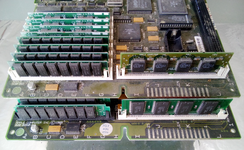
One on Top, Two on Bottom:
1776166500477.png
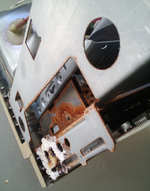
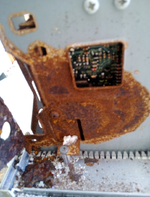
One's rusty drive
1776166714433.png
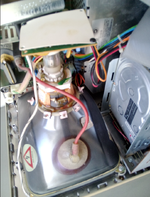
At first, Two looks much better
1776167412325.png
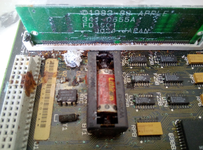
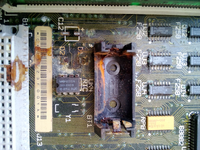
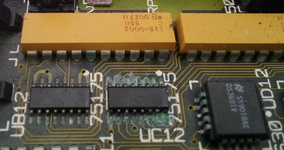
Until we get to the back! Oh no it's the battery and fluffball C12, before and after toothbrush debris removal.
1776167521840.png1776166790820.png1776166934272.png
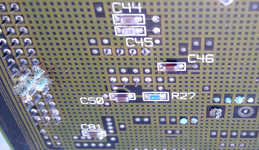
There's a some white and green corrosion on the bottom, a little green on top.
1776167938303.png1776168021774.png

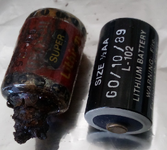
The batteries:
One on R. (with 0.125 V, would you believe!), Two on L.
1776166235438.png

I'm just ignoring the disks, CRTs and PSU boards for the time being.

What does everybody think? Repairable or doomed?
 
number one probably just needs a deep clean and recap. scrub or blow all the dust off, remove the old surface mount capacitors... clean up the leaked electrolyte.

number two will need more work. clean the dust off the board, remove the battery crust... neutralize the corrosion with white vinegar.
several components will need replacing by the looks of it.

worst case scenario, number two would make a good donor for an se/30 reloaded board
 
number one probably just needs a deep clean and recap. scrub or blow all the dust off, remove the old surface mount capacitors... clean up the leaked electrolyte.

number two will need more work. clean the dust off the board, remove the battery crust... neutralize the corrosion with white vinegar.
several components will need replacing by the looks of it.

For cleaning ... I was intending to soak overnight in isopropyl alcohol 98%, wash in distilled water, gentle hairdryer. Is that appropriate?
 
For cleaning ... I was intending to soak overnight in isopropyl alcohol 98%, wash in distilled water, gentle hairdryer. Is that appropriate?
Isopropyl alcohol is not a great solvent for the corrosion on these boards, and soaking it overnight would just be a waste of time. My method is to remove all the SMT electrolytic capacitors first, scrape any visible green corrosion from chip legs with a dental pick, then submerge the board in 5% vinegar for 5-10 minutes. Wear gloves and scrub the board with a toothbrush while it is in the vinegar. I use an old Sonicare and it works nicely. After the vinegar, rinse the board thoroughly with distilled water. I have gotten away with using warm softened tap water, but I can't recommend that because I have no idea what minerals are in your water. Shake the water off the board, but don't fully dry it, and go straight to rinsing with isopropyl alcohol (highest concentration available) to get the water out of the crevices, then dry with your preferred combination of air, heat, and time.
 
May I suggest Dish soap and a soft brush, it’s a efficient and inexpensive way to neutralize and clean your board at least for an initial wash and it is very easy to rince.

FYI: I’m in the EU, dish soap may be different and inadequate depending on your brand/country.
 
remove SMT electrolytic capacitors ... scrape any visible green corrosion ... submerge the board in 5% vinegar for 5-10 minutes... scrub the board with a toothbrush in the vinegar. ... rinse with distilled water ... Shake the water off ... don't fully dry... rinse with isopropyl alcohol ... dry with your air / heat / time.

Dish soap and a soft brush ... at least for an initial wash

Many thanks both, I will try some mix of those and report back.
 
Back
Top