• Hello MLAers! We've re-enabled auto-approval for accounts. If you are still waiting on account approval, please check this thread for more information.

Macintosh SE/30 M5119 - Restoration

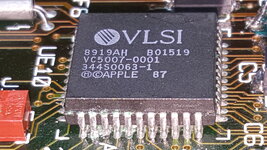
I was thinking that too, but removing that entire chip feels like serious business. Is the VLSI chip impossible to find an NOS replacement for? Can that be socketed?
Do you have a hot air station/gun? Removal is easy with a hot air gun.
I wouldn't socket it, that's just going to create another potential weak spot.
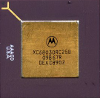
The ASC is a custom Apple chip so not easy to find replacements for.
 
Do you have a hot air station/gun? Removal is easy with a hot air gun.
I wouldn't socket it, that's just going to create another potential weak spot.
The ASC is a custom Apple chip so not easy to find replacements for.
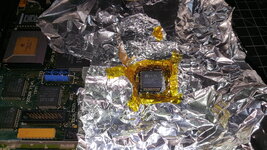
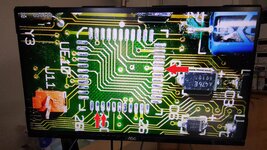
Thanks! I do have the standard Yihua 959D. But UE10 is surrounded by those new tantalum caps. I do have kapton tape and foil.

If I'm going to remove UE10, I really need better magnification, and it doesn't come cheap. Might have to wait until I can fix that.
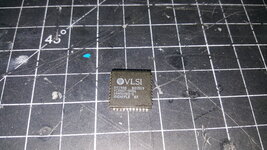
20250120_235611.jpg
 
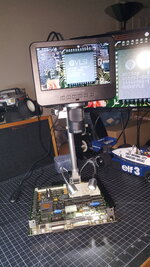
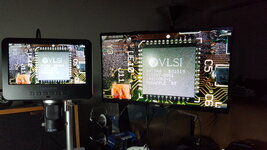
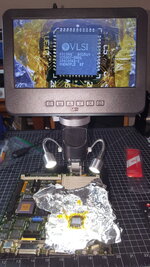
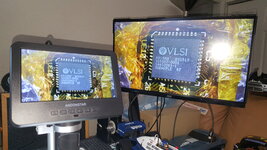
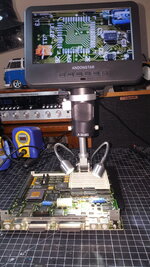
Got the new scope, might take some getting used to, there's a disconnect between the eyes and hands having the screen remote - just feels weird at the moment. Looks incredible though, now that I can see what I'm doing.
20250121_230301.jpg

20250121_230326.jpg

Will practice getting my hands and eyes to agree on this, and then remove the VLSI chip - without ruining any traces, hopefully.
 
As soon as the hot air flowed, the kapton tape lifted, and then the foil got in the way.

Removed the kapton tape and foil, used the square nozzle for the hot air, flooded UE10 with flux, and set the Yihua 959D to 400°C, with a fan speed of 7. Took about 2 minutes and kept bumping it with tweezers, until it loosened and came off.
20250122_150055.jpg

The microscope didn't help with using the hot air, it gets in the way directly above it. But it does help, and I will be keeping it. Has video capture too.
20250122_150106.jpg

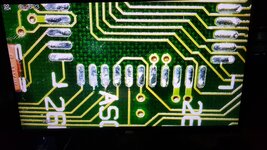
There are three pads that will need to be fixed, or bodged.
20250122_150114.jpg

We'll see what repairing this achieves in relation to the symptoms: no chime, simasimac.
 
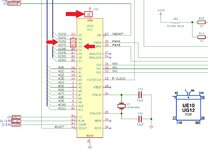
The three missing pins are 19, 20, and 35. Pin 35 is Vcc for UE10, and it was rotted off like UE8 was.

UE10 pins.jpg

Need to manage my expectations, but this feels like I'm on to something significant here.
 
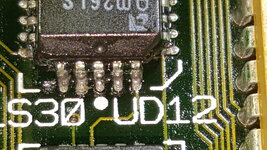
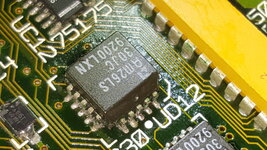
Looks like UD12 is corroded and may have some bad traces.
20250122_203841.jpg

20250122_203900.jpg


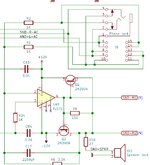
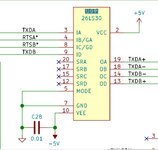
UD12 is listed in the Serial and Sound schematic.
UD12.jpg

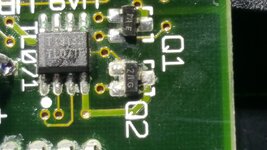
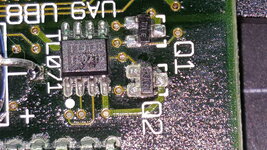
Will remove TL-071, Q2, and UD12 in order to check the traces and remove the corrosion.
 
TL071 is an audio amplifier and 26LS30 is a serial port line driver (an electronic circuit that amplifies a signal and drives it along a transmission line or cable)
 
SE/30 will not boot without ASC. I tried it on multiple boards. (simasimac)
26LS30 will not prevent a boot
TL071/Q1/Q2 issue will make you unable to hear the death chime if there's one from the speaker, they are audio amplifier/driver to drive internal speaker. Line-out jack should work fine without those.
 
TL071 is an audio amplifier and 26LS30 is a serial port line driver (an electronic circuit that amplifies a signal and drives it along a transmission line or cable)

Thanks for the info, I really appreciate it! So many sound chip problems on this board.

SE/30 will not boot without ASC. I tried it on multiple boards. (simasimac)
26LS30 will not prevent a boot
TL071/Q1/Q2 issue will make you unable to hear the death chime if there's one from the speaker, they are audio amplifier/driver to drive internal speaker. Line-out jack should work fine without those.

This is giving me hope, thank you!

I've looked this board all over, and there is no other corrosion near the CPU, RAM, ROM, or muxes. It was starting to worry me that fixing the ASC wouldn't cure the simasimac, or even have a chance of doing so; really glad to hear a missing/broken ASC can and will halt a boot.

I'm certain that these logic board problems were caused by the cap corrosion, the broken traces/areas of the board must be in those limited locations where the leaks occurred, which makes it easier to find the problem, visually. Having to find the problem with just a scope and meter alone, would probably not work out well for me even though I do have both, and an ancient lightweight electronics degree.

Will give it another go tomorrow night.

Thanks again for the info and reply guys!

 
The boot chime does wait forever on certain status bits from the ASC so it can work "by accident" due to stray bus capacitance, but I wouldn't rely on it.
 
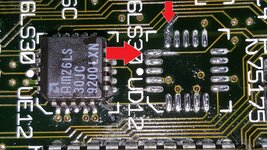
Got UD12 removed. Was able to scrape the board traces, and solder the broken traces closed again, no bodge wire necessary. Will go over the bare traces with UV solder mask before installing the chip again.
20250125_145127.jpg


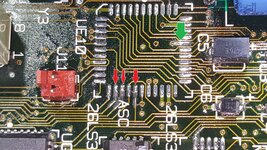
Will have to run wires for the broken traces on UE10 pin 19, 20, and 22, like I did with Pin 35, the trace gap is too large to fix these with solder only.
20250125_145210.jpg
 
Back
Top