• Hello MLAers! We've re-enabled auto-approval for accounts. If you are still waiting on account approval, please check this thread for more information.

Macintosh Portable SRAM card: Schematics available?

wholy shit that was fast. I wish my chinese PCB supplier was that fast. 

Im still waiting to hear back on a quote from days ago. 

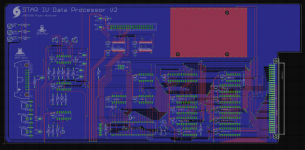
Oh, and BTW, I dont use the autorouter. I always layout PCBs manually. seems to work better for me. 

For example, this was my latest design: 
unknown (1).png

 
Last edited by a moderator:
Well my boards are kinda large, I havent had a quote done yet because I am not at home right now, but I am just curious of the cost. 

 
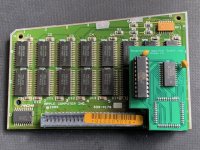
I've made up the board but haven't programmed the GAL yet.

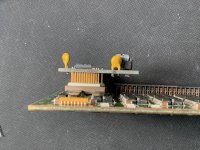
I should have clipped out the base of the PLCC socket. Not only would it have made soldering a darned sight easier but it would have allowed the adapter to settle about a mm lower, up to its skirt. Oh well, too late now.

So, the jobs now are to "Dremel"* a bit of the PLCC socket to allow space for the RAM socket plastic and program the GAL.

* It's actually a no-name Dremel clone.

IMG_1872.jpg

 
For whatever it's worth I just started testing my first GAL-powered board (the one I dropped a picture of earlier) and so far things are working. The memory decoder GAL so far/knock on wood seems to have been 100% correct first try, I've had to make a couple corrections to the I/O decode GAL but, hey, that's the cool thing about PLDs, fixing a boo-boo is reprogramming instead of cutting traces and running wires...

So, yeah, there's at least a chance that GAL code I threw out is at least approximately correct, or at least close enough to be fixable.

 
Well, I managed to remove the base of the socket and the PLCC adapter sits nicely.

I then did a test fit in the machine and... the board fouls the next socket along by about 0.25mm! :-(

I have no idea why Winslow made the adapter so high, it could have easily been half the height. *sigh*

IMG_1873.jpg

 
Last edited by a moderator:
I then did a test fit in the machine and... the board fouls the next socket along by about 0.25mm!
Isn't it amazing how things never *just clear* the possible obstruction by a quarter millimeter, it's always the reverse?

I'd suggest you could try at least testing things by sticking a stacking header between the board and the motherboard to raise it up enough to clear the PDS slot, but then of course you won't be shutting the lid of the Portable.

 
Yeah, it's "Sod's Law".

Still, I'm wondering about a 50-way female IDC connector + ribbon cable from the M/B socket connecting to a male connector with one side broken away (on the PCB side). That would be a quick and cheap solution to all the problems and there should be space for the memory board to fit at a jaunty angle. I'm not going to have a ROM or modem card in there after all.

 
Is there any possibility of shortening the pins on that connector? I can't clearly see how they're constructed, are the uprights thicker metal with the smaller solderable pin set inside the end, or is there an insulator around a contact that's all around the upright pin that at least in theory could be trimmed back to let the board sit lower? Or, heck, it'd be a huge PITA, but how about filing the pins down if they *are* metal?

Edit: I guess they're turned metal. I'm sure filing them down would be amazing fun.

Here's a Winslow catalog, it at least *looks* like they make that adapter in different heights. What suffix did you buy?

https://www.winslowadaptics.com/app/uploads/2019/03/PLCC-plugs-I5.pdf

 
Last edited by a moderator:
Is there any possibility of shortening the pins on that connector? I can't clearly see how they're constructed, are the uprights thicker metal with the smaller solderable pin set inside the end, or is there an insulator around a contact that's all around the upright pin that at least in theory could be trimmed back to let the board sit lower? Or, heck, it'd be a huge PITA, but how about filing the pins down if they *are* metal?

Edit: I guess they're turned metal. I'm sure filing them down would be amazing fun.

Here's a Winslow catalog, it at least *looks* like they make that adapter in different heights. What suffix did you buy?

https://www.winslowadaptics.com/app/uploads/2019/03/PLCC-plugs-I5.pdf


I didn't see that they did it in different heights. There was no choice in any of the retail supply sites I could find. Only RS Components had it as far as I could see.

As for the pins, they are very fine, 0.49mm so it's not really feasible to modify them after manufacture. (They are metal, looks like gold coated.)

 
As for the pins, they are very fine, 0.49mm so it's not really feasible to modify them after manufacture. (They are metal, looks like gold coated.)
I actually had to file the pins down on a right-angle ISA slot connector I bought once to fit it into a board that had too-small holes once and that was *not* fun, and in that case the size mismatch was a lot less so, yeah, it'd be really hard. Only chance would be a motorized sanding wheel and one slip, bang, you've killed it.

Winslow also lists surface mount ones in different profile heights, but of course that would mean respinning the board entirely.

It's kind of a long shot, but you could try emailing the company about needing a lower profile socket than you can find at resellers. Sometimes they'll send you a free sample.

 
Last edited by a moderator:
For us mere mortals there's Kicad. It's... totally okay, really!

(When I first started using it I really wished it had a functioning autorouter but, hey, routing by hand is an interesting puzzle challenge.)

 
For us mere mortals there's Kicad. It's... totally okay, really!

(When I first started using it I really wished it had a functioning autorouter but, hey, routing by hand is an interesting puzzle challenge.)
The "Freerouting" auto routing work-around works fine. It needs a bit of time and sometimes it gets stuck. Just moving a component by a 0.1mm in the design and suddenly it works again.

 
The "Freerouting" auto routing work-around works fine. It needs a bit of time and sometimes it gets stuck. Just moving a component by a 0.1mm in the design and suddenly it works again.
I actually looked into it after you mentioned it, and my eyes totally glazed over between it needing that manual export stage and it requiring a Java runtime to execute. ;)

 
... manual routing in Kicad works pretty well, actually, as long as you enable the option that gives you "springy" traces and automatic stitching of segments. For some bizarre reason that was disabled when I installed it. I have *no idea* who thought that was a sensible default.

 
Oh bother! Just checking the GAL programming next to the schematic and discovered a major error. A20 isn't actually connected to the GAL at all!

It seems that when I moved from the 20V10 to the 16V8 I missed one wire in the schematic,

Oh well, it'll just mean lifting pin 1 of the GAL and putting a patch wire.

 
Back
Top