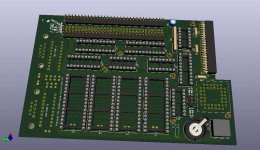
well I think the CPu on the Portable is an HC000 which is CMOS. so that entire machine may be CMOS for the power factor.




As I mentioned, HC is slightly more efficient than HCT if you're interfacing solely with CMOS family parts. HCT should work but there's no reason to prefer it over HC. Is there some part you want that doesn't come in HC?Yeah, the other components were 74AC24x parts. So, I'm guessing the 74HCT parts will be fine then.
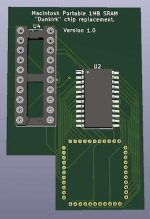
"Obsolete" is a tricky word when it comes to 74 series logic. It's rare for a part to actually stop being manufactured *completely*, but there are parts like the '154 that for whatever reason just don't end up being popular enough to get ported to new processes. That's what I meant. It's available up to HC/HCT, but so far as I can tell they never made it in AC/ACT, VHC/VHCT, etc. Basically, it's not really a part you'd choose for new designs.The 154 is available in plentiful supply from multiple manufacturers and from multiple suppliers.
"Obsolete" is a tricky word when it comes to 74 series logic. It's rare for a part to actually stop being manufactured *completely*, but there are parts like the '154 that for whatever reason just don't end up being popular enough to get ported to new processes. That's what I meant. It's available up to HC/HCT, but so far as I can tell they never made it in AC/ACT, VHC/VHCT, etc. Basically, it's not really a part you'd choose for new designs.
(Dirty secret: I'm working on something myself that requires a part that's in the same category, IE, still technically manufactured but in a paucity of packages and processes, the 74x670.)
But, anyway, whatever, HC should be fine, and if you're happy with surface mount it's available. And I agree with ditching the '244. If you're hooking CMOS loads straight up to the bus instead of trying to get that LS '154 wedged in there having the '154 and the GAL each sitting on 4 of the address lines adds exactly the same load to the bus as the '244 does, no lines continue on to drive anything else.
Ha! I'd hardly call what I do "engineering". I just decided last year it was time to get off my butt and actually make some stuff myself instead of just shouting from the bleachers, everything I "know" is stuff I picked up in the process.Dang. Since when did you pick up electronics engineering? haha.
"Obsolete" is a tricky word when it comes to 74 series logic. It's rare for a part to actually stop being manufactured *completely*, but there are parts like the '154 that for whatever reason just don't end up being popular enough to get ported to new processes. That's what I meant. It's available up to HC/HCT, but so far as I can tell they never made it in AC/ACT, VHC/VHCT, etc. Basically, it's not really a part you'd choose for new designs.

That must be one rare bird, given Digikey doesn't even list it as an obsolete part (they're pretty good about telling you "yeah, this existed but we don't have it). And I can't find anyone, not even on Aliexpress, claiming to have it for sale. Not to get conspiracy-theory-y but I wouldn't rule out the possibility Hitachi went ahead and made a datasheet for the part but either nobody *ever* ordered it or it was essentially a one-off for one big customer.Actually there was a 74AC154 made by Hitachi, which is spec sheet I was getting the timings from.
The thing to remember about the HC process is it dates back to early 1980s, verses late '80s for AC, so, again, my point still stands that '154 is technically an obsolete part so far as being carried forward into modern processes. (This page has a quick rundown as to when the various families were introduced and typical delay times for what is probably the simplest part in the 74xx family tree, the 7400 NAND gate.)The SIOC-24 SMD 74HC154 chips are currently available from both of the UK chip suppliers, both the Nexperia and TI versions are ~66p + sales tax.
Oh, yeah, good catch. You should be fine with a 10-100nf (I use .1 picofarad by default, which is a 100nf) placed near the VCC input on each chip between VCC and ground.Thanks for the link, very interesting, especially the capacitor part. I may need to add a couple to the circuit
Why? You have a VCC connection to each pin, you literally just have to drop the capacitor right next to the chip, run a short trace to the VCC pin, and connect ground to the ground pour.This is going to be tricky to route on such a 2 layer board.