• Hello MLAers! We've re-enabled auto-approval for accounts. If you are still waiting on account approval, please check this thread for more information.

Quadra 605/LC475: "EViL RAS LINE HACK" revisited . . .

I wish I had a Computer Shopper from 1990. I'm not nitpicking RAM prices, just going with what I've got printed out here.
The real issue is that if you were buying RAM from some of those truly hole-in-the-wall vendors often what you were essentially getting was daily spot pricing on a very fluid commodity. It's totally possible on the day you ordered your SIMMs in May 1990 they cost $45 while if you'd called at the same time next month they would have been $60. Many of the ads for RAM in the contemporary magazines for which archives exist (Byte, MacWorld, PC Mag... unfortunately Computer Shopper seems to be lost to history) simply say "CALL" instead of printing prices at all. I'm just listing the lowest prices *I see in print* because that's the only data point everyone can track.

One thing I will note, though, is that in a May 1990 Macworld that the same company that was asking $130 for 2x2MB SIMMs in October was asking $254 for it in May 1990. Same company wants $98 for in May 1991, and also only wants $910 for the 16MB kit, so memory *really* went down in price a few months after the LC was introduced. Are you *sure* you bought your 386sx the day Windows 3.0 came out, not Windows 3.1? Are you actually reading a dated receipt? A mid-1991 date jives a lot more closely with the archived magazines. (The other item on your BOM that I'm wondering about is the 80MB hard drive. An 80MB drive looks like it had about a $200 price premium over a 40MB in September 1990, and that would have been more in May. Again, price adds up better if you add a year and change. You could probably get a 386sx for $1,350 in May 1990, possibly even with mono VGA instead of Hercules, but I'm thinking that's a 1/40MB config, not 4/80MB).

 
I'm absolutely positive I built it in expectation of the Win3.0 release in 1990. I couldn't justify the massive PITA I'd heard it was to get CorelDraw up and running under Win286. Not looking at receipts, it's a spreadsheet printed on fanfold off the ImageBanger Wide Carriage back in the day.

$180 - 4MB RAM - thought it could have been an estimate as I've got the same number for the 4MB upgrade for the SE, but I did find that receipt and it's a lot more.

$250 - Seagate 80MB SCSI HDD 5.25" - that's a hard number in what appear to be $10 increments. Only nine of my numbers are down to the penny on a page with only  ten empty lines.

MacConnection - 4MB upgrade kit for SE ordered 12/31/91 $340 including tool kit and Video Tape!

 
Back on topic!

Just did some buzzing: No connections between SMT DRAM RAS pins and the SIMM's four RAS lines per the pinout above as I was expecting. I need someone to verify that. My beeping meter needs new batteries so I used a penlight continuity tester. One of the CAS pins is connected to CAS0 on the SIMM, but I didn't go farther than that.

All  RAS lines on the MoBo DRAM ICs of the 605 appear to be connected together, which I found surprising. I'll have to check that on the IIsi, the diagram above is showing two RAS lines connected to Bank A is out of the schematics and what I was expecting to see on the 4MB of the 605 board.

My working assumption was that RAS lines from the mobo ICs (Bank A?) don't touch the 72pin SIMM socket at all because the extra 4MB seems to always show up. They appear not to be connected. That's the only thing that makes sense to me at this point. I'd have been very surprised if we found less than eight RAS lines grouped all in a row on MEMCjr. I was under the impression that six were required for the three bank estimate between ICs and SIMM as it stands right now. Something does not compute.

Surprisingly, a search of the 605 DevNote turns up bopkes for the word "bank!" I wonder why it's not there at all? After the 72pin changeover, the word "bank" probably only applied to Macs with interleaved memory?

@trag: Check out the bank MUX notion I floated up in that MDU diagram.

 
We really need to find a source for schematics. I've been wondering about bringing PowerPC Mac minis to 2 gigs, too...

 
I couldn't justify the massive PITA I'd heard it was to get CorelDraw up and running under Win286.
I hate to dredge this up again, but just to be clear: which version of CorelDraw?

All versions prior to 2.0, released in September 1991, were released before Windows 3.0 and were only officially compatible with Windows 2.1. In that light I find it pretty unlikely that you bought Windows 3.0 on day one because "CorelDraw was a PITA to get running under Win286.". Getting 2.0 to run on Windows 2.1 may well have been a PITA... but that also moves the date you would have been buying your 386sx over a year into the future, which makes the prices you're quoting fit those shown in the archived magazines *far* better.

Of course, the first version of CorelDraw that was really popular was 3.0, which came out in May 1992. That version ran under either 3.0 or 3.1 but 3.1 because, among other reasons, it was the first one with TrueType font support. (IE, no need for Adobe Type Manager.) This was the version I had back in the day; bought the big-box "Corel Suite" package with a CD-ROM including a ton of fonts and terrible clip art on sale for a huge discount in 1994-ish?

Citation from the Corel corporation for the dates.


Thanks for the link, it will explain a lot!

Running under Win286/whatever, CorelDraw 1.11 with DXF import/export support became something of a standard for Sign and Display production from its release. If not the runaway success of 1.11, CorelDraw 1.0 with its Type 3 PostcScript Font support had been popular for vinyl graphics production from almost first release. Generic (non-Gerber Scientific production systems) hardware/software solutions were based for the most part on digitizing tablets and Generic CAD on the PC running under DOS.

Gerber's digitizing system was based on the Apple IIe//Pad and was part of their closed garden product lineup. Many early adopters of automation in the Letterhead movement (hand lettering purists called us StickerHeads in the beginning) avoided wasting money on that system like the plague. Converting scalable Postscript fonts and already digitized logos etc. to full sized polyline plots wedged into Gerber's SignMaker vinyl cutting series was a godsend for most.

I'd been end-running the Postscript importation bottleneck using Fontographer and a Type 3 font conversion app for my Mac based setup since 1988, far ahead of the curve. That's why I had the luxury of waiting for Win3 to hit the shelves at Software Etc. on day one, avoiding the PITA I mentioned.

I was a classically trained hand letterer/gold leaf artist which also explains why I was able to wait for the second generation of Gerber's system which was based on what they called "cubic curves" in a new, smaller, plastic case enclosed Font Cartridge format as opposed to a badly limited number of slots (6 vs. 20?) for bare PCB card "Fonts" that were in a Delta X/Y polyline format I helped to crack in one of my projects. Gerber's "Font" cartridges were $300 per copy and contained only a single Typeface, so the three faces of the Futura alone added $900 to my Gerber Sprint along with several others.

Helvetica Medium was the only "font" included as standard equipment for Gerber's revolutionary machines causing a plague of that face that still makes me shudder. CorelDraw's collection of fonts, good/bad/indifferent initiated recovery from the Helvetica Blight of the 80s. [:D]

It took a year or two for Illustrator and Freehand to match CorelDraw's industry specific features. When it was released, CorelDraw for the Mac hit my hard drive and the PC fell into disuse. Interestingly, the paperless, diskless FaxModem based logo/artwork straigt from the customer's 

fax machine artwork import system I'd cobbled together (Tandy 1000SX 8088 under DOS coupled to my SE/Radius16) worked so well it never migrated to the 386SX. System 7 broke drivers which were never updated for the SCSI based HDD partition sharing setup, so the SE remained at 6.0.8 for the remainder of its service life.

As a side note, release of the LogiTech hand scanner was de bombe!

 
Last edited by a moderator:
That's why I had the luxury of waiting for Win3 to hit the shelves at Software Etc. on day one, avoiding the PITA I mentioned.
See, I'm still not parsing this. What was a "PITA" about running software that was designed for Windows/286 on Windows/286? If you're just running Windows for one application there's not a ton of difference between 2.1 and 3.
 

When it was released, CorelDraw for the Mac hit my hard drive and the PC fell into disuse.
When was this? So far as I can tell CorelDraw on the Mac only briefly existed as a bad shovelware port to OSX in the early 2000s.
 

CorelDraw 1.0 with its Type 3 PostcScript Font support


Are you sure about this? According to the sources I see the original versions of Corel Draw used a proprietary non-Adobe format for fonts. Do you have a citation with regard to this alleged Postscript support?

CorelDraw 3.0 was the first version that shipped with Adobe fonts, which required ATM to use on Windows 3.0 and Adobe Type Manager for Windows didn't come out until mid-1991.

 
Last edited by a moderator:
See, I'm still not parsing this. What was a "PITA" about running software that was designed for Windows/286 on Windows/286? If you're just running Windows for one application there's not a ton of difference between 2.1 and 3.
In networking with others in the business, I'd heard it was a PITA and I'd also read about the upcoming release of Win3.0, so I avoided installing it until Win3.0 hit the shelves. You've gotta remember, the folks I heard this from were not particularly computer literate, they were finding their way around new digital tools. It may or may not have been a PITA for me, but why bother rushing things.

Are you sure about this? According to the sources I see the original versions of Corel Draw used a proprietary non-Adobe format for fonts. Do you have a citation with regard to this alleged Postscript support?
Nope, couldn't find one, but if we can find the docs online they'll outline it would be fabulous. ISTR "writable postscript" fonts being converted into Corel's WFN format. That was their trademark unencumbered terminology for Postscript Type III Fonts. IIRC you convert in either direction, but that's a bit hazy. Postscript Type I fonts encryption was only just beginning to be cracked at that point. Fontographer/Freehand creators at Altsys had just, or would soon, chase the cat out of that bag. Can't think of the name of the program offhand, but calls to the PostScript Interpreter in the LaserWriter I didn't have gathered the unencrypted Typeface data therein, converting Type I to Type III.

This would have been around 1990 when I spent about an hour on the phone working through "Writable Postscript" font shenanigans with "MJ." My very much annoyed partner asked me why I wasted "so much time with all this computer stuff?" I asked him if he realized that the guy who wrote the computer articles for three of four (2 of 3 at the time maybe?) trade publications had just called his partner for tech support. He said "Oh, I never thought of it that way." HEH! [:D]

CorelDraw 3.0 was the first version that shipped with Adobe fonts, which required ATM to use on Windows 3.0 and Adobe Type Manager for Windows didn't come out until mid-1991.
Didn't matter for our purposes, Type III or WFN in CorelDraw was sufficient. If you bought type from any source but Adobe, Type 3 is what you got.

Couldn't find CorelkDraw in the System 6-7 software hoard, you may well have got me on that one, the drawer hasn't been rooted through in a very long time. IMSI's TURBOCAD 2D/3D v3 for Mac is probably the big bag I was remembering as CorelDraw.

 
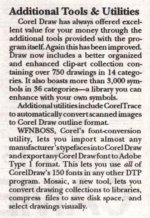
Finally found a reference, but it doesn't make much sense:

WFNBOSS-00.JPG

 It's a review of v2.0  https://issuu.com/dougalder/docs/1991-01_tcp_bc-ocr/42

I was (am still) pretty sure WFNBOSS in the early versions imported Type 3 Postscript fonts and exported WFN fonts to Type 3. As you said, CorelDraw 3.0 added TrueType and Type 1 support after Adobe's stranglehold was broken.

That hour long conversation I mentioned was about exporting the WFN font library via WFNBOSS to Type3 fonts to then be converted to Gerber's SignMaker Font Cartridge format for download into a (four-ROM) Font Emulator of some sort (cough) for cutting vinyl letters using Corel's fonts.

edit: Found it! This lady looks awfully familiar! OS9 & Below.

QGUU6548QGQGUU6548QG.jpg

https://www.ebay.com/itm/corelDraw-8-MAC-CD-digital-image-photo-picture-editor-graphics-enhancement-suite/282974754820

And when it rains it pours. CorelDraw 6 for Mac OS7, 8 & 9

Corel 6 for Mac.jpg

https://www.ebay.com/itm/Corel-DRAW-Graphics-Suite-X6-MAC-PPC-ONLY-Vintage-PRE-1999-only/273321309484

 
Last edited by a moderator:
Back
Top