Oh, interesting, I didn't know someone had productized it, but I'm guessing those basically use the
CapNet schematic. That's a solution that's probably good enough for most use cases, but I'd really like to go the full way and use actual transformers if possible.
Very good comment. Could someone please explain when it would be preferable to choose the PhoneNet type adaptors over the cheaper CapNet (no transformer required) type adaptors?
However, the CapNet link does not work in my location. For everyone who is interested: CapNet is a low cost DIY solution for everyone who wants to set up a LocalTalk network without throwing bucks at expensive adaptors. Schematics are to be found in the collection »LAM«, to be downloaded here:
loeten-am-mac-016.hqx. It is a collection of information written in HTML, dated to 1996(!). After downloading and extracting the folder find the document »inhalt.htm« to open the start page.
Please note, that the DeskWriter series of inkjet printers requires a little modification in the adaptor to switch into LocalTalk mode.
The main information follows here (credits to
Nate Hawthorn,
Christopher Ferebee and also to
Kai Kramp, who collected the information from elsewhere to put it into his LAM compilation).
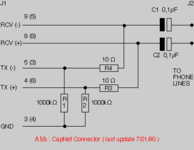
PARTS LIST:
QTY | DES | ITEM |
2 | R1,2 | 1K 1/4W RESISTORS |
2 | R3,4 | 10 OHM 1/4W RESISTORS |
2 | C1,2 | .1 uF THREE LAYER CERAMIC CAPS |
1 | J1 | DB-9 MALE OR MINI DIN 8 CONNECTOR |
1 | J2 | 2 PIN BERG OR RJ-11 PHONE CONNECTOR |
5 | WIRE | (NOT SHOWN) 22 GAUGE STRANDED WIRE 6" |
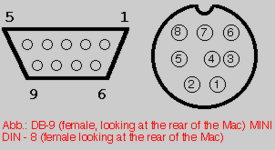
I found the CapNet circuitry to work flawlessly at my home. It is intended to work over an existing analogue phone cable network. If there is no phone wiring available, one may use any two wire cable at hand to daisy chain all network devices. I just modified my own set of adaptors to have a male mini DIN 8 pin connector (to connect each network device) and also each
two sockets (instead of one J2) for small jack plugs (in parallel), to make my own network cabling from two wire cables with matching jack plugs.
The RS422 serial connection is designed to work on distances up to several hundred metres. If you consider to interconnect from one building to another building, be sure to know what you are about to do. Electrical safety standards should be met at all times!


 Hello Guest! We're hosting a challenge to welcome vintage Intel macs to the MLA during the month of July! See this thread for more information.