• Hello MLAers! We've re-enabled auto-approval for accounts. If you are still waiting on account approval, please check this thread for more information.

Transformers for homemade LocalTalk/PhoneNet dongles

If you don't want to have to care about mini-DIN, you could make a PhoneNet card instead of a PhoneNet dongle. There are two Communications Slots varients in use by some Macs, which helpfully expose the signals for SCC Channel A in the exact same location so you can make a "Universal Serial Modem Card" that works for both varients. The serial pins connect between the SCC and the transceivers for the Modem Port, and include a line that disables the normal transceivers for the Modem Port so the card can do whatever it wants with that channel. A PhoneNet card made this way would require its own transceivers, have a much bigger PCB, and only work on a subset of Macs rather than (almost) all of them. But it wouldn't need a mini-DIN connector.
 
Oh, interesting, I didn't know someone had productized it, but I'm guessing those basically use the CapNet schematic. That's a solution that's probably good enough for most use cases, but I'd really like to go the full way and use actual transformers if possible.
Very good comment. Could someone please explain when it would be preferable to choose the PhoneNet type adaptors over the cheaper CapNet (no transformer required) type adaptors?

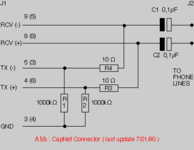
However, the CapNet link does not work in my location. For everyone who is interested: CapNet is a low cost DIY solution for everyone who wants to set up a LocalTalk network without throwing bucks at expensive adaptors. Schematics are to be found in the collection »LAM«, to be downloaded here: loeten-am-mac-016.hqx. It is a collection of information written in HTML, dated to 1996(!). After downloading and extracting the folder find the document »inhalt.htm« to open the start page.
Please note, that the DeskWriter series of inkjet printers requires a little modification in the adaptor to switch into LocalTalk mode.

The main information follows here (credits to Nate Hawthorn, Christopher Ferebee and also to Kai Kramp, who collected the information from elsewhere to put it into his LAM compilation).
1716720809426.png
PARTS LIST:
QTY​
DES​
ITEM
2​
R1,2​
1K 1/4W RESISTORS
2​
R3,4​
10 OHM 1/4W RESISTORS
2​
C1,2​
.1 uF THREE LAYER CERAMIC CAPS
1​
J1​
DB-9 MALE OR MINI DIN 8 CONNECTOR
1​
J2​
2 PIN BERG OR RJ-11 PHONE CONNECTOR
5​
WIRE​
(NOT SHOWN) 22 GAUGE STRANDED WIRE 6"
1716721079122.png

I found the CapNet circuitry to work flawlessly at my home. It is intended to work over an existing analogue phone cable network. If there is no phone wiring available, one may use any two wire cable at hand to daisy chain all network devices. I just modified my own set of adaptors to have a male mini DIN 8 pin connector (to connect each network device) and also each two sockets (instead of one J2) for small jack plugs (in parallel), to make my own network cabling from two wire cables with matching jack plugs.

The RS422 serial connection is designed to work on distances up to several hundred metres. If you consider to interconnect from one building to another building, be sure to know what you are about to do. Electrical safety standards should be met at all times!

 
If you don't want to have to care about mini-DIN, you could make a PhoneNet card instead of a PhoneNet dongle.
This could be a cool project if anyone wants to take it up. My only Mac with a comms slot has it occupied by an ethernet card, though...

Could someone please explain when it would be preferable to choose the PhnoeNet type adaptors over the cheaper CapNet (no transformer required) type adaptors?
I'd like to better understand this as well. I think the transformers provide true isolation between the bus and the devices connected to it while the capacitors do not, and potentially the lack of isolation could cause electrical troubles in a situation where there's a difference in ground potential between devices... but that's a "here be dragons" situation with my level of electrical engineering knowledge.
 
I'm still unsure of how it's safe to feed the TX lines directly into a transformer with <1 Ohm DC resistance, without a series cap. Am I missing something?
 
I'm still unsure of how it's safe to feed the TX lines directly into a transformer with <1 Ohm DC resistance, without a series cap. Am I missing something?
Do we know that the official LocalTalk transformer has a higher DC resistance? (I don't know how to test this, and I don't have a LT dongle anyway.) Because the official schematic definitely has TxD± being fed directly into the transformer without a series cap...
 
I'm not an EE, but I think the signal you're feeding the transformer isn't really a DC signal: it's jumping up and down, so it's closer to AC for the purposes of this discussion. The transformer is a coil, so it has an impedance to AC --- it doesn't behave like a direct short would.
 
@Tashtari - Just sitting down to solder together my phone net to DB9 kit and realized the orientation and offset (9 lines to 10 pin) at the IDC end of the cable is not specified. Can you clarify? Pin 1 of the IDC connector must be a no-connect, which just adds to the confusion.
 
@Tashtari - Just sitting down to solder together my phone net to DB9 kit and realized the orientation and offset (9 lines to 10 pin) at the IDC end of the cable is not specified. Can you clarify? Pin 1 of the IDC connector must be a no-connect, which just adds to the confusion.
Gah, sorry for the late reply, this fell between the proverbial cracks...

Code:
 _______________   _____________
|  \o o o o o/  | | |  _____  | |
|___\o_o_o_o/___| |_|_________|_|
    |||||||||        |||||||||
    |||||||||        |||||||||
    |||||||||        |||||||||
    |||||||||        |||||||||
    |||||||||        |||||||||
   _____--_____    ____________
  | [][][][][] |  |F C - 1 0 P |
  |_[][][][][]_|  |____________|

With the stuffed side of the board face-up and the pins and sockets in the ribbon cable face-down, you want the space in the 10-pin Berg connector where the tenth wire would be to be on the left, such that the ribbon cable is slightly right of center. If you look at the traces on the back, this corresponds with the 9th pin (top right as you look at the unstuffed side of the board) leading to one of the resistors and the 10th pin (bottom right as you look at the unstuffed side of the board) being unconnected.
 
Back
Top