Radeon 9100 that I can't flash

indibil

6502
Hello.

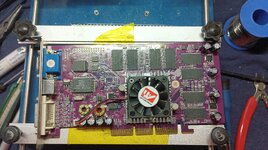
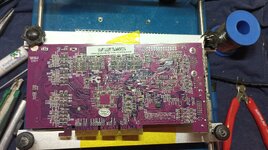
I recently acquired this 64MB Radeon 9100 (equivalent to a Radeon 8500LE), and just like I did with another 9100, I decided to flash it.
1779292169393.jpg1779292169449.jpg

The previous one worked with the original ROM by adjusting the speeds to 250/250.

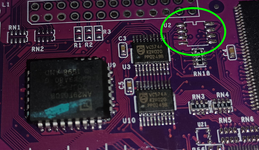
This graphics card came with a 64KB EEPROM, a PM39LV512, and since the original ROM is 128KB, I flashed it onto an AM29F010. I verified that the extra pin was traced on the PCB, and it was; it's routed.

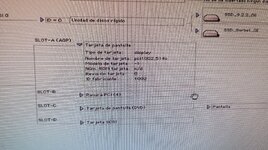
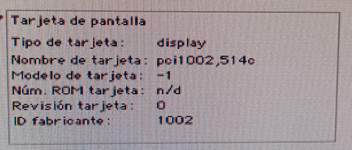
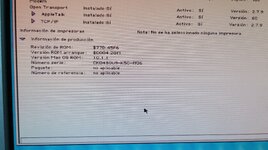
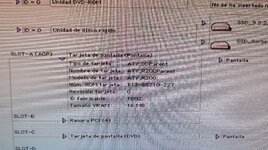
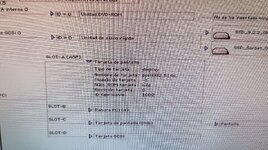
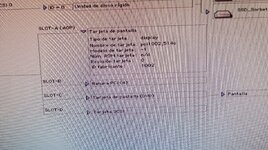
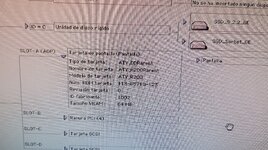
After soldering the EEPROM and installing it in a G4 GE, which now has a flashed 8500, there's no image. Using an ATI Rage Pro PCI card, I can access the system profile and view the information, but it doesn't match what the 8500 displays.

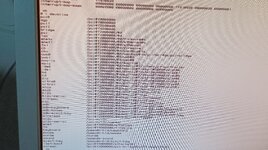
Working Radeon 8500:
1779292169507.jpg

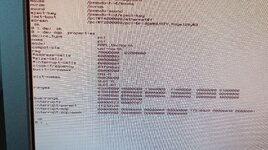
Radeon 9100 flashed:
1779292169562.jpg

Does anyone have the ability to review the two dumps I've attached and see if there are any incompatibilities? I also have the ROM that @joevt modified many years ago, but I don't know if it would be more compatible or if they're similar. I'm attaching it as well.

Thanks.

 

Attachments

Looks like the ROM did not get applied correctly? Can you use a flashing utility to read the ROM?
What does .properties show for the GPU in Open Firmware?
Does it show that a PCI Option ROM exists and is 128K? If so, can you map it in Open Firmware and dump the hex?
 
Looks like the ROM did not get applied correctly? Can you use a flashing utility to read the ROM?
What does .properties show for the GPU in Open Firmware?
Does it show that a PCI Option ROM exists and is 128K? If so, can you map it in Open Firmware and dump the hex?
Thanks for replying.

Before seeing your response, I decided to flash the original PC ROM to a 128kb EEPROM to see what Apple System Profiler would show, and it shows exactly the same thing as with the Mac ROM we saw earlier.

1779468885286.png

I use an Ati Rage Pro 1128 PCI to be able to view the 9100 AGP.

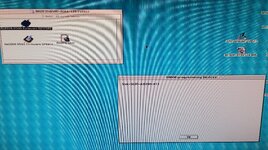
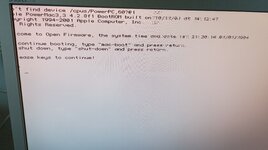
I used a 128kb EEPROM to try to patch it with the update released by ATI, but it doesn't work, and sometimes it shows this error:

1779467230809.jpg

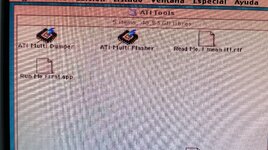
Next, I performed a DUMP from OS9 using "ATI Multi Dumper", both from the PC ROM and the Mac ROM, soldered onto the board.

1779467705141.jpg

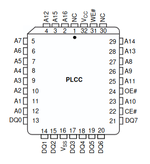
I've attached the files, but I think I've already located the problem: it's only accessing 64kb of the EEPROM, even though it has a 128kb chip.

On the PCB, there's a trace coming from pin A16, the only additional pin compared to the 64kb EEPROM, but I don't know where it should go.

1779469529930.png
Do you know where this A16 pin should be connected?
 

Attachments

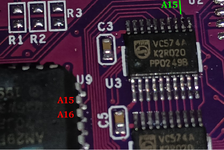
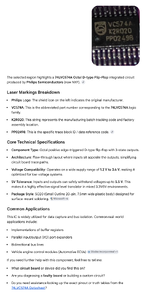
It appears that the EEPROM addressing passes through these ICs, which seem to be VCS74AK2R020, but I'm unable to find any datasheet with this part number.

A15 connects to pin 12, but A16 doesn't connect to any pin. Without desoldering it, pin 11 appears to be unconnected. Perhaps it should be connected there? Will I need to remove them to see where all the addresses go?

1779475166918.png

1779474308332.jpg
 
I copied your last image, cropped the chip, and went to Google Images to do a search for the image.
It says this:
Google search 74LVC574A.png

It links to this Datasheet:
https://www.futurlec.com/Datasheet/74LVC/74LVC574A.pdf

I suppose there's two of those to buffer 16 address lines. You want to buffer 17 lines A0-A16 (2^17 = 128 kiB) but there's not enough pins. That means you need another one of those 74LVC574A for the last address line.

That seems strange to me. I don't recall ever reading about this problem - where an ATI graphics card can't connect a 128 kiB chip.
Why does it look like one of the 74LVC574A is connected to the other?
Do the two 74LVC574A share the same Output Enable signal?
What about the Clock Input signal? Is it connected? Do both chips share the same Clock Input signal?
Have you mapped all 17 address lines?
Are these address lines connected to the PCI address lines?

Check .properties in Open Firmware to see if the ROM is recognized as 128 kiB.
 
Okay, let's see if I have time this weekend to investigate further.

Perhaps it would be possible to replace the EEPROM with an M25P10 in U2?

Captura de pantalla de 2026-05-23 07-19-27.png
 
Last edited:
Perhaps it would be possible to replace the EEPROM with an M24P10 in U2?
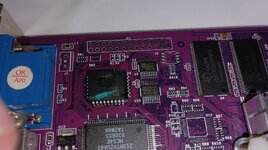
My guess is that one of those empty locations on the PCB may be for a different type of flash chip, but I have no references to base that on. Compare with other Radeon 9100s?
 
My guess is that one of those empty locations on the PCB may be for a different type of flash chip, but I have no references to base that on. Compare with other Radeon 9100s?
The PCB doesn't look like any of the other 8500/9100 boards I have; the others use M25P10s. I can try to check for continuity at U2, but I suppose I'd have to disconnect Vcc from both 74LVC574As to be able to use an M25P10.
 
Last edited:
My guess is that one of those empty locations on the PCB may be for a different type of flash chip, but I have no references to base that on. Compare with other Radeon 9100s?
I took a few minutes to test this out before getting down to my weekend work.

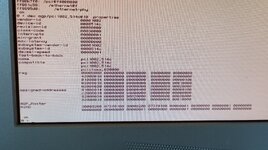
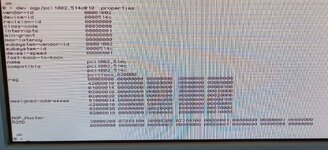
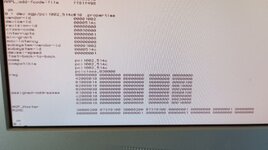
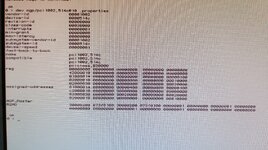
I tried displaying the .properties in OF, but I'm not sure if I did it correctly; I've attached it.

I also tried adding an M25P10 and simultaneously disconnecting Vcc on the 74LVC574A, but I get the same result and the same information in both OF and Apple System Profiler.

1779516180673.jpg
1779516180712.jpg
 
I tried displaying the .properties in OF, but I'm not sure if I did it correctly; I've attached it.
The agp device is the pci host controller for the AGP slot. PowerPC Macs can have multiple PCI controllers each with their own PCI bus.

The AGP graphics card is probably a child device of the agp device. agp is a devalias for the pci@f0000000 device. pci0 is another devalias for the same device.

I think the AGP bus usually has only one child device but there exists some AGP cards with multiple PCI function numbers or a PCI bridge with multiple PCI device numbers.

Type dev / ls to get a list of devices.

You are looking for the pci1002,514c device. Maybe it will be agp/pci1002,514c?
Alternatively, you can use the device number agp/@D (might be something other than @D)

Alternatively, you could do a dump-device-tree to get properties for all devices.
But first, you should learn how to connect using telnet so that you can capture the output as text.
https://forums.macrumors.com/thread...l-work-in-a-beige-power-macintosh-g3.2303689/

What version of Open Firmware does your Mac have?
 
Back
Top