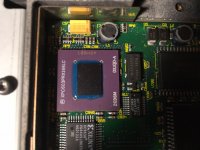
According to
this datasheet, the 745 is "drop-in compatible" with the 740 and 603ev. I'm not an EE, but I take "drop-in compatible" to mean I can take the 745 and install it in place of the 740 or 603ev without changing anything on the original board. It also suggests that any changes to pin assignments are for non-vital functions and thus ignored by the 745 and host system unless the chip is installed in a specific application that exploits these changes.
This datasheet also specifies the minimum operating frequency of the 745 as 200MHz with a maximum of 350MHz, bus frequencies of 33, 50, 66 and 100MHz, and a maximum 10x multiplier. If a 745 was sourced, our theoretical maximum would be 333MHz on a 33MHz bus. A 40MHz bus may be possible but is technically unsupported, and anything over 350MHz is unattainable anyway.
From what I can judge from the pics I would guess that the PLL resistors are those located near the XILINX chip in that picture; they're the only ones with the appearance typical of a bank of selectable components that generally makes up a PLL config.
I'd be willing to take a shot at it if there are no other takers, but no guarantees. I have a dead 5500 board I'll use to try to judge the times and temps to use for removal of the original processor and cleaning of the board, which will hopefully translate to the upgrade card and increase my odds of success.
I'd figure someone had a damaged upgrade card around somewhere. Those flip-chip packages are extremely fragile and people crack the dies all the time through improper handling or installation; this is the major factor that drove Sonnet to factory-install heatsinks to their upgrades and void the warranty if you removed them.