• Hello MLAers! We've re-enabled auto-approval for accounts. If you are still waiting on account approval, please check this thread for more information.

PowerBook Duo battery replacement

Maybe the progression of diagrams is way confusing. They're all labeled for identity and filename. I've been working toward making a final post with the diagrams of all three Duo Bats from Apple and my two BTI Bats all together.
I'm not clear what the middle diagram (FrankenPack) is. Am I right, your goal is to build a new battery (first diagram) that's internally identical to the BTI battery (third diagram)?

Could you please do a rough sketch of what your Type I battery circuitry was before you moved everything around and give me the model number? :?:
I'm afraid I can't give a diagram, since I already tore the whole thing apart, but I described it several posts back. Replace your green board with the ID chip that looks like a transistor, eliminate the orange wire, and you've basically got it. The model number of my Type I is M7782 and my Type III is M1499.

Could the extra wiring a/o screw down barrier strip cause any electrical signal or power transmission problems? :?:
I'm not exactly sure what you mean, but as long as you're not creating a short circuit on bare metal somewhere, just having some extra metal inside shouldn't cause any problems. It's a battery and power cable, not a radio. :-)

 
A quick record of my successful Powerbook duo Type 3 battery rebuild.

This thread seems to have most of the available info on the subject so I thought I would add to it with my experience...

After reading through this thread I decided to go with 1600mAh 2/3A NiMH cells.

They match the capacity of the original 4/5A cells but give some room to easily reconstruct the cell (and are a bit cheaper).

First I used a Dremel like cutting disc tool to carefully cut through the seams at the sides and front of the pack. The back seam with the external contacts then snaps easily. 

The cells I used had metal tabs already attached that I lightly soldered together to replicate the original structure including the 2 safety fuses.

Everything fits back in the pack very easily. Although the cutting tool has left quite a gap in the sides of the pack but is fully hidden when the battery is inserted into the machine so doesn't really matter.

I haven't gone through a full discharge/charge but the battery control strip on my Powerbook duo 2300c shows about 1 hour 30 mins. I was expecting more... but it's far better than not having any battery! :)

The cells I used were sourced from here. Although I purchased them from there eBay shop as it worked out slightly cheaper:

https://www.componentshop.co.uk/1-2v-1600mah-nimh-2-3a-single-cell.html

https://www.ebay.co.uk/itm/1-2V-NiMH-Single-Cells-with-Tags-All-SIZES-for-DIY-custom-battery-packs/231512711506

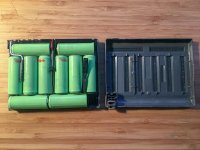
Original dead corroding cells in the battery after opening:

IMG_2368.jpg

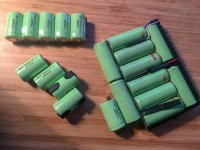
Compare new and old cells:

IMG_2369.jpg

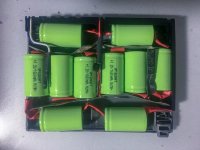
Reconstructed battery pack with smaller modern cells:

IMG_2389.jpg

 
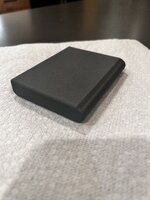
I bought the same 2/3A batteries from the same link above and they are too wide to fit in the enclosure. At least the replica one I have modeled to 3d print. They are wider than standard AA batteries right?

Can I use higher Mah batteries? Would these work for example:

 
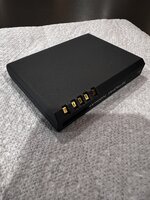
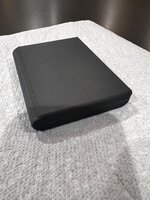
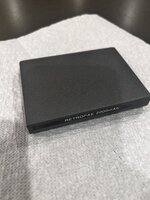
Finished my repro pack. I used the Ternegy 2000mah AA batts. I get 2 hours minimum from battery amnesia.

Unfortunately I don’t have a way yet to duplicate the serial number on the DS2400 chips so an original battery is still required to build a pack.
 

Attachments

  • IMG_7946.jpeg
    IMG_7946.jpeg
    1.7 MB · Views: 41
  • IMG_7945.jpeg
    IMG_7945.jpeg
    1.7 MB · Views: 32
  • IMG_7944.jpeg
    IMG_7944.jpeg
    1.7 MB · Views: 29
  • IMG_7943.jpeg
    IMG_7943.jpeg
    1.9 MB · Views: 31
I know you can read data off of a DS2300 using an ardiuono but havent found out how to emulate the chip itself. would you need any support hardware or could you do it with the ATTiny by itself?
 
The link in my post above has a very short code snippet which does the emulation we'd need. 1-wire isn't a complex protocol, and the only "difficult" part might be powering the ATTiny chip - theoretically a resistor/capacitor would probably do it from the data line, but considering how little data it needs to transmit even that might be unnecessary.

I have a Type 3 battery I've re-celled so if I get a moment over the next few days I can try it out.
 
So, Im going to ask a clarifying question.
1. Dremel or cut the old pack open- dremel or sharp blade? not sure hoe thick the old plastic is.
2. reuse the wiring and electronics from the old pack but not the old batteries
3.solder in the NEW batteries and install them in the 3d printed stl files you sent
Correct?
What glue did you use to connect the top and bottom part of the battery?
 
1. After detaching the sliding cover, I slowly used a hand saw on the left hand side of the pack (contacts away from you, label up - as if you were putting it into the Duo) and the plastic is quite thick. Once you see some of the plastic is all the way through, stop and note that the slot you've cut it now wide enough to put a screwdriver/spudger in and twist to break the ultrasonic welds and split the pack in two.

2. Yes, you need to keep the electronics.

3. Use tabbed batteries and solder the ends of the tabs together. Don't solder directly to cells.

I used hot glue, but YMMV. Hot glue also neatly filled in the slot I cut in (1)
 
I know you can read data off of a DS2300 using an ardiuono but havent found out how to emulate the chip itself. would you need any support hardware or could you do it with the ATTiny by itself?
The DS2400/1 has a ~1nF capacitor inside to power itself, at idle the data line is pulled HIGH so the DS can charge up.
An appropriate diode and capacitor should suffice to power an ATTINY while the data line is LOW for signaling.
(should... IANAEE!)

DS2400 series ESN emulation Here is a sketch for an Arduino nano that i made clone a DS2401 i have.

The program from This Youtube Video i had to make some small changes to it.
(invert the HIGH/LOW since im directly driving the data line without a transistor,
add a 20uS delay at the end of writeZero so it doesn't cut short the timing window)

I still need to rewrite it to work on 1 pin for 1-wire but i think its pretty close.
 
Finished my repro pack. I used the Ternegy 2000mah AA batts. I get 2 hours minimum from battery amnesia.

Unfortunately I don’t have a way yet to duplicate the serial number on the DS2400 chips so an original battery is still required to build a pack.

Do you have the STL files for this? Just curious.

Also I am not sure how to get the sliding door off without breaking the door. to unclip it doesnt seem obvious.
 
it's easy on some pack types and difficult on others. generally you want to press down on the button and slide it off,
 
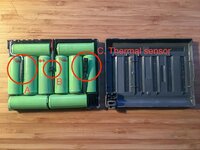
I opened up my pack (1499) and question, which is the DS2400 that's being referred to in this thread? I annotated a picture that was found earlier in this thread (which looks just like mine).

IMG_2368.jpg

C is a thermal sensor (klixon). It's the only thing that is inline to the cells (all 10 cells are connected serially).

B looks like a 3 leg transistor but one leg has been cut off and unused (there's a tiny stump left). The other two legs go two of the five pads on the battery exterior. This thing isn't attached to the cells. There's another component inside heat shrink tubing but I haven't opened that up yet.

A is also not inline to the cells and is connected to two of the five pads on the battery exterior. I haven't opened the heat shrink tubing on this part either.

The exterior pads (from left to right in the picture above):
  • Positive to first cell
  • White wire to A
  • Black wire to A and B
  • Red wire to B
  • Negative to last cell
Cells seem to be 4/5 A size NiMH, which are still available. The ones I see are either 2000mAH or 2200mAH. I'm going to pick up 10 of them. I've got a welder and tabs so I should be able to layout it exactly like the stock one.

But I'm curious about this ID chip / DS2400. I'm just rebuilding the one I have right now (which is dead) and so if this ID chip thing is still ok then I'm all good. But if not, again, curious which one of the marked items (A or B) it is in the picture above.
 
The pinout order is:

BATT(+)
Thermistor
GND
1-Wire ID chip
BATT(-)

So - A is the thermistor (so the Duo can read the battery temperature as part of the charging algorithm), B is the DS2400 ID chip, and there should be two fuses inline with the cells (C is one of them, there should be another one at the other end of the cell chain.

If you’re doing a rebuild, I’d reuse all of the components and except the old cells. The ID chip has the battery serial number and the battery Type (1, 2, or 3), which allows the Duo to use the correct charge algorithm and to calculate the battery power remaining properly. Your rebuilt battery will almost certainly give you wrong results for battery state of charge and discharge time remaining, since the cell characteristics are different than the originals.

 
The pinout order is:

BATT(+)
Thermistor
GND
1-Wire ID chip
BATT(-)

So - A is the thermistor (so the Duo can read the battery temperature as part of the charging algorithm), B is the DS2400 ID chip, and there should be two fuses inline with the cells (C is one of them, there should be another one at the other end of the cell chain.

If you’re doing a rebuild, I’d reuse all of the components and except the old cells. The ID chip has the battery serial number and the battery Type (1, 2, or 3), which allows the Duo to use the correct charge algorithm and to calculate the battery power remaining properly. Your rebuilt battery will almost certainly give you wrong results for battery state of charge and discharge time remaining, since the cell characteristics are different than the originals.


Oh jeez, I meant thermal fuse, not sensor.. brain not functioning today.

Ok, this makes sense although I was thrown off by what looked to be a transistor with a clipped leg on B.

Too bad on what will be incorrect cell characteristics.
 
Ok, this makes sense although I was thrown off by what looked to be a transistor with a clipped leg on B.
Here’s the data sheet for the modern-ish version of the chip, pin 3 is a no-connect:


Note that Apple ordered a custom variant with their own fixed-prefix to identify them as the manufacturer and to identify the battery type.

[Edit] The implication being that, while you could order a new DS2400/2401, you won’t be able to order one with Apple’s custom fixed values. 3rd party batteries (I have two VST Type-3s) used a small microcontroller to spoof the 1-Wire values and appear as an Apple battery.
 
From what I've seen emulating the Duos the system will run fine if it can't validly identify the battery, it just won't charge it.

The useful thing here is that PG&E's firmware is downloaded so someone could potentially write a utility to download a version that's patched to not require the custom DS2400/2401.
 
So much for reading these threads on a phone... I missed the first 7 pages or so :/ all of my questions were answered in the previous pages. Great.

My rebuild will be with 4/5 A NiMH batteries which is what the battery I had came with stock. I believe it's a type 3 battery model 1499 based on previously shared images of a type 3 battery. Looks like worst case scenario I don't get to utilize the full capacity of the replacement batteries (2000 mAH) but will deal with that later.

I saw a note from @bigmessowires regarding how it didn't boot from the rebuilt pack until he had stuck it in the dock for a few minutes first. This actually is similar to behavior I initially saw with a rebuilt battery for my PowerBook 540c. In that case it was related to the PRAM battery. If it's dead or not charged, my 540c didn't want to boot from the battery. Once I replaced the PRAM battery, it worked fine after that. It's possible that putting the Duo into the Dock charged the PRAM battery enough for it to boot from the main battery subsequently?

The useful thing here is that PG&E's firmware is downloaded so someone could potentially write a utility to download a version that's patched to not require the custom DS2400/2401.

PG&E?
 
Back
Top