• Hello MLAers! We've re-enabled auto-approval for accounts. If you are still waiting on account approval, please check this thread for more information.

PowerBook Duo battery replacement

Please try not to quote excessively. Trim for relevance. See the 68kMLA style guide.

I don't trust reviews
This is not some gamer fanboy site; these are serious RC etc hobbyists. When you read reviews by people who have tested these cells for capacity on proper equipment and found them lacking, and post their test results, it seems worthwhile to avoid that make and purchase the ones with better results - especially when the reviews are consistently negative on one brand. We're talking about cells that are sold as 2400MAh that are really about 800MAh for example.

I should be looking at AAs? Because 1600MAh is beyond AAA capacity by 150%.
I've seen AAAs allegedly rated to 1100MAh.

AAs are a tight fit
Yes, but IMHO only just. If you can find some that are at the lower end of the tolerance range - and *without* nipples (ie, flat ends or solder tabs only) you *might* just squeeze ten of them in. The dimensional tolerances are listed earlier in this thread.

800MAh / If two batteries * are in parallel, then they are combined 1600MAh, and then you take those parallel pairs and hook them up in series to rig up your 12v. Right?
Correct. That is called a series/parallel configuration.

* {sic: cells. A battery is a group of cells wired together}

I have doubts about fitting 20 AAAs in there
As do I, extreme doubts; feel free to do the math yourself though. It also sounds like a wiring nightmare.

if the Duo charger is a timer deal
No, it must be an intelligent charger. How else would it cope with recharging a half-discharged pack?

could you check to see if they have AA Cells for my oversized Duo BatPack from BTI?
What size are they?
Uh ... AA size? :?:

miles:km - 10:16

km: miles - 10:6

 
My personal inclination (when I get around to it) is to try the tab AAs. If it turns out they are too big for a Duo batt - hey, portable 12V powerpack, and that's always a handy thing to have.

 
I know the conversion for Klick <-> Mile and, having cut my teeth on slip-sticks, can easily do it between my ears.

Hence the: :o) So: ;) And: :lol:

My High Capacity BTI Battery Pack protrudes from the front edge of the Duo approximately the amount quoted earlier for fitting a set of AA Cells in place of the 4/5 AA Cells normally used in a standard size Duo BatPack. Therefore I'm assuming that when I crack the case, early this week, I'll find full sized AA Cells. Hopefully, they haven't eaten up the circuitry needed to install new Cells.

12v BatPack Hookup through the, now (and so far }:) ) useless, Modem Port opening would work nicely, as would the Docking Connector, if memory serves.

 
The problem with the 4/5AA cells is that they can't be acquired in 1600MAh capacities.

So the risk of overcharging is very much possible. Is there enough room for AAs in there?

Should be. Let's fill this out:

(dimensions are diameter x height or length, depending on orientation)

4/5 AF dimensions: 17x40mm (Battery Station says 16.5x42)

Fullsize A dimensions: 17x50mm (Wiki) (Battery station says 16.5x48)

4/5 AA dimensions: 14.5x43mm

Fullsize AA dimensions: 14.5x50.5mm (must be the button version)

Tabbed flat terminal AA: 14.2x50mm link, retardedly expensive)

AAA: 11x45 flat terminal, batterystation.com says 10x43.7. Like these. "We have a great supplier for these..." ...they all come from China, ya know...

Here's the issues:

AAA: Too small of a capacity. Maxes out at 1000-1200mAh.

AA: It won't even fit lengthwise. Capacity is not a problem.

4/5 AA: Not enough capacity. (1200mAh)

4/5 A: Original size yes, but it won't ever go in the same way. Not unless Apple had a spontaneous flashback and decided to retool and retrain everybody just to make some Duo batteries. (And you'll know they're charge for that)

A: Too big.

Confirmation of 1600mAh cells.

I suppose I could stagger the AAA cells. That's basically all I can think of that's left. I don't have the dimensions of the inner part of the Duo pack. But I think it could work that way. Since AAAs are about 6mm thinner than the AF size cells, and 6mm is about 50% of their thickness, this means it MIGHT work. I'll have to get 20 flat based 800mAh AAAs (with tabs, otherwise I'll have to pay for them to be done as there is NO way I can rig up a spot welder without spending $) and see what happens. A pair of paralleled cells should give me the 1600mAh I need x 10 pairs equals VICTORY!

The next step would be to know if the Duo will overcharge the batteries. I suppose it probably charges at 1 Coulomb then tapers off around 85%. As long as it doesn't go over that we MIGHT be fine.

 
A Coulomb is a unit of charge, like a bucketfull of electrons. It's the amount of charge transferred by a 1 amp current in one second. (equivalent to 1/3600th of an amp-hour) Think of it this way - a full battery will have a lot of Coulombs in it; the flow rate in and out is the current, in amps.

 
I was befuddled about cell sizes when I cracked a pair of Batteries a little while ago. At the beginning of the thread, we were talking about 4/5 AAs and I forgot about the original cells being 4/5 A.

I can confirm that a 2" Chisel works like a charm on the standard Duo Batteries wit no damage at all to the Flex Circuit. However, the second one I tried was quite a different beastie. The BTI High Capacity BatPack lacks the slot running around the perimeter of the standard case. I got it open with minor cosmetic issues, but managed to cut 4 of the 5 wires that are placed where the flex circuit would be on the standard pack.

The oversized, 3/8" protruding, BTI High Capacity BatPack uses the same 10 4/5 A cells as the standard Duo BatPack! 8-o

The difference in depth allows for a bunch of spacers on the sides for two rows of higher capacity 4/5 A cells separated by a PCB running, front to back, between the rows. My working assumption is that this PCB makes the Battery Pack itself very intelligent, allowing higher capacity cells to be fully charged inside the Duo.

Pics and disassembly documentation to follow, along with details of the PCB. :approve:

BTW, the cracked open standard pack fits very nicely back into the Duo, so what's the problem in replacing the 4/5 A Cells? :?:

 
I stand by what I wrote earlier: the original cells were not 1600mA cells; they hovered around 800,900, 1000mA in the different versions of the Duo battery produced.

Is there a Developer's note, I wonder, on the Type 1, 2 and 3 batteries?

 
Are there any markings on any of the cells in either pack, Trash?

The reason why we're not in favor of using 4/5As is: 1) expensive, 2) a real tight fit on reassembly because the factory churns them out by the pallet and thus has the tooling/skills to pack it real nice and tight in there, 3) the mAh of today's batteries is not the same (likely) as the older ones, so they (likely) won't be fully charged.

If we could only get a solid pin down on the mAh: my vote is on 1600mAh because the Apple KB article says they're 1.6Ah batteries, and the 'fritter post says 1600mAh too.

What we can do, and i've been checking up on this, is for the mAh of the PowerBook 520/540 series for more "results in Google"...since they're sort of close on the chart to see what other people think/know:

017f15c2.png.15a5b6ff4149c405bcfe32b69b172efc.png


Dunno yet, I'm tired. I'm just taking some "before" pics of the still assembled, but open, battery packs tonight.

For the Apple Pack: no markings whatsoever. :-/

For the BTI Pack labeling: Panasonic Brand NiMh "Rechargeable Batteries" and they've also got the number 9711 on them, whether that designates a Lot# or Model# remains to be seen. It's a different printing process, so it's likely a Lot#.

What's interesting about the design of the BTI Pack is that it has paper thin labels covering grooved skeleton frames on both the Top and Bottom of the Pack. The Apple version has solid, if thin, plastic on the bottom side. Maybe tolerances can be eased just a hair by sanding away some more of the Apple Pack's grooved bottom plate.

Great news: one of my existing Duo Batteries is showing increasing charging/discharging times for conditioning cycles on the LIND SuperCharger II that jruschme donated to the cause!

Thanks again, jr! [:D] ]'>

 
The challenge would be then sanding uniformly around the entire area of the Apple branded pack. This probably means something like a mill, and that should be possible with someone in the know. Even then, why? If you get 4/5A batteries today they're in excess of 2000mAh, which means they probably won't charge completely. Bad.

If you pull all the batteries out, does it look like it's possible to stagger AAAs in there? There should be enough room in there to do so, it's just a matter if 20 is possible to cram in there. I was going to think about layouts, but then I need dimensions and a program. At the moment only the SE/30 has a drawing application(s) on it. (I don't but should have AppleWorks on my Mac mini)

 
That's why the BTI Pack's PCB is of interest. It was a High Capacity Pack which sticks out the front of the Duo, yet it has the same config: 4/5 A batteries. So I'm thinking it may be a more intelligent battery pack, allowing for fully charging a ten-pack of higher Capacity A Cells.

After I wreck . . . erm . . . pull apart . . . the two Packs for documentation in the morning, I'll play with a couple of handfuls of AAA batteries! :approve:

Milling machine? :lol: Sand, fit . . . sand, fit . . . sand, fit . . . }:)

 
the mAh of today's batteries is not the same (likely) as the older ones, so they (likely) won't be fully charged.
Look, I really have to dispute this, but I suspect that without experimentation, we're both blowing smoke on the issue.

The Duo's inbuilt charger must be more than a simple timer, or else it would not be able to recharge partially-discharged batteries. It most likely uses the ΔV charging method - ie, measuring the voltage returned from the battery pack - to detect end-of-charge status. This return voltage will cross the threshold when the battery is nearing full, whatever its capacity is.

Case in point: your table shows the Duo 210 battery is 0.9Ah, and the 280c is 1.6Ah - yet you can use either battery in either machine. Second case in point: Trash80s extended-life pack. QED.

Excellent find on that table btw :) I'll add it to the peripherals links thread.

 
It is possible to use both Type II and Type III batteries in Duo 210 and 230 systems with the addition of appropriate battery management software. Type I batteries can be used in newer Duo systems, but battery life is significantly reduced. The PowerBook 2300 series uses the same power adapter as the 200 series Duos. Source link
The first claim is probably correct, the second is likely also, and the third is wrong. The Apple source says that the 210 through 280 uses a 25W power supply which came with it, the 280c and 2300 use a 36W power supply although the 36W will work with the 210-280 series.

The charging circuit could use a delta-time method also, if it knows the discharge over time according to use cycles, then it can calculate what time to charge based on x number of charge-discharge cycles.

I dunno. I'm going for 1600mAh because that's the original capacity and the most safe. I'd love to have 2400mAh but that's not known at this time other than a prior post here which said he had problems with the higher capacity batteries being not fully charged AND Trash's BTI pack which has circuitry present which is not found in the standard 1.6Ah packs -- but has (likely) just higher capacity (1800, 1900, 2000mAh?) batteries with circuitry to manage or trick the Duo into fully charging them.

 
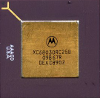
BTI IC = 7 discrete components & PIC on DS PCB

PIC "Output Side" = R1 + D

PIC "Input Side" = R2 + C2 + C1 + C2 + R4

PIC16C64

-RC/SO

9647CAW

Motorola Logo (99% sure on the logo)

PCB pics & layout to follow.

Same kinda boxie thingamahoozie on board as on Apple Battery Pack. :approve:

WAG: looks like the PCB could be wedged inside the Duo between the Battery contacts and the DUO MoBo! [}:)] ]'>

 
Yep, like I guessed, intelligent battery pack PCB for higher capacity cells that could very likely be installed inside the Duo in order to fully charge a handful of High Capacity re-celled Standard Duo Bats.

8-Bit EPROM Microcontrollers with Analog Comparators
[}:)] ]'>
 
Well, youll still need to dump the code out of the PIC if you want to clone it.

Most likely since its a C, it was masked in the factory and its program prevention protection fuse set. So the only way to dump the code out of those PICs, is to either VCC or Clock glitch it during a read event.

 
Or code up a new PIC from scratch.... it wouldn't have to do much; monitor one or two analog voltages from the pack (voltage, temperature), and spoof the appropriate signals at the appropriate times to the battery contacts.

Documenting/cloning the *rest* of that PCB would be a Good Thing, though ;)

 
Back
Top