• Hello Guest! We're hosting a challenge to welcome vintage Intel macs to the MLA during the month of July! See this thread for more information.
  • We've made some quality of life improvements to the Trading Post. More info here.

Power Macintosh 7500 thinks it's an 8500

Matlaw

6502
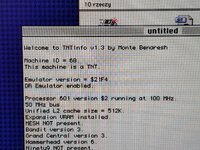
Hi, after trying to clean very stubborn flux residue the Gestalt ID changed from 68 to 69 and now every software displays the wrong Macintosh model. Before the disassembly, isopropyl soaking and scrubbing it was showing the correct ID.
Tried resetting the Cuda chip, starting with and without the PRAM battery and no dice :(
There are no schematics for the TNT architecture, so I can't check if it's the matter of a short, missing resistor or something else.
Can the Gestalt ID be software controlled? I really hope I didn't screw up anything on the board. Thanks in advance for any help
 
Hi, after trying to clean very stubborn flux residue the Gestalt ID changed from 68 to 69 and now every software displays the wrong Macintosh model. Before the disassembly, isopropyl soaking and scrubbing it was showing the correct ID.
Tried resetting the Cuda chip, starting with and without the PRAM battery and no dice :(
There are no schematics for the TNT architecture, so I can't check if it's the matter of a short, missing resistor or something else.
Can the Gestalt ID be software controlled? I really hope I didn't screw up anything on the board. Thanks in advance for any help

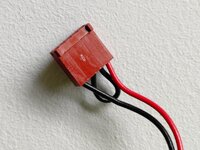
Did you plug something into the LED header on the board?

That is what tells the computer if it is a 7500 or 8500.
 
Did you plug something into the LED header on the board?

That is what tells the computer if it is a 7500 or 8500.
I didn't plug the LED back in, because I'm trying to model a new LED holder (gotta love old ABS+FR).
So that's what the loop's for.
Thank you, thank you so much and gosh, now I feel stupid
 

Attachments

  • IMG_20260712_133757_298.jpg
    IMG_20260712_133757_298.jpg
    1.2 MB · Views: 7
  • IMG_20260712_134039_131.jpg
    IMG_20260712_134039_131.jpg
    3.2 MB · Views: 7
I didn't plug the LED back in, because I'm trying to model a new LED holder (gotta love old ABS+FR).
So that's what the loop's for.
Thank you, thank you so much and gosh, now I feel stupid
Yup, exactly that. That is what the loop is for.

By the way, the 9600 schematic is available, which is mostly the same as your board. References are going to be different and the video / AV stuff isn't there, and it has two Bandit chips etc etc, but it is the same TNT style platform.

 
Read F301A000 in Open Firmware.
Code:
F301A000 rw@ 4 u.r

The BoxID bits are bit 11 and 12 (where bit 0 is the LSB).
Code:
From LSB on the right to MSB on the left, the bits are:
1,0   = 10 : PCI1PRSNT2A_I,PCI1PRSNT1A_I (00=7.5W, 01=15W, 10=25W, 11=No connection)
3,2   = 00 : PCI1PRSNT2B_I,PCI1PRSNT1B_I (00=7.5W, 01=15W, 10=25W, 11=No connection)
5,4   = 10 : PCI1PRSNT2C_I,PCI1PRSNT1C_I (00=7.5W, 01=15W, 10=25W, 11=No connection)
6     = 1  : GCRTSA_I (RTS from SCC modem port of GC to DS8925 ; RTS is a signal that enables TXD± )
7     = 1  : GCRTSB_I (RTS from SCC printer port of GC to DS8925 GeoPort transceiver IC or LocalTalk™ Dual Driver/Triple Receiver )
8     = 1  : factory tests (active low) (emmo) (Serial Test Manager)
9     = 1  : MicSense_I = (connecting long PowerTalk Microphone doesn't change this on my pm8600? What does?)
10    = 0  : ETH10BT_LINK = 0 connected, 1 = not connected (I tested this on my pm8600)
12,11 = 01 : BoxID(1),BoxID(0); 00 = pm9500? 01 = pm8500?
13    = 0  : IO1_PU composite video out (active low) (sixty6) (1 on pm9500)
14    = 1  : IO2_PU fast SCSI (active high) (mesh)
15    = 1  : IO3_PU unused (pulled high)
 
Yup, exactly that. That is what the loop is for.

By the way, the 9600 schematic is available, which is mostly the same as your board. References are going to be different and the video / AV stuff isn't there, and it has two Bandit chips etc etc, but it is the same TNT style platform.

That schematic was quite helpful for some stuff. I was really going down the rabbit hole of the TNT and it helped me identify the PCI bus arbiter as I was trying to understand all the ASICs on the board. Also came across a lot of other cool stuff, such as the Hammerhead, Bandit and Grand Central ERS documents. And Curio too :D
I find it fascinating that they started the work on these ASICs (so the whole TNT architecture, or maybe even for the first Tesseract?) back in 1993, while Sculley was still a CEO. Over time they they changed some stuff and started the Tsunami project. At some point they cut out the video out capabilities after designing the 7500's case. According to some internal documents from December 1994, the 7500 model was to be equipped with an 80 MHz 601 instead of the 100 one.
Really love the deep story of this machine
 
Read F301A000 in Open Firmware.
Code:
F301A000 rw@ 4 u.r

The BoxID bits are bit 11 and 12 (where bit 0 is the LSB).
Code:
From LSB on the right to MSB on the left, the bits are:
1,0   = 10 : PCI1PRSNT2A_I,PCI1PRSNT1A_I (00=7.5W, 01=15W, 10=25W, 11=No connection)
3,2   = 00 : PCI1PRSNT2B_I,PCI1PRSNT1B_I (00=7.5W, 01=15W, 10=25W, 11=No connection)
5,4   = 10 : PCI1PRSNT2C_I,PCI1PRSNT1C_I (00=7.5W, 01=15W, 10=25W, 11=No connection)
6     = 1  : GCRTSA_I (RTS from SCC modem port of GC to DS8925 ; RTS is a signal that enables TXD± )
7     = 1  : GCRTSB_I (RTS from SCC printer port of GC to DS8925 GeoPort transceiver IC or LocalTalk™ Dual Driver/Triple Receiver )
8     = 1  : factory tests (active low) (emmo) (Serial Test Manager)
9     = 1  : MicSense_I = (connecting long PowerTalk Microphone doesn't change this on my pm8600? What does?)
10    = 0  : ETH10BT_LINK = 0 connected, 1 = not connected (I tested this on my pm8600)
12,11 = 01 : BoxID(1),BoxID(0); 00 = pm9500? 01 = pm8500?
13    = 0  : IO1_PU composite video out (active low) (sixty6) (1 on pm9500)
14    = 1  : IO2_PU fast SCSI (active high) (mesh)
15    = 1  : IO3_PU unused (pulled high)
Open firmware on PowerSurge Macs works only via serial? I've never tried it on this Mac
 
Open firmware on PowerSurge Macs works only via serial? I've never tried it on this Mac
You can set it to work by keyboard and monitor as well but it defaults to serial.

Feels a little overkill for "didn't plug the jumper in" though. I feel like it would just confirm what you already know, i.e. that the box ID is reading the values for the 8500 instead of 7500.
 
The original Tesseract project goes back to the 80s. It was a weird thing.

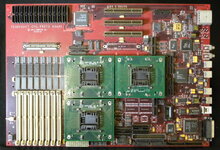
View attachment 101248

That is a 1992 version. Dual 601 CPUs and those aren't PCI slots.
Yeah, Gassee's Jaguar. A Mac not for the masses, but for the classes. I wonder how similar in ideas the Jaguar, Tesseract and The New Tesseract were.
It's interesting that the Tesseract used only twisted-pair ethernet, while the first Power Macs had only AAUI that required an external transceiver.
I'd love to see more what was happening at Apple back then. Right now I'm going through "Apple Confidential 2.0"
 
The 8500 has the exact same board with the AV features. Also the 7500, 7600 and 7300 have varying amounts of AV between them.
One can say that the TNT board is very modular. Probably the best design of the Spindler era. 7300 lacks video input, so they also removed "Plan B" chip.
Too bad that they left video out only for the 8500/8600, but I guess they really wanted to push people to the more expensive model
 
One can say that the TNT board is very modular. Probably the best design of the Spindler era. 7300 lacks video input, so they also removed "Plan B" chip.
Too bad that they left video out only for the 8500/8600, but I guess they really wanted to push people to the more expensive model
I suspect that was the situation, although I generally prefer towers anyway.

I feel like part of the reason the TNT based machines were so good is I suspect that the OS was developed primarily with them in mind. The business class / generally high end machines. I wonder if there was a get it right on the TNT first policy. Everything non-TNT tended to be a little less stable, at least in my memory of it, the 7200, 6500, even the beige G3 that replaced the TNT was a bit of a "leave it alone if it works because if you run an update, you might end up bug fixing for a day".

Although other people's experience might have been different.
 
Back
Top