• Hello MLAers! We've re-enabled auto-approval for accounts. If you are still waiting on account approval, please check this thread for more information.

Plus Too: a DIY Mac clone project (128k -> Plus)

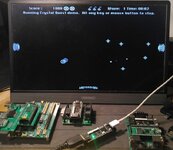
The first time in over 20 years. A new Macintosh Plus has been born! (Well, I suppose that was really on the 4th when you first got the Happy Mac to work. But eh.)

Congrats on your lasted achievement! :D Do you know why it locked up after five minutes?

 
Fabulous!!!! :approve:

< hoists a long neck root beer in salute to BMOW's incredible progress and latest milestone achievenent! >

< burrrrrrrrp!!!!! :I >

 
I think the freeze-up is something related to the mouse interrupts. It seems to happen if I move the mouse around in fast circles, but I haven't had a chance to look into it further than that yet. Ack, so much more to do!

 
Oooo! Awesome! I can't wait for the next update.

Have you thought about adding a ROM SIMM slot? :D

What is the effective speed of the system? Is it clocked at 8MHz, or does it run at a faster speed?

 
It runs at 8.125 MHz, which was chosen because it's 1/8th of the 65 MHz pixel clock necessary for 1024 x 768 @ 60 Hz VGA video. The real Plus runs at 7.83 MHz, so everything is a little bit too fast.

One strange thing is that loading data from the virtual "floppy disk" is unexpectedly slow. I haven't timed it, but it seems slower than even a real Mac Plus, which is odd because there are no delays here for track-to-track head movements. Or maybe it's the general execution speed of the computer in general that feels slow, I can't be sure. When it's working better, I'll run Speedometer or something on it.


 
Especially cool when trying to play a version of Tetris at 8x normal speed! :lol: ;)

Were games "relatively" CPU Clock Corrected by the time the Plus and its OS levels were released? :?:

 
Were games "relatively" CPU Clock Corrected by the time the Plus and its OS levels were released? :?:
I can't imagine why they would be. So far as I'm aware the Plus runs at exactly the same speed as the 128k/512k.

(The SE ran at the same clock speed but changed the video timing to free up more RAM bandwidth, so it's slightly faster. But it didn't debut for another year-and-change.)

 
The arrival of cheap FPGAs from the far east has sparked my interest in those retro FPGA implementations again. After having done an Atari ST and an Amiga, I have decided to give the Mac Plus / PlusToo some attention.

plustoo.jpeg

This time I'll try to focus on accuracy. The memory timing is already back to the original 16Mhz with two 500ns bus cycles like the original Mac Plus which actually causes it to be as slow as it was back then. Also, the video is back to its original timing and is being sent over HDMI (which my main development screen actually accepts :-), and the floppy now reads tracks on the fly rather than storing the entire image in ram/rom.

Next on my agenda is floppy write support which the PlusToo never had ... and I'd like to redirect one of the serial ports to the WiFi modem some of my setups have and which will allow the Mac to dial into some old BBS like I did with the Atari ST.

The nice thing about these FPGAs thingies is that they are real hardware and it's e.g. trivial to expose the original video signal and drive the original CRT.
 
Speaking of CRTs: Are there small, cheap CRT replacements for the classic macs? Has anyone e.g. ever tried to see if these 4 inch CRT's can be made to accept the 22kHz signal of classic Macs? Wouldn't it be great to combine that with such a tiny FPGA replica?
 
Back
Top