Just casually, given that you already have the machines and it sounds like you may have set them up and started to use them -- what are your initial impressions?
The heart of what LEM wrote, in 1997 when they first started publishing, basically boils down to that if it's 1997 and these machines still cost several hundred dollars and you have a choice between, say, a 6200 and a 7200, is that you should get the 7200.
I'd be interested in a more modern take on it, and my perception of that (and what I'll likely write on my own blog when I've had a chance to poke at the 6220 a bit) is whether or not they "can be used" -- the descriptions you see of the 6200 describe a computer that, more or less, should literally fail to boot up.
My take on the entire thing has long been that the 5200 and 6200 and their immediate family (up through the PCI change) were the cheapest PowerPC-based Macs you could get and were often among the cheapest you could get, period (though: some 5xx and 6xx machines stayed on sale for far too long.)
Considering their performance has to be done thinking about the context of a world where you can get an entire computer and some start-up software and usually a printer and a monitor for about $1900, or you can pay 3x that and get a computer (the 9500) that should be just around 2x as fast on paper and includes the following amenities:
- power cord
- mouse
- unformatted text editor
Of course, those are the extremes, but even stepping up to the next machine after the 6200 close to doubled your cost once you actually assembled a working computer and put some software on it.
That comparison of course stops making sense when the iMac and the Power Mac G3 crossed over in price and your $1299 could buy you either an expandable system with fewer included amenities or a most-in bundle system, trading some legacy compatibility for most of what you'd need to get started up front, without trading off any performance.
One more thought: From a modern perspective, I don't think that "reviews" of vintage hardware make sense, especially in any supply-limited ocmmunity. We shouldn't, at this point, be telling anybody to shy away from any Mac they can get their hands on.
I think it's important to be aware of what you're getting (something LEM does insanely badly in the modern context, for continuing to host extremely factually incorrect articles with little or no revisions showing up-to-date research or reflecting the needs of people "shopping" for these machines in modern times) but I don't think there's a good reason to classify any given vintage Mac as an "avoid this one".
Again, it's not like we're shopping for three-year-old PowerBook G3s to run OS X on and cache-having /233s cost the same as cacheless /233s on the used market.
but then basically hand-waves away the rest of it, with things like 'every computer uses bridge chips', 'PowerPC native code ran as fast as on every other Power Mac', etc.
To address this, specifically: An important thing to note here is that to my knowledge, Mac OS did not
completely shed 68k code until literally Mac OS X. Every single release up to that point was frequently lauded as "even more PowerPC-native!" but as far as I know, apple either never really finished the job, or they only finished it mostly in the very newest versions of OS 9.2, which won't run on anything so old. (9.2 requires either PCI, by which point "the pain points" were gone or a G3, I forget which.)
So, the fairest way to evaluate this specifically is to run 9.1 with as much RAM as you can fit into either of these machines, and the newest software you reasonably can, such as the PPC versions of IE/OE4 or IE5/OE5 and Office 98 or 2001. Those applications have stiff-ish system requirements though, and so you might run into the
other problem: A machine from 1995 with limited upgrade potential just isn't well equipped for things that were new several years later, at a time when everything in computing was moving very fast.
(That said: Anecdotally, IE4/OE4 run "fine" on my 840av under 8.0 or 8.1 with 24MB of RAM, but really only one at a time, I haven't had a lot of reason to try IE/OE4 on my next closest system, the 6100/66, but it'll be something I make time to do under 7.6.1 and 8.1 on that system as well.)
Given that the author
has close to the exact machine you do, and says that in their experience it's "fine" I think it's okay to accept the hand-wavey explanation as being sourced both in the technical fact of reducing the amount of 68k emulation gets rid of one of the biggest pain points of the machine, and their experience using it.
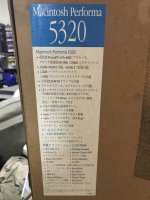
That said, if your point is to prove something about the original group of 603 machines, the 5200/6200, doing it on a 5320/100 with the 603e (which addressed one of the bigger pain points in 68k emulation specifically)
and had a 256k cache as a cherry on top is... not very valid.
One more thing to note: Initial shipments of 5200s had 8MB of memory installed from the factory, and there's a reasonably good chance, especially for those of us around the right age to have used these things when they were new in our schools, 7.5 on 8MB of RAM is an extremely bad look and probably exacerbated everything else about the machine. (Incidentally there were a handful of 7200 configurations with 8MB of RAM as well, I don't know why Apple thought that was a good idea except that Apple has pretty much for its entire existence included too little RAM in its computers.)