Hello Mac community,
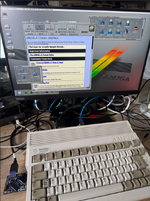
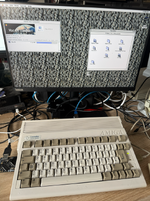
since I have gotten my first actual Macintosh last month (LC475), I must admit that the "Mac Bug" has bitten me, which is why I have now also pushed the trigger on getting a Macintosh SE/30 yesterday.
In order to have fun with it, I decided to port one of my other Amiga projects to the SE/30, therefore, I would like to announce today that I have started to develop a new graphics card for the SE/30 called:
DoubleVision SE/30
Technically, it is very much a Macintosh port of my Amiga graphics card, the P-Vision, but with some Mac SE/30 specific feature enhancements.
So what can it do? Well, here is the feature List:
The card itself is low-profile and it has an internal HDMI port, which can be put outside of the SE/30 via a small bracket.
As I said, most of the development is already done, as the designs works great on the Amiga, therefore I expect that the most challenging part for me is to write the graphics ROM driver for the MAC in order to enable the display output. I have already started to look into this direction. ;-)
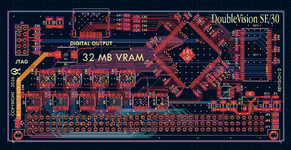
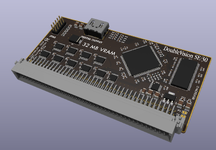
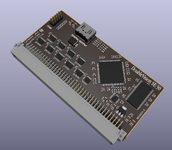
So for now, let's start with a first render of the board PCB, which I expect will be nearly identical to the final PCB.
As always, questions, comments, etc are always welcome.
since I have gotten my first actual Macintosh last month (LC475), I must admit that the "Mac Bug" has bitten me, which is why I have now also pushed the trigger on getting a Macintosh SE/30 yesterday.
In order to have fun with it, I decided to port one of my other Amiga projects to the SE/30, therefore, I would like to announce today that I have started to develop a new graphics card for the SE/30 called:
DoubleVision SE/30
Technically, it is very much a Macintosh port of my Amiga graphics card, the P-Vision, but with some Mac SE/30 specific feature enhancements.
So what can it do? Well, here is the feature List:
- HDMI video plug using DVI video signalling
- 32MB VRAM framebuffer, clocked at 165MHz
- Supports 1bit,2bit,4-bit,8bit,15bit,16,bit and 32bit color depths
- All standard VGA and MAC resolutions, supporting up to 1280x1024@60p AND 1920x1080@30p
- Fast 64-bit BitBlt engine, pushing up to 130 Mio Pix/s (8bpp)
- 32 KB internal ROM for graphics drivers
- Firmware can be fully upgraded on the host system (via "FlashFPGA App" running on MacOS)
- Special MAC SE/30 features:
- Card can work in dual-mode (second monitor to the SE/30 internal monitor) or route the SE/30 internal video output to HDMI
- If MAC is booted, and no HDMI is connected, framebuffer memory is added as 32 MB system memory
- Eleborate write-through cache to minimise read/write latency to VRAM
- Makes full use of 68030 2-cycle 32-bit synchronous bus termination - yielding up to 32MB/s host memory performance using 16MHz bus!
The card itself is low-profile and it has an internal HDMI port, which can be put outside of the SE/30 via a small bracket.
As I said, most of the development is already done, as the designs works great on the Amiga, therefore I expect that the most challenging part for me is to write the graphics ROM driver for the MAC in order to enable the display output. I have already started to look into this direction. ;-)
So for now, let's start with a first render of the board PCB, which I expect will be nearly identical to the final PCB.
As always, questions, comments, etc are always welcome.