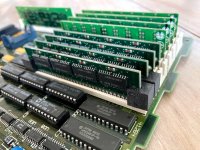
I'm replacing some SIMM connectors with broken plastic clips with new metal-clip connectors on some SE/30 boards. The solder on the data pins was easy enough to get out with solder wick. But the ground pins are being unsurprisingly difficult. I've tried lots of flux, adding fresh solder and various temps but haven't had luck.
Any tips for clearing out those difficult connections with these tools or recommendations of needed gear if the kit I have isn't enough?
Are the old pins still in the holes?
If not, I usually do this for stubborn through-holes.
1) Grow a third and fourth arm.
2) Stand the board on edge, so you have access to both sides of the problem hole.
3) Apply heat via soldering pencil to one side of hole (liberal flux helps with good heat conduction).
4) Touch the sharp end of a sewing pin with a plastic head (plastic head provides insulation, or use regular pin with gripping tool) to the other side of the hole.
5) As the solder melts, gently push the pin through the hole, moving the soldering pencil from directly over the hole to the side, touching the solder pad and pin.
6) Withdraw the heat.
7) Withdraw the pin.
The timing between steps 6 and 7 can be a little tricky. I usually find that solder doesn't stick to a stainless pin, so one is left with a little volcano of solder sticking up on the heat side. But, if you're too late, the solder may manage to harden and grip the pin. If you're too early the solder may just flow back into the hole after the pin. But the timing isn't super critical. This rarely gave me trouble. Maybe one time in 20 or so.
If the pins/socket are still in the holes, I usually do the following -- however, note that I've only ever done this on PCI cards, to remove DIP chips, not on an SE/30 logic board, so YMMV:
1) Support the board with the connector/chip facing downward and room for the connector/chip to fall out of the board.
2) cover any nearby components in modeling clay so they won't blow away.
3) Apply heat from an adjustable heat gun (has a ~2" wide nozzle) to the solder holes with one hand.
4) With the other hand, probe the solder in the solder holes with a dental pick, while heating.
5) Move the heat gun as needed to melt any holes that are still hard.
6) Gently push the connector/chip off the board by pushing the pins down out of the holes once the solder is melted in all the holes.
Again, liberal flux is helpful for this method.
Finally, another possibility is to use a product called Chip Quik. It is an alloy which mixes with solder and lowers its melting point. I used to use it a lot, but eventually got to where I don't really need it, but ti can be a life saver for those difficult situations. My main complaint about it is that you really need to clean it all up off of your work, when you're done and that's tedious.
No doubt others will be along with other advice. There's lots of ways to skin the soldering/desoldering cat.