Mac G4 MDD motherboard

maccy

6502
Hi All,
please can anyone help with identifying the power pins on the G4 MDD board, there are 2 rows of pins with Power, Reset, NMI written alongside ie 4 pins against each title but not sure which row of pins to short to start computer, reason is front panel board switch appears to be faulty, image showing pins to short would be good, thanks
 
I just tried on my working MDD. The results are weird. I couldn't get it to boot jumping any of the pads in any x or y direction. It's possible I have heavy oxidation (did try to scrape the pads a bit). I didn't try jumping diagonal.
 
Strange, (sorry btw I meant the pads not the pins) I thought these pads were similar to other mboards which have + and - usually written on them to identify which ones to jump, but not apple, the pads seem to be in a row of 2 x 2 pads with Power, Reset and NMI written against, but no indication of which ones to jump to start the machine.
Other way may be if anyone can identify which of the 10 pins on the mboard socket from the front board panel to jump to bypass the front power switch?
 
My MDD is acting up, so I poked at this more. These pads do work (though may be oxidized/grimy, as in my case, you should close them in the shorter direction (across the width/beam of the machine). I didn't try NMI (would be cool for macsbug reverse engineering), just power and reset. It wasn't consistent for me, but again possibly oxidization related.
 
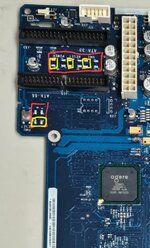
I assume you folks mean these?

1000035733.jpg

I've drawn yellow boxes around pairs of pads that would trigger those functions. They're pads for tactile buttons same as the Reset PMU button.

You could solder on the missing buttons for convenience.

Buuuuuut.

If your MDD is playing up, the most likely cause is the PSU as it is a very common failure mode. The solution is recapping the PSU rather than finding another power button.
 
Last edited:
If your MDD is playing up, the most likely cause is the PSU as it is a very common failure mode.

As a former "MDD doctor" during their heyday, 100% this. Unfortunately this wasn't well known at the time, so we'd often get a new PSU and have the exact same problems, then swap the board, same problems, etc. ASD always passed, but the weird behaviors would continue (for instance, shutting down randomly, failing to power up consistently, etc). Some of these had symptoms of capacitor plague brand new.

However, there are a few other things to check for after you've recapped or ATX modded (personally I recommend this, but it is a chore) the PSU:

1. CPU<-->mainboard interface, especially as the heatsink applies pressure to the CPU PCB potentially bending it or leading to poor contact. This has lead to the "push on the heatsink" advice. This also worked with TiBooks with bad graphics, but I forget which corner...had one that worked fine with a clamp applied.
2. Front panel board, though I think it was usually actually the PSU being intermittent when people replaced these. It never solved issues for me, but there were a larger than normal number of people replacing these in the early 2000s.
3. Cable damage from the hinge/constant flexing

I recently picked one up and it only sometimes boots. Still diagnosing but I think it has both a bad GeForce gpu and a bad PSU. I'm not convinced these machines were ever well-designed (Apple was really pushing the thermal envelope of the case design and powerpc, and then got burned by cheap bad capacitors) but they are fast and pretty.

 
I am tempted to 3d print something for one of the 5.25 bays, and run wires down. I may do this if I can get mine reliable again.
 
Back
Top