• Hello MLAers! We've re-enabled auto-approval for accounts. If you are still waiting on account approval, please check this thread for more information.

Another SE/30 recap disaster

blatboy

6502
Much like LazarusNine,  I had my own disaster.

Two issues:

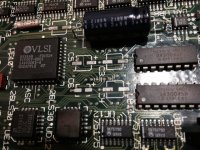
1. Had my iron set for 650F and was using some solder tweezers (Hakko FX-8804-02) thinking it would be easier to get the SMD caps off.  It was, but it left residue in between the pads.  I think I got a little too rambunctious trying to clean off the residue and it looks like I exposed a trace.  I think.  Check out C4.

IMG_0149.jpg.bca99698e878eea3cfc1d69bdab9886b.jpg


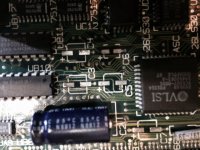
2. As far as the axial caps go... I've done this with through hole components enough that it should not have been an issue, but it was.  I just couldn't clear of solder out of 3 those 4 holes.  I have a fancy desoldering gun, but that didn't seem to do the job.  (Seemed the tip was too big for these smaller holes?  Normally not an issue when desoldering through hole caps.)   Maybe I don't have the mojo I need for solder wick.  I do prime it with solder to get it going... cleared one hole, but the others... nada.  I have a cheap solder sucker that... surprise, didn't seem to do it for me either.

Note I do plan on putting this baby in the dishwasher. (no soap, no drying cycle) I'm hoping that will take care of some of that cap residue, and will be more gentle than me chipping at it with a solder tool and isopropyl.  

Anyway... please take a look at these shots.  Maybe it's not as bad as I feel it is.  Maybe I should be publicly shamed.  Learning on the internets and having fancy tools is really swell and all, but it's skills like these where I wish I could get time in person with someone who really knows how to do these things... especially when repairing these older boards.  Even though I've successfully recapped one board, this hardly makes me an "expert."

Thanks again for any thoughts you have.

 
The board looks like it's got a covering of grime on it.  You probably won't be able to tell what state it's in until you clean the surface to see what's under it.  I re-capped my SE/30 board yesterday and what I found worked really well was to cut the tops off the old caps then gently remove the remaining base and plastic seat using a small flat screw driver.  By doing it that way you don't use any heat and there's very little danger of lifting traces.  I then removed the remaining legs and solder using de-solder wick.  The best place to find tutorials on soldering is youtube.  There's some really good instructional videos on soldering.

 
Last edited by a moderator:
The board looks like it's got a covering of grime on it. You probably won't be able to tell what state it's in until you clean the surface to see what's under it.
I agree a 100 % with Kingchops, first step is to remove all the dirt from this board, then use a wick to remove all the residues.

I don't think you lifted a pad, but not easy to say right now.

 
Remaining solder on pads show me temp of solder tweezers was too low.If temp is enough,surface of remaining solder would be more clean and smooth.

Pins of C11 and C2 are hard to through.I set solder sucker 450C.Heat from other side with solder iron,and suck from the other side.

I visited your web site and found you are a trombone player.so cool!.I play the trombone as an amateur player.

 
Last edited by a moderator:
A couple of extra hints, it seems counterintuitive, but add new solder to the old (it usually lowers the temp that is required, which aids in removal of the old solder).  solder wick works well at this stage.  If you do this again, I am now a big fan of cutting off the tops of the old caps, then using a soldering iron from the inside on the individual leads.  Everyone has their favorite method.

 
A couple of extra hints, it seems counterintuitive, but add new solder to the old (it usually lowers the temp that is required, which aids in removal of the old solder).  solder wick works well at this stage.  If you do this again, I am now a big fan of cutting off the tops of the old caps, then using a soldering iron from the inside on the individual leads.  Everyone has their favorite method.
Thanks!  yeah... I know a few of those tricks.  I think it's just the fact that I'll do it... then won't need to for a year or so.. then try again after I've lost the touch.  Use it or lose it, man.

Remaining solder on pads show me temp of solder tweezers was too low.If temp is enough,surface of remaining solder would be more clean and smooth.

Pins of C11 and C2 are hard to through.I set solder sucker 450C.Heat from other side with solder iron,and suck from the other side.

I visited your web site and found you are a trombone player.so cool!.I play the trombone as an amateur player.
Good to know!  I think my solder sucker has a temp control... I should check it out.  (Hakko FR-300) 

That said... to really clean up this board and do it right I feel I need one of those hot air soldering stations w/a preheater station.  

Haha.  Yeah.  I'm a full time musician and a struggling engineer...   ;)

 
before you get too ahead of your self and go and buy more equipment, why don't you first get acclimated with Solder Wick and flux,  get those pads nice and clean.

 
Yes.Solder Wick does great.I removed caps today,this is after I did Solder Wick.

Solderwick.jpg

But Solder Wick can't open through hole...Hakko sucker is expensive.I got Engineer's which is Hakko's copy..

FullSizeRender-1.jpg

 
Last edited by a moderator:
yeah i hear ya.. i own (3) Fr-300's and (1) s993a       TK ended up with my old hakko 808 that thing was a monster.

 
I have a new Hakko FX-951 that I got for free.  Works really well.  I have a few tips for it now, too, including a wide flat one that's great for removing surface caps and a very small thin one that's great for through-hole.

(I won 4 of them at auction, then sold the other 3 which paid for the 4th. :)  )

 
Last edited by a moderator:
I think over all SMT soldering is one thing... but  Vintage Soldering,  and Rotted pad/trace recovery,  and other kinds of damage recovery is an art.

And can be extremely time consuming.   And i just love these boards that were Dishwashered's 4-5 years ago, called good and sold.

These things are extra screwed now.

 
What was the rationale behind putting the boards in the dishwasher?  It *seems* common sense that you wouldn't put such things in a dishwasher with soap, but what do I know.

 
What was the rationale behind putting the boards in the dishwasher?  It *seems* common sense that you wouldn't put such things in a dishwasher with soap, but what do I know.
One of the most common problems with these boards is electrolytic capacitor leakage.  The electrolyte is conductive and causes shorts on the board.  Washing in a dishwasher or by hand cleans off leaked electrolyte.  Many faulty boards can be made to work simply by washing.  Or prior to repair the leaked electrolyte needs to be cleaned off.

 
What is the best way to remove flux residue?  I use a toothbrush and rubbing alcohol, but it doesn't always work. Sometimes I have to get an exacto knife in there and scrape it out.

 
Back
Top