• Hello MLAers! We've re-enabled auto-approval for accounts. If you are still waiting on account approval, please check this thread for more information.

A 'once and for all' declaration regarding L88M mask MC68040 CPUs

Here's an eBay seller in China offering chips with mask 02E31F. Do these look legit?
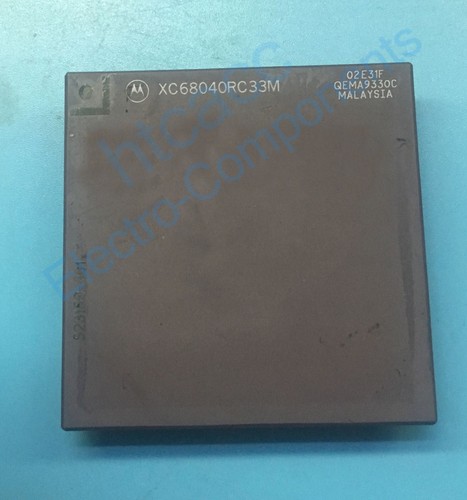
I bought a 02E31F MC68040RC40 from ericwoosrarechips on eBay and it was exactly as advertised, not remarked and fully functional. Out of stock right now but more do appear now and then. https://www.ebay.com/itm/383675636030

I'm glad this thread was bumped because I got to learn about what process my cpu is.
 
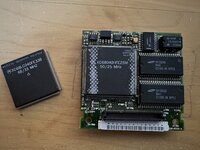
Just for this information to be recorded somewhere, here is the data from the Powerbook 550c CPU's of which I am aware, including my own.

All of them are Motorola XC68040FE33M QFP184

All of them have the same mask & location of production: 02E31F Malaysia

Part Numbers: QEES9519A, QEEB9517B, QEBP9511A, QEBQ9511A

I found information on another one, Part Number: QECW9514A
 
I bought a 02E31F MC68040RC40 from ericwoosrarechips on eBay and it was exactly as advertised, not remarked and fully functional. Out of stock right now but more do appear now and then. https://www.ebay.com/itm/383675636030

I'm glad this thread was bumped because I got to learn about what process my cpu is.
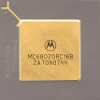
From my experience buying various 68040 chips on eBay from a variety of sellers, I would trust Eric Woo 100%, and I would be very , very suspect of any other seller. Especially ones sourced from China. I have purchased some which said California and they drop shipped from China.

Advice for those who are looking for full 68940 chips or higher rated ones than they have: put a notification on Eric Woo and when he lists an item you’ll get notified, and buy from him.
 
I need to self-crit on this. I'm making strides to move beyond my weird obsessions. I honestly, now, couldn't care less :) I've apologized privately to the individual I went full passive-agressive on regarding the issue (which is/was my issue), and I don't want to let something that is made up of a load of pixels and energy get the best of me. </confession>

I haven't seen any QPFs beyond embedded iterations of the 040—but I am far from the expert there. Found this in the NXP documentation:
View attachment 53112
So unless it's 3.3V I don't think they did, sadly :/

Just to follow up on this after doing some in-depth research, it turns out that Apple likely used all XC parts in the 550c, but the full 68040 in the QFP was eventually qualified, so the MC68040FE33A did exist, but was never used by Apple. Also, the MC68040FE40A did indeed exist, but was not a Motorola original part. The MC68040FE40A was created by NXP in the 21st century after successive die shrinks made it possible to for it to run cool enough for its intended purposes as an embedded part. However, it had a very limited run and was not widely used, so pieces are rare and command upwards of $350+ on the secondary market. I would love to try and place one on a CPU daughtercard, along with the appropriate clock and the ROM from the 550c to see if the fastest full 68040 possible in a Powerbook is possible.
 
Why would you want the 550 ROM? Full 040s just work with the 520/540 ROM as well.
It's a myth that the 550 ROM is needed for the FPU to be detected.
 
I remember reading a detailed swap attempt on hackaday a few years ago which ended with the assumption that something in ROM must be different. Maybe they just had two bad chips in a row, though the second seemed relatively thoroughly checked.

 
They likely had bad/remarked LC chips.
With a known good full 040 replacing the LC040 on a 540 CPU module just works... FPU is detected and works, no further modifications needed.
IMG_6490.jpg
 
They likely had bad/remarked LC chips.
With a known good full 040 replacing the LC040 on a 540 CPU module just works... FPU is detected and works, no further modifications needed.
View attachment 53177

Given the crystal on that chip, does the chip run at 33/66? What does the "H" before the FE stand for? Is that the extended extended temperature range chip?

Huh, so it was just a bad chip. Makes sense since the non-Mac OS that doesn't rely on the ROM couldn't detect it either.

Makes me wonder about the G3 upgrade that was attempted for the Blackbird, if the chip was no good? Makes me want to try another chip.
 
Bringing this back from the dead as I have some new data. I measured power consumption of a QFP L88M CPU inside of a Q605 at various speeds. These numbers should be identical for K63H cpus.

These numbers should hold fairly constant for other systems as long as the 040 large buffer output mode is not used. I don't think any Macs used that.

25mhz -> 0.5A -> 2.5 watts
40mhz -> 0.7A -> 3.5 watts
50mhz -> 0.86A -> 4.3 watts

Power consumption was stable with a max variance of about 30ma - not really worth mentioning. For what it's worth, the Sieve benchmark in speedometer generates the highest power consumption and heat generation when run repeatedly. I didn't make note of the low point. This was measured with a specific adapter board and a fluke meter; I don't have a way to measure other masks of 040 at this time.

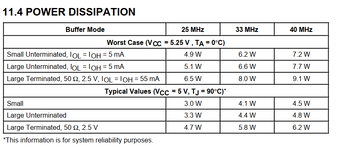
Here's motorola's specs from 1993 (and onwards; unclear what mask this applies to). It can be seen power consumption of the L88M mask is somewhat improved but still a far cry from "runs cool to the touch" :)

1747234523460.png

On the topic of QFP CPUs: Almost no documentation exists around these QFP chips, not even a pinout of the full 040 parts. Even the LC and V-suffix CPUs don't have any thermal specifications ("TBD" is the best you'll get).

I did find this interesting nugget in a SBC datasheet using a 68EC040FE (QFP) chip. This would have been around the time when the first ones were being qualified.

1747234882580.png
 
Very interesting.

Power consumption was stable with a max variance of about 30ma - not really worth mentioning.

This is consistent with the assertion that old school desktop Macs didn't reduce reduce power consumption on idle (in contrast to Portable / PowerBooks).

Here's motorola's specs from 1993 (and onwards; unclear what mask this applies to).

Did you measure the temperature of the chip? I guess if we pretend that temperature was somewhere in the middle of 0C and 90C, then 5.85W @ 40 MHz would be the approximate specified power consumption. Thus, your measurement of 3.5 W @ 40 MHz would indeed be a significant improvement.

Out of curiosity, are you able to measure the total power consumption of the Q605 during these tests? It would be interesting to know if the CPU hammering the other chips significantly alters total power consumption.
 
Very interesting.


This is consistent with the assertion that old school desktop Macs didn't reduce reduce power consumption on idle (in contrast to Portable / PowerBooks).


Did you measure the temperature of the chip? I guess if we pretend that temperature was somewhere in the middle of 0C and 90C, then 5.85W @ 40 MHz would be the approximate specified power consumption. Thus, your measurement of 3.5 W @ 40 MHz would indeed be a significant improvement.

Out of curiosity, are you able to measure the total power consumption of the Q605 during these tests? It would be interesting to know if the CPU hammering the other chips significantly alters total power consumption.

No, I didn't measure the temperature - my testbed has a heatsink-fan attached to the chip so makes it difficult. Temperature is a function of the thermal conductivity of the die to the case (constant) and then from case to ambient air (modified by airflow, heatsink, thermal material), so for PGA it's very easy to estimate temperature (and distance to maximum permissible temperature) given a known power draw. Motorola has a very thorough treatment of the thermal characteristics of the PGAs. the QFPs don't have that same data, unfortunately, but it's possible to make some educated guesses based on contemporary motorola chips which used similar packaging.

Note that from the data above the "Small" line under typical values represents the expected power consumption. It's probably for the E42/31 mask chips, if i had to guess, rather than the earliest masks that were notable hogs. Note they're specifying TJ (junction temperature) as 90 there rather than ambient=0 as used on the worst case scenario.

I could measure the system power consumption with a kill-a-watt at some point. I'd expect the increased clock to result in somewhat higher power consumption though I doubt it's enough to be a concern.
 
I’m adding some of my non-scientific findings to this thread.

I have tested various PowerBook 500 Series CPU cards upgraded to full 040s, including E31F, E42K and L88M revisions. I’ve run them under load without heatsinks, at 40MHz, whilst pointing an IR thermometer at them. They pretty much all get up to the same temperature under load, which is in the region of 65-75C.

The major difference I can see is that an E31F needs a heatsink not to crash whilst the newer revisions can tolerate the heat.
 
I’m adding some of my non-scientific findings to this thread.

I have tested various PowerBook 500 Series CPU cards upgraded to full 040s, including E31F, E42K and L88M revisions. I’ve run them under load without heatsinks, at 40MHz, whilst pointing an IR thermometer at them. They pretty much all get up to the same temperature under load, which is in the region of 65-75C.

The major difference I can see is that an E31F needs a heatsink not to crash whilst the newer revisions can tolerate the heat.
You definitely should be using a heatsink or something with those. With a surface temperature of 70 degrees that means it probably has exceeded the maximum tolerable junction temperature internally.

Due to the lack of data for the 68040 QFP, I've been using the thermal resistances from MC68340 as the ceramic QFP package is contemporary with the 040 and visually appears to be the same construction.

1747836690972.png

junction to case gives the resistance from die to the ceramic, and junction to ambient is resistance from die to ambient air.

These QFPs don't have a lot of thermal mass and worse thermal dissipation characteristics; PGA tested around 23 C/w without a heatsink, per motorola, where we can see a similar QFP is 33 C/w. The resistance decreases massively with a heatsink added which is how this can work at all; there's a nice treatment of the thermal characteristics in both the 68040 and 68030 datasheets. It has a nice analysis of required airflow vs ambient temps vs power to keep the junction below the maximum tolerable temperature.

The tolerable ambient temperature is roughly given by tjMax (110) - powerWatts * thermal resistance C/w.

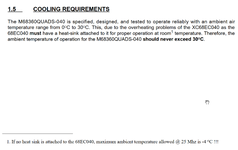
For no heatsink at 3.5 watts, I come up with a max ambient temperature of -6 degrees C! This does roughly agree with the statement I found on the 68360QUADS datasheet; 68EC040 is specified at a maximum of 3.9 watts and typical of 2.4 watts.

1747836917697.png
 
I’m adding some of my non-scientific findings to this thread.

I have tested various PowerBook 500 Series CPU cards upgraded to full 040s, including E31F, E42K and L88M revisions. I’ve run them under load without heatsinks, at 40MHz, whilst pointing an IR thermometer at them. They pretty much all get up to the same temperature under load, which is in the region of 65-75C.

The major difference I can see is that an E31F needs a heatsink not to crash whilst the newer revisions can tolerate the heat.

The 500s have that plate that covers the cpu which acts as a heat sink right?
 
Back
Top