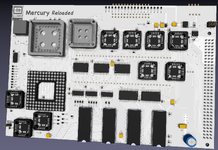
Now we're talking! Nice work figuring a possibility for grafting a new front end onto Performer. Is that SRAM cache or DRAM stretched across the bottom of your Mercury modeling?
Thanks!
Its dimensions fully comply with the constraints stated in the 'Physical Design Guide for Macintosh SE Cards' chapter of Designing Cards and Drivers (Inside Macintosh Library). It should fit nicely on any of the early Macs. It's not just a front-end; it's a full project that is almost ready for generating Gerber files.
As for the board, those are EDO RAM ICs (16-bit x 1024 bits), though I could eventually swap them for a single 72-pin SIMM socket to support a 16MB SIMM of the same chip. Although SRAM would reduce the PLD chip count, I haven't found anything suitable in 16-bit with the right density.
There are some big questions I need to answer regarding the extended RAM and Virtual before making a PCB run.
For instance, I haven’t been able to find anything about the accelerator profile parameters stored within the software.
It clearly uses some sort of memory layout table based on the 68030 brand/model.
It seems very logical that boards like the Gemini Ultra and the Vandal locate all the fast RAM space contiguously in a single block starting at a predefined address above the first 16MB block; this starting point might vary depending on the model chosen during installation.
Also, do some accelerator models enable the system RAM and the fast RAM at the same time?
If so, the application must have a profile table where this mapping is reflected. This would confirm that it could effectively configure the MMU while handling physically discontiguous RAM regions.
I’ve been monkeying around with ResEdit and AI assistance to locate those configuration tables inside the code, but with no luck so far. (It's not my
forté)
I just want some assurance that the utility is smart enough to discover this 4MB extended RAM block and merge it with the 4MB of fast RAM located in the early Mac memory map (i.e., by writing the MMU parameters accordingly).
Even after 30 years, I still get the impression that this program is some sort of dark magic.
Does any one of the software guys here have gone down that rabbit hole and have something to share about the inner workings of this software?