Greetings,
Almost a month ago @John Tucker revealed he had an ANS booting Mac OS, somehow a rumor came true.
With the help of some folks at Tinker Different, 4 ROM were finally dumped and released by @joevt on his GitHub along some precious analysis.
The ROM we are looking for in order to boot Mac OS is version 2.0. Only one thing remains: building a DIMM to get others ANS to boot Mac OS.
Here is how I did mine.
I started looking at my ANS ROM DIMM. I noticed it was similar to other PowerMac ROM DIMM, confirmed by some research by @stynx @Jockelill and @dougg3 on this thread.
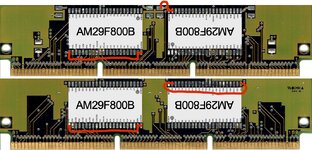
But something wasn't right on ANS DIMM (up) when I compared it to a spare DIMM from a PM7100 (down), can you spot the problem?
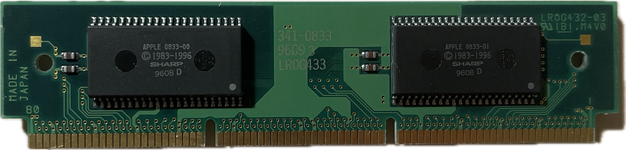
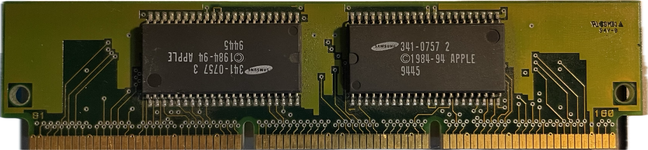
Congrats if you find it, it's quite unusual: one side of my ANS DIMM have upside-down ROM chips. The first pin is on the top right corner instead of the top left one, the PCB design is not reusable since binding the pins of a normal chip the other way to mount it reversed will certainly break them.
But after a quick check nothing seem different from an electrical standpoint, the PM7100 looked like a strong candidate for a PCB donor.
One small problem remains: finding a compatible SOP-44, 8Mb EEPROM, well turns out a quick search with those keywords lead to a flash reference with a compatible pinout from AMD: AM29F800B.
While this chip is EOL, I found few NOS on eBay. While I was waiting for the flash to be delivered I de-soldered the ROM from the PM7100 and started to dump their content.
This step was only necessary so I can verify how the ROM should be split between each ROM chip.
The ROM if made from 8 bytes words, splitted like this.
The word 0x49B2BE8F0000002A will be splitted as it follow:
I wrote a quite inefficient php script to slice ROM in 4 parts:
Then the flash arrived I flashed them with my TL-866+ and an adapter for SOP-44.
Then I soldered the 4 chip on the PM7100 DIMM PCB.
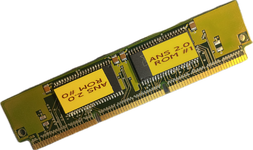
My first boot attempt failed because I forgot to wire some signals on the flash chips.
Indeed, original ROM are read only by nature, but flash must be set in read mode, pins WE# and RESET# must be tied to Vcc in order to do so. But on the DIMM PCB those pins are N/C! Nothing that some wiring can't fix.
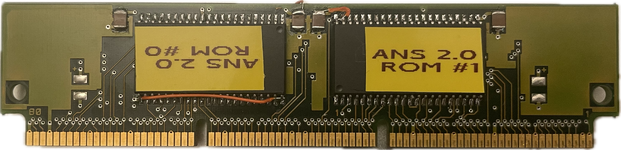
After that the ANS booted!
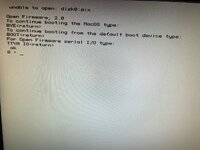
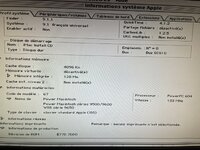
The ANS identifies it self as a Power Mac 9500/9600 Work Group Server and booted a Mac OS 9 install CD without any modifications.
As confirmed, video and internal SCSI works fine.
Since years I've relied on the work of many contributors to fix or improve all my old Macs, I'm now glad I could share to the community this humble participation.
You will find scans and chip layout attached below.
Special thanks to @Dandu who shared the story on his blog!
Almost a month ago @John Tucker revealed he had an ANS booting Mac OS, somehow a rumor came true.
With the help of some folks at Tinker Different, 4 ROM were finally dumped and released by @joevt on his GitHub along some precious analysis.
The ROM we are looking for in order to boot Mac OS is version 2.0. Only one thing remains: building a DIMM to get others ANS to boot Mac OS.
Here is how I did mine.
I started looking at my ANS ROM DIMM. I noticed it was similar to other PowerMac ROM DIMM, confirmed by some research by @stynx @Jockelill and @dougg3 on this thread.
But something wasn't right on ANS DIMM (up) when I compared it to a spare DIMM from a PM7100 (down), can you spot the problem?
Congrats if you find it, it's quite unusual: one side of my ANS DIMM have upside-down ROM chips. The first pin is on the top right corner instead of the top left one, the PCB design is not reusable since binding the pins of a normal chip the other way to mount it reversed will certainly break them.
But after a quick check nothing seem different from an electrical standpoint, the PM7100 looked like a strong candidate for a PCB donor.
One small problem remains: finding a compatible SOP-44, 8Mb EEPROM, well turns out a quick search with those keywords lead to a flash reference with a compatible pinout from AMD: AM29F800B.
While this chip is EOL, I found few NOS on eBay. While I was waiting for the flash to be delivered I de-soldered the ROM from the PM7100 and started to dump their content.
This step was only necessary so I can verify how the ROM should be split between each ROM chip.
The ROM if made from 8 bytes words, splitted like this.
| ROM-0 | ROM-1 | ROM-2 | ROM-3 |
| Byte 1, Byte 0 | Byte 3, Byte 2 | Byte 5, Byte 4 | Byte 7, Byte 6 |
The word 0x49B2BE8F0000002A will be splitted as it follow:
| ROM-0 | ROM-1 | ROM-2 | ROM-3 |
| 0xB249 | 0x8FBE | 0x0000 | 0x2A00 |
I wrote a quite inefficient php script to slice ROM in 4 parts:
PHP:
<?php

const WORD_LENGTH = 8;
const ROM_CHIPS = 4;

$pathToRom = $argv[1];
$romFile = fopen($pathToRom, 'rb');

if (!$romFile) {
    echo "Can't open ROM file \"$romFile\"\n";
    die(-1);
}

$romChips = [];

while ($word = fread($romFile, WORD_LENGTH)) {
    $word = str_split($word);

    for ($i = 0; $i < ROM_CHIPS; $i++) {
        $romChips[$i][] = $word[$i*2+1];
        $romChips[$i][] = $word[$i*2];
    }
};

fclose($romFile);

for ($i = 0; $i < ROM_CHIPS; $i++) {
    file_put_contents('ROM_'.$i.'.bin', $romChips[$i]);
}
Then the flash arrived I flashed them with my TL-866+ and an adapter for SOP-44.
Then I soldered the 4 chip on the PM7100 DIMM PCB.
My first boot attempt failed because I forgot to wire some signals on the flash chips.
Indeed, original ROM are read only by nature, but flash must be set in read mode, pins WE# and RESET# must be tied to Vcc in order to do so. But on the DIMM PCB those pins are N/C! Nothing that some wiring can't fix.
After that the ANS booted!
The ANS identifies it self as a Power Mac 9500/9600 Work Group Server and booted a Mac OS 9 install CD without any modifications.
As confirmed, video and internal SCSI works fine.
Since years I've relied on the work of many contributors to fix or improve all my old Macs, I'm now glad I could share to the community this humble participation.
You will find scans and chip layout attached below.
Special thanks to @Dandu who shared the story on his blog!