What exactly do you mean by "synchronous", here? The term refers to communication where both ends are working from the same clock signal. In traditional serial signalling, this is achieved by continuously sending ASCII SYN ("synchronous idle") characters when nothing else is being sent, so that once the receiver has figured out the timing it doesn't have to worry about losing it again. None of that applies to LocalTalk's modified HDLC format, which as far as I'm aware is always asynchronous (the clock timing of every newly received message is independent of any others received previously).
The clock is one of the differences between syn and async communication, but there is also the max length of one package.
Async, most known as RS232 on PC, only supports on single character + optional 9th bit (mostly parity).
Sync comm. has a much larger package size, I think on AppleTalk one DDP is 599 bytes max !
So AppleTalk is async comm. with SDLC& FM0 and that's why they used the more expensive SCC on old Mac.
FTDI chips nor almost all microcontrollers internal UART (PIC, ATMEL, ...) don't support this.
So then you need to emulate it by bit banging an IO port (aka TaskTalk) what limits the max speed (TaskTalk can reach max 230k) .
I have worked with the 68360 controller in the nineties, this CPU has 4 SCC build-in supporting AppleTalk and an 32 bit 68k.
It's propose was as communication bridge like ISDN, printer buffer, ethernet ...
By chance I still have some of those chips and development boards and would like to build an AppleTalk switch/bridge,
where every Mac has a direct line to this 68360 and clock speed can be optimized for every Mac also.
I'm very new to the Mac, so I first want to have a working network with all different old Mac so I can study the protocol.








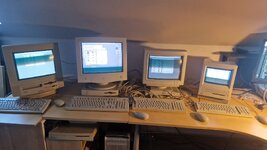
 Clear picture, no strange noises from HD nor fan.