• Hello MLAers! We've re-enabled auto-approval for accounts. If you are still waiting on account approval, please check this thread for more information.

Fixing a Tired Eject Motor for a Vintage Mac Floppy Drive

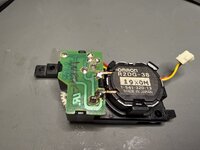
Eject motors getting weak over time has been a thing with vintage Macs since... well, since they weren't vintage. I've accumulated a small graveyard of them and finally decided to crack one open and see what was going on.

First step: getting in:
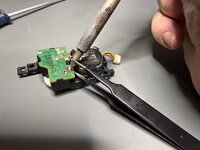
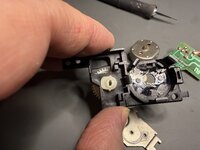
You have to desolder the tabs (or wires) that connect the PCB to the motor. Once that’s free, pop off the bottom cover, pull the gears, remove the motor and, on some models, the board too. You'll know if you have to do that. Be gentle, those plastic tabs are brittle. (Guess how I know.)

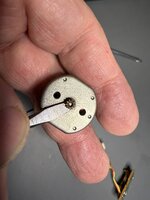
With the motor out, pry open the two metal tabs holding the case closed. After that, use a small screwdriver and work your way around the gear, prying and rotating until it finally gives up. Then the motor will separate.

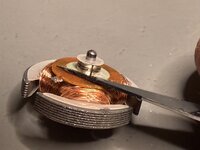
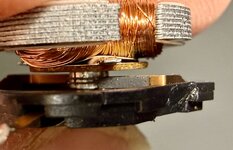
And here’s where the culprit showed itself: the armature and brushes were covered in a hard, black contamination that killed electrical contact. It was stubborn enough that I had to carefully scrape it off with a fresh X-Acto blade. Go slow, don’t bend the contacts, and don’t rush, this part is delicate!

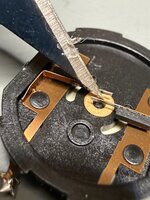
Once cleaned, Reassemble the armature into the end cap first, easing the brushes out of the way as you thread the shaft through. Hold the armature steady, reinstall the stator/cap (magent side), and bend the tabs back down. A drop of DeoxIT inside the motor isn’t a bad idea, either.

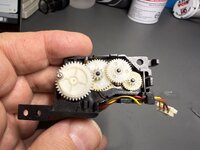
A tip for reattaching the board if you have to remove it: Make sure the pin on the large eject gear is pointing inward so it doesn’t hit the board contacts during assembly. Rotate it outward afterward, reinstall the gears, and, since you’re already in there, swap the small gear with a new one. You can order them from the usual places. They are pretty inexpensive. A little white lithium grease helps, too.

Last step: re-solder the tabs and fire it up.

Vintage Mac motor resurrection complete.

(See attached images in no particular order)
 

Attachments

  • IMG_5933.jpeg
    IMG_5933.jpeg
    2 MB · Views: 23
  • IMG_5896.jpeg
    IMG_5896.jpeg
    1.2 MB · Views: 23
  • IMG_5907.jpeg
    IMG_5907.jpeg
    1.4 MB · Views: 23
  • IMG_5913.jpeg
    IMG_5913.jpeg
    1 MB · Views: 25
  • IMG_5917.jpeg
    IMG_5917.jpeg
    1.2 MB · Views: 26
  • IMG_5929.jpeg
    IMG_5929.jpeg
    2.1 MB · Views: 23
  • IMG_5931.jpeg
    IMG_5931.jpeg
    2.2 MB · Views: 23
  • IMG_5920.jpeg
    IMG_5920.jpeg
    1.5 MB · Views: 24
Awesome info, thank you for posting this! Did it shoot the disk across the room afterward? ;)
Not quite. Though you could probably cross a drive with a nerf gun and have some fun. Probably wouldn't be that good for reading floppies afterward, but it'd get the attention of the user.
 
I did the same procedure on the same model of motor with good results. In my case it was not working at all initially.

The most delicate part in my opinion was the reassembly, specifically and quoting you “easing the brushes out of the way as you thread the shaft through”

I have some tips that helped me:
  • To clean the brushes I used isopropyl alcohol and q tips
  • ensure you don’t bend the brushes too much while spreading them, otherwise they might not maintain electrical contact with the shaft anymore.
  • you can notice two circular holes on the cap (visible on your picture). You can pass two thin rigid wires through them in order to spread the brushes apart while you reassemble the shaft and the cap. I suppose they might be here for this exact reason.
 
Last edited:
As someone who has worked quite a lot with industrial brushed motors, I feel obliged to say that this method of cleaning the commutator is likely to dramatically shorten the life of the brushes, and is liable to be quite a short-lived repair of the commutator itself.

I don't mean to rain on anyone's parade, sorry!

A lathe or a dedicated commutator dressing machine is the correct way, but even spinning the armature in a cordless drill and using a piece of very fine emery to polish the armature would be a better method.
 
In my case, I cleaned the shaft and brushes with isopropyl alcohol and qtip.
It was enough to clean off the black deposits.
In my view the real possible damage is to bend the brushes.
 
Last edited:
I remember as a kid applying a treatment like this to the DC motors in some of my model train locomotives, although I was probably a bit less gentle about scraping off the commutator than OP was. I found there was a temporary benefit but that it didn't last long. I'd be interested to know how well this repair holds up.
 
I agree an x-acto might create micro abrasions.

What happens is that any deviation from perfect roundess of the commutator causes the brushes to bounce, which in turn causes them to arc.

That's why this job is typically done on a lathe.
 
What happens is that any deviation from perfect roundess of the commutator causes the brushes to bounce, which in turn causes them to arc.

That's why this job is typically done on a lathe.
You'd need a jeweler's lathe. If I had one, I'd probably use it. Nowadays since the floppy would be used rarely, it probably does not matter.
 
I did the same procedure on the same model of motor with good results. In my case it was not working at all initially.

The most delicate part in my opinion was the reassembly, specifically and quoting you “easing the brushes out of the way as you thread the shaft through”

I have some tips that helped me:
  • To clean the brushes I used isopropyl alcohol and q tips
  • ensure you don’t bend the brushes too much while spreading them, otherwise they might not maintain electrical contact with the shaft anymore.
  • you can notice two circular holes on the cap (visible on your picture). You can pass two thin rigid wires through them in order to spread the brushes apart while you reassemble the shaft and the cap. I suppose they might be here for this exact reason.
Yeah, I probably should have said it's delicate a few times. Good tips!
 
I also experimented with the realignment of the head motor to solve read / write errors.

See
I've had to realign a few Sony 2Mb drives. I use a floppy formatted in a good drive and adjust the optical stop a fraction of a millimeter at a time until the computer mounts the floppy. I've gotten it right the first try, but more often it takes a while. The other outlier is about an hour.
 
Last edited:
As someone who has worked quite a lot with industrial brushed motors, I feel obliged to say that this method of cleaning the commutator is likely to dramatically shorten the life of the brushes, and is liable to be quite a short-lived repair of the commutator itself.

I don't mean to rain on anyone's parade, sorry!

A lathe or a dedicated commutator dressing machine is the correct way, but even spinning the armature in a cordless drill and using a piece of very fine emery to polish the armature would be a better method.
I agree, though in the motors I've worked on, the black contamination was way to thick and hard to go easy on. Perhaps using a drill or lathe and a micro file after would help extend the lifetime of the motor. On the other hand, they duty cycle of the motor nowadays is so low it probably does not matter. The brushes in them are made out of brass. They won't wear much.
 
I remember as a kid applying a treatment like this to the DC motors in some of my model train locomotives, although I was probably a bit less gentle about scraping off the commutator than OP was. I found there was a temporary benefit but that it didn't last long. I'd be interested to know how well this repair holds up.
It has a much lower duty cycle than a model train would. I think it's a safe bet that this fix won't last forever, but it can be repeated.
 
In my case, I cleaned the shaft and brushes with isopropyl alcohol and qtip.
It was enough to clean off the black deposits.
In my view the real possible damage is to bend the brushes.
Agreed. They are really delicate. I also tried IPA on the shaft. No luck here. I wonder if it was a different lubricant used in your drive? The one in all of mine was hard and tar-like.
 
Back
Top