Found this while browsing some of my old postings:
Ah, here's the text of a message I sent to Mike, which he never used, AFAIK:
=============================================
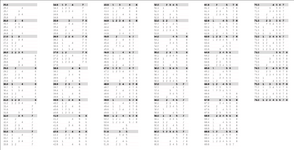
The XLR8 instructions list integer and integer + .6 MHz bus speeds. However, it appears that the Carrier ZIF is settable in .2 MHz increments.
Switches 1 - 4 control the fine speed settings. If you imagine them as the digits of a binary number, with 1 most significant and 4 least significant, you can set any bus speed multiple of .2 MHz from 0 to 3 MHz (15 X .2) + the coarse speed setting.
So for example OFF, OFF, OFF, OFF (all OFF) is 0 X .2 = 0 MHz plus the coarse speed setting (switches 5 - 8).
OFF, ON, OFF, ON (2,4 ON) = 0101 binary = 5 decimal. 5 X .2 = 1.0 MHz plus the coarse speed setting.
ON, OFF, OFF, ON (1,4 ON) = 1001 = 9 => 1.8 MHz + Coarse Setting.
Etc.
The coarse speed settings (switches 5 - 8) seem to be in 3.2 MHz increments.
OFF, ON, OFF, ON (6, 8 on) = 41 0101
OFF, ON, ON, OFF (6, 7 on) = 44.2 0110
OFF, ON, ON, ON (6,7,8 on) = 47.4 0111
ON, OFF, OFF, OFF (5 on) = 50.6 1000
etc.
--------------------------------------------------------------------
That's the gist. The stuff below is examples that drag on for a bit.
In equation form: 25 + 3.2 * (5 - 8) + .2 * (1 - 4) = bus speed;
where (5 - 8) and (1 - 4) are four digit binary numbers represented by the corresponding switches, where a switch set to 'ON' is a 1 and a switch set to 'OFF' is a 0.
So, for example, if you wanted 54.8 you solve the above equation (or read the XLR8 table and adjust your switches up or down a couple of binary values). 54.8 - 25 = 29.8. 29.8 / 3.2 = 9 + a remainder so set switches(5 - 8) to 9. This is 1001 or switches 5 & 8 ON. That's our coarse setting. 25 + 3.2 * 9 = 53.8 so we still have 1 MHz to go. 1 / .2 = 5 so switches (1 - 4) need to be set to 5 or 0101 which is 2 & 4 ON.
So 2, 4, 5, 8 should yield 54.8 MHz. Filling in the equation above just to expand the example we have 25 + 3.2 * (1001) + .2 * (0101) =
25 + 3.2 * (9) + .2 * (5) = 25 + 28.8 + 1 =
54.8.
One could more easily arrive at this conclusion by noting that 54.6 on the XLR8 table is switches 2,5,8. Adding 1 to the value of the fine settings simply means turning switch 4 on, so 2,5,8 => 54.6 and 2,4,5,8 => 54.6 + .2 = 54.8 MHz.
I imagine that speeds below 40 and above 66 are accessible and predictable using this system, though not very useful.
Ah, here's the text of a message I sent to Mike, which he never used, AFAIK:
=============================================
The XLR8 instructions list integer and integer + .6 MHz bus speeds. However, it appears that the Carrier ZIF is settable in .2 MHz increments.
Switches 1 - 4 control the fine speed settings. If you imagine them as the digits of a binary number, with 1 most significant and 4 least significant, you can set any bus speed multiple of .2 MHz from 0 to 3 MHz (15 X .2) + the coarse speed setting.
So for example OFF, OFF, OFF, OFF (all OFF) is 0 X .2 = 0 MHz plus the coarse speed setting (switches 5 - 8).
OFF, ON, OFF, ON (2,4 ON) = 0101 binary = 5 decimal. 5 X .2 = 1.0 MHz plus the coarse speed setting.
ON, OFF, OFF, ON (1,4 ON) = 1001 = 9 => 1.8 MHz + Coarse Setting.
Etc.
The coarse speed settings (switches 5 - 8) seem to be in 3.2 MHz increments.
OFF, ON, OFF, ON (6, 8 on) = 41 0101
OFF, ON, ON, OFF (6, 7 on) = 44.2 0110
OFF, ON, ON, ON (6,7,8 on) = 47.4 0111
ON, OFF, OFF, OFF (5 on) = 50.6 1000
etc.
--------------------------------------------------------------------
That's the gist. The stuff below is examples that drag on for a bit.
In equation form: 25 + 3.2 * (5 - 8) + .2 * (1 - 4) = bus speed;
where (5 - 8) and (1 - 4) are four digit binary numbers represented by the corresponding switches, where a switch set to 'ON' is a 1 and a switch set to 'OFF' is a 0.
So, for example, if you wanted 54.8 you solve the above equation (or read the XLR8 table and adjust your switches up or down a couple of binary values). 54.8 - 25 = 29.8. 29.8 / 3.2 = 9 + a remainder so set switches(5 - 8) to 9. This is 1001 or switches 5 & 8 ON. That's our coarse setting. 25 + 3.2 * 9 = 53.8 so we still have 1 MHz to go. 1 / .2 = 5 so switches (1 - 4) need to be set to 5 or 0101 which is 2 & 4 ON.
So 2, 4, 5, 8 should yield 54.8 MHz. Filling in the equation above just to expand the example we have 25 + 3.2 * (1001) + .2 * (0101) =
25 + 3.2 * (9) + .2 * (5) = 25 + 28.8 + 1 =
54.8.
One could more easily arrive at this conclusion by noting that 54.6 on the XLR8 table is switches 2,5,8. Adding 1 to the value of the fine settings simply means turning switch 4 on, so 2,5,8 => 54.6 and 2,4,5,8 => 54.6 + .2 = 54.8 MHz.
I imagine that speeds below 40 and above 66 are accessible and predictable using this system, though not very useful.