• Hello MLAers! We've re-enabled auto-approval for accounts. If you are still waiting on account approval, please check this thread for more information.

Bicolor LED IIci mod - need a little help. Almost there!

olePigeon

68040
I've nearly got it working, but something's not quite right.

I'm missing something about bicolor LEDs.  I've made a wire harness that I thought would work:
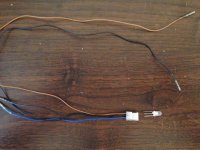
001.JPG

And it almost does.  I bought a Red & Green bicolor LED.  It has 3 pins.  I AltaVistaed online and it said the middle pin is the common anode, then I run the red on one side and the green on the other.  So I put two black wires on the middle pin, and then a brown wire for red and blue wire for green (those were the only colors I had.)

The problem I've run into is that the green is always on, then flashes off with HDD activity.  The red works properly and turns on when I insert a floppy disk.

I want the green to turn on during HDD activity.  Did I wire it wrong?  Or is that how bicolor LEDs work?

 
Last edited by a moderator:
OK, I guess there're differently wired bicolor LEDs.  A green/amber one I got is different.  I had to swap the wiring on the floppy drive, but this one is always on green, but flashes amber for activity.  The green gets brighter when there's floppy activity.  Odd.

What'd I'd like is for it to flash one color for HDD activity, and another color for the floppy activity.

 
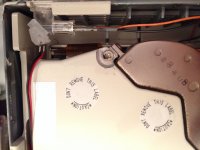
As interesting as the bicolor was, I found a better solution.  I just ran the original LED to the front with the HDD LED.  Works fine.  I just need mount it.

 
OK.  Here's the final product.  A little crazy glue to mount the LED holder to the edge of the HDD LED holder.  Fortunately the floppy LED holder has a long edge and it enters in at almost a 45° angle, so it lines up perfectly with the HDD led holder. :)   Here's a video of it in action.

LED.JPG

 
Since the floppy drive has mounting screw holes on the bottom, it should be easy to make a mounting bracket for the floppy board that just screws directly to the floppy drive.  At the moment I just covered it in kapton tape to keep it from shorting something.

 
Last edited by a moderator:
Oops.  I guess this should be in the hacks.  Posted it in the wrong section.

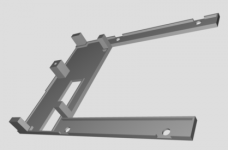
Anyway, here's the bracket I designed.  I'm going to attempt to print it sometime this week.  It screws onto the bottom of the floppy drive, then the board screws into that post (it's the only spot to screw stuff in.)  The opening on the left side is so the strain relief on the IDC cable can dip a bit lower and be flush with the bracket for an extra 1mm of clearance.

floppyb.png

 
Last edited by a moderator:
I have an extra one of these boards actually, so I might be interested in performing this hack on something. Like maybe in my soon-to-be-revitalized IIx, perhaps.

c

 
I did like the bicolor LED route, though.  Just don't know how they work.  Some more Lycosing, and I discovered that some bicolor LEDs have a common anode, and some have a common cathode.  I'm not sure which is which, but I think I have one of each, which is why I got different results with the LEDs when I rewired it.

 
.

I want the green to turn on during HDD activity.  Did I wire it wrong?  Or is that how bicolor LEDs work?
The anode on a diode is the positive terminal and the cathode is the negative terminal. So, assuming your black wires are negative or ground, you had this one wired backwards. I suspect there's a bit more going on as that would not, by itself, explain why the floppy light works properly.

 
Black is negative and the center pin is shared negative, so I run negative to both floppy and HDD from the shared negative pin on the LED.  Then the positive red is wired to the floppy, and the positive green is wired to the hard drive.

The LED works correctly when connected to just the HDD or just the floppy.  Blinks just red correctly when connected to only the floppy, blinks just green correctly when connected to only the HDD.  When I connect both, the light is permanently green and turns off with HDD access, but then blinks red normally with floppy access.

Could the floppy drive be sending power over the negative?  Maybe it's wired differently because it's a floppy drive and not a hard drive?  Can I filter the floppy negative somehow?

It's entirely possible they're not compatible.  This is the LED I believe I'm using:

image001.jpg.7a40836f7233e8da857c50dd478ab212.jpg


Last edited by a moderator:
I've made some progress.  I have two different LEDs, but I can't tell them apart.  I have an amber/green one, and a red/green one.  They look identical. However, one must have a common cathode, and the other must have common anode.  I think the amber/green one has a common cathode, and the red/green has a common anode.  The reason I think this (though, I could have it flipped, hopefully one you can tell me which is which) is that when I wire up the red/green to two hard drives, both the red and green fire simultaneously making it amber colored regardless of which HDD is doing the work.  They essentially share the LED, each using it in turn, and firing both colors simultaneously making it amber colored.  My guess is that the red/green has a common anode because it's sharing the red/green color.

However, when I wired the amber/green LED, it worked perfectly.  One hard drive fired off the amber, the other fired off the green.  So this leads me to believe that the amber/green LED has a common cathode.

I'm still not certain which LED is which because I'm not sure how LEDs work in the first place.

I'd like to know because I want to get a red/green LED working.

 
Last edited by a moderator:
You might need to use the common anode LED or a unit with discrete leads for each emitter (4 pins)

I see two possibilities with what you've described: One is that one or both of the LED circuits is switched on the cathode rather than the anode. The other is that the black wires are not ground, but simply 3.3v potential difference between their respective hot wires. I suggest you pull out a multimeter and measure DC voltage from each pair, then between the two black wires, then between the two hots, then between HDD black, floppy hot, then HDD hot, floppy black. This will help give you a picture of what's going on.

 
I was editing my post when you responded, I put more info in.  I think I figured out the LEDs, but I think you're still right regarding the floppy drive.   My friend suggested that the HDD LED may simply be grounded, while the floppy LED is negative.  So when I connect the floppy LED, it's sending power over the ground to the HDD LED, lighting it up permanently.

 
I think you're on the right track. My diagnostic above may be overly complicated. If you measure a voltage between the two blacks, you probably shouldn't use a 3 pin LED. Diodes, including LEDs only allow current to flow in one direction, so that's why the polarity is important. Also lead length is one identifier of polarity on LEDs. On your LEDs, one lead will be longer or shorter than the other two. The shorter lead(s) are/is negative (cathode), the longer lead(s) are/is positive (anode).

 
Last edited by a moderator:
Unfortunately, these LEDs are either cut wrong or something.  I don't know.  Their leads looks the same.  Middle one is longer than the outer two, but they behave completely different.

In any event, after having the LED wired correctly for two HDDs, I then proceeded to hook up the floppy.  With the correctly wired amber/green LED, the effect is reversed compared to the red/green LED.  The HDD light works properly, but the floppy drive light is on continuously.  The light gets brighter when there's floppy activity.

Compared to the red/green LED with the floppy connected, the HDD LED would be permanently on, then turn off during activity.

So my conclusion is that the floppy drive handles its LEDs differently from HDDs.  I'll need to measure it somehow, it's difficult to get to when the computer is put together.

Assuming the floppy drive is sending power over its negative line and messing up the grounding/polarity of the LED when connected to the HDD, is there a way to filter the power while keeping the negative connected?

 
Last edited by a moderator:
Back
Top