I wonder if it could be a prototype ROM board name, and being such, it was too insignificant to record it? So instead of a whole computer being named Lobos, it was just this ROM simm?
I’m thinking maybe it could be a Quadra ROM?

I wonder if it could be a prototype ROM board name, and being such, it was too insignificant to record it? So instead of a whole computer being named Lobos, it was just this ROM simm?

I was too, timeframe would be right. It would have to be the 950 which was 1992?I’m thinking maybe it could be a Quadra ROM?

I was thinking that too - could also be a 1993 machine, but pre-release, so 610/650/800 or a workgroup server too. Or, it could have been erased, but lets hope not!I was too, timeframe would be right. It would have to be the 950 which was 1992?
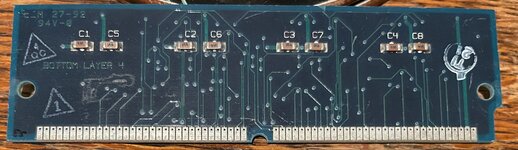
Thanks very much for the extra info - there are capacitors on the back, you can see a low res picture from the seller here: https://www.worthpoint.com/worthopedia/apple-ap1950-01-lobos-simm-board-64-3243494164Fascinating! Here are some things that I notice about the ROM SIMM's pinout based on the picture:
It's very likely that my ROM SIMM programmer (which isn't made by me or bigmessowires anymore) is capable of reading the current contents of this SIMM. Unfortunately, I couldn't make more if I tried right now, due to the global chip shortage. There are several forum members who bought one from me originally. There might be some SIMM programmers floating around in the UK...maybe someone who has one will see this thread. Desoldering the flash chips would work too, but the programmer would make it massively easier.
- It's definitely programmable. The Am28F020 is a 2 megabit flash chip.
- The total capacity of the SIMM (assuming there aren't any chips on the back) is 1 megabyte, which would put it at the size of most Quadra ROMs, and a handful of later 030 machines as well.
- The thick trace running across the top goes to pin 1 on the chips, which is "VPP". You have to put a high voltage on this pin in order to erase/reprogram the chips. I suspect that resistor R1 is pulling it down to ground for normal operation. I wonder if VPP is also brought out to one of the pins on the SIMM connector...
- It kind of looks like they might have picked SIMM pin 13 for this. If you look at pin 13 in the picture, it has a really fat trace matching that thickness that goes directly to a via.
- Chip pin 31 (write enable) which is also needed for erasing/reprogramming is also hooked up on all 4 chips, so I suspect it's brought out to one of the SIMM pins. I'd be curious to know what pin Apple actually officially used for WE. I don't think it matches the pin I picked on my programmable ROM SIMM that became the ROM-inator, because I used SIMM pin 13 (which appears to be VPP on this SIMM). Probably doesn't matter for the purposes of reading out the contents though.
- If I had to guess, I would probably say SIMM pin 3, which is one of the unused address pins. It looks like if you go straight up from pin 3, there's a via near the top of the board, and that trace goes to the WE pin on all the chips. I'll bet on the back of the board there's a trace that goes straight up from pin 3 to that via.
- I checked a few of the data pins and it seems to match the normal Apple ROM SIMM pinout.
I like the idea of trying to boot an SE/30 or II series Mac with it. Some (but not all) of the newer Quadra ROMs are also capable of booting the older II series machines and SE/30. So if you can get it booted, you could read out the contents with CopyRoms or a similar utility.
you can see a low res picture from the seller here: https://www.worthpoint.com/worthopedia/apple-ap1950-01-lobos-simm-board-64-3243494164

I may have missed it... but what counts as "local"?Hopefully I can find someone local with a compatible machine.
I'm down in Kent, so around there really.I may have missed it... but what counts as "local"?
Thanks very much for the extra info - there are capacitors on the back, you can see a low res picture from the seller here: https://www.worthpoint.com/worthopedia/apple-ap1950-01-lobos-simm-board-64-3243494164
I'll post a high res picture of the back either tomorrow or Monday, and hopefully get to checking in the AITV box then.
Well, at least that's UK...I'm down in Kent
 I have a variety of Macs I could pop this in and see what happens if you're interested. I also recently downloaded a variety of ROM dumpers to get the code off my StarMax - which resulted in a working ROM file for SheepShaver... Happy to attempt a download as well if you want.
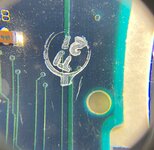
It looks like this through a loupe if it helps clear things up:Awesome picture! Thanks for sharing. Unfortunately, that stamp on the right is covering up some of the vias and traces I'm trying to look at. Nevertheless, I'm pretty darn sure that SIMM pin 2 = VPP and pin 3 = WE. I was wrong about pin 13 -- it's going to one of the inner layers, likely +5V.
Looks like C5, C6, C7, and C8 are for VPP, and C1, C2, C3, and C4 are likely for +5V.
I haven't checked every trace, but it looks to be the same 64-pin ROM SIMM pinout used by everything from the SE/30 onward.
Thanks!Well, at least that's UK...


It’s been over a year… what did it end up being a ROM for?
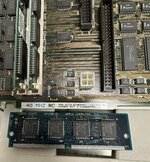

It does, however I doubt there's any difference. I just checked and there is a 33mhz CPU installed and the oscillator was changed. I have it currently disassembled awaiting a 40mhz CPU. Once I get it I will try to dump the ROM.@switch998
I... would love a copy of a 40MHz Wombat ROM. The stock ones do 40MHz, but the RAM timings are marginal...
Does the machine boot?