• Hello MLAers! We've re-enabled auto-approval for accounts. If you are still waiting on account approval, please check this thread for more information.

What's inside an original [10100] Cayman Gatorbox?

pl212

6502
Unlike the newer model in @cheesestraws' thread, this earlier 1990 device holds a few modular surprises. Let's start off with a glamour shot:
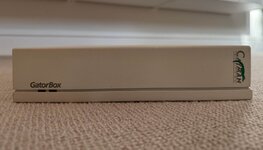
IMG_1260.jpeg

However, Strong Admonitions™ in the user manual warn against use in this orientation, despite how tempting it is for use in a rack.

Luckily mine came with the original stand:
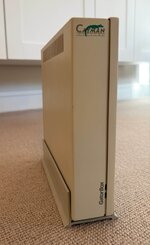
IMG_1261.jpeg

Viewed from the back, we get a glimpse of some separation between LocalTalk/Serial and Ethernet:
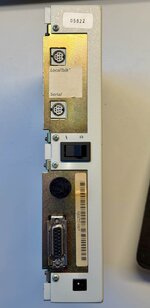
IMG_1254.jpeg
(The round plastic thing is a cap over the coaxial Ethernet jack.)

Opening it up, we find two prominent daughterboards obscuring our view of the motherboard:
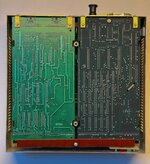
IMG_1252.jpeg

(I'm... not quite sure what the retaining device at the bottom is... perhaps fiberglass?)

Removing that odd brown bar gives us a peek at the motherboard beneath:
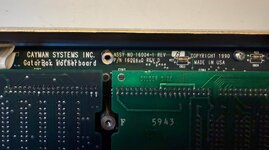
IMG_1253.jpeg

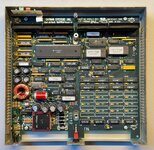
Let's remove the two smaller boards — we'll come back to them! — and see what's underneath:
IMG_1255.jpeg

(Inserted learned conversation about insights revealed, etc). I do note some bodge wires at the top left, and a traditional fuse at the bottom center.

Also notice that unpopulated RAM chip area... 🧐

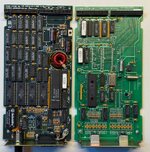
Let's take a look at the two boards -- Ethernet on the left, and Serial/LocalTalk on the right:

IMG_1256.jpeg

Interestingly, the manual details that Thin Ethernet is the default, unless the AUI option is selected in software. The modularity suggests there could have been a twisted-pair board, but even a later (1991) manual tells you to use a (Cayman-branded) thick-to-RJ45 adapter.

Another possibility is that earlier revisions shipped with DB-9 serial ports for LocalTalk, and when the SE/II shipped, they could update to this mini-DIN 8 board?

I believe this first model requires software to be loaded from a TFTP or proprietary Mac server upon every boot, so that'll be my next step towards getting this working...
 
Last edited:

Oh, interesting. Thankyou for the photos!

However, Strong Admonitions™ in the user manual warn against use in this orientation, despite how tempting it is for use in a rack.

Does it say why? Were they worried about thermals or something?

two prominent daughterboards

I wonder if this was actually to have interface swappability or just to save space? All the circuitry for each interface is on the daughterboard (the Ethernet controller is on the Ethernet board with a bunch of presumably packet RAM, and the SCC is on the serial board), it could have been a bet-hedge - perhaps they thought they might need to build a token ring card or something? But again, given how packed the motherboard is, maybe it's just "well, we have to have it on two boards, might as well separate ethernet and localtalk" or something. Interesting!

Let's remove the two smaller boards — we'll come back to them! — and see what's underneath:

Obligatory: please tell me you took that battery out...

One thing that's mildly interesting here compared to the later one I have is the way they're handling power. In the later machine, there's a mains PSU in the unit itself, at the bottom, and it generates all the rails. Here, it looks like you've got an external voltage brick generating a single voltage and then it's got some kind of DC/DC converter in there to generate the other rail(s?) it needs, given the presence of the TL594. If the power stuff and the unpopulated RAM footprints here were removed, there might be nearly enough space to have done the interfaces integrated into the one board.

The other thing that having the integrated PSU does for the newer gatorbox is makes it actually impossible to run it on its side, rather than merely being told not to - one has to wonder whether that came into the design considerations, if people kept running this one on its side after being told not to and they kept overheating or something.

Ethernet on the left

I love the comically oversized footprint for CE7 (?) at the top right there.

Serial/LocalTalk on the right:

Once again, those huge capacitor footprints tickle me. I wonder what the unpopulated components here were intended to do.

It's also interesting that this board really demonstrates that once you've got an SCC to drive your LocalTalk port, having a second serial port is basically free, in hardware terms, so it's almost rude not to. Only the drivers/receivers and filter networks are per-port.

I believe this first model requires software to be loaded from a TFTP or proprietary Mac server upon every boot, so that'll be my next step towards getting this working...

Pretty sure all the software to do this is on the Garden; mine doesn't require that, but I am fairly sure it's the same software that does the TFTP gubbins too.
 
maybe CE7 was meant to be a fat component except in this particular variation of the board it wasn't required yet however to avoid a dead circuit they had to use something else(small) to keep the circuit working?
(and beside note how CB02 and CB03 on the serial/localtalk board itself are very different footprints too)
 
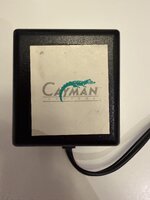
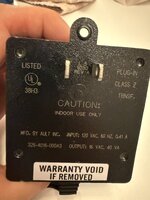
Let’s try to document the original AC adaptor as it’s a bit weird. The GatorBox requires a Class 2 transformer that can deliver 16 volts of AC power at 40 watts.

Don‘t ask me what I paid for this adapter, or more probably, what I paid for the “Cayman” label on it…
IMG_1302.jpeg

IMG_1304.jpeg

I measured the AC output as 18.5 volts, which seems within spec given the no-load conditions of the test. Anyone want to place bets if it will work or explode when I plug it in?
 
Obligatory: please tell me you took that battery out...

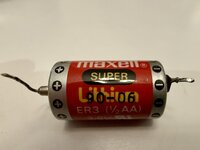
Let’s desolder that guy and see what we’re dealing with:

IMG_1311.jpeg

The motherboard has two sets of holes for mounting, so you have some flexibility for replacement. Oddly the Maxell I found had a kind of solder tab on the negative post and an axial on the positive, which was then bent 90°. I’ll replace it with a standard through-hole design.
 
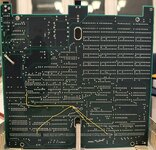
One more thing: releasing the motherboard to desolder the old battery revealed more epic bodge wires:

IMG_1308.jpeg
 
Let’s try to document the original AC adaptor as it’s a bit weird. The GatorBox requires a Class 2 transformer that can deliver 16 volts of AC power at 40 watts.

Quite a lot of things from that period seem to use AC wall supplies then do rectification "in-house" as it were: you can see a fairly chunky bridge rectifier on your first board pic at the bottom just left of the middle (D01 - D04). I've always assumed this was due to space and it being harder to make decent snall DC PSUs back in the day, but I don't know that.

I measured the AC output as 18.5 volts, which seems within spec given the no-load conditions of the test. Anyone want to place bets if it will work or explode when I plug it in?

There's not a huge amount to go wrong with unregulated AC supplies, it's probably really just a transformer in there. My bet is that if it hasn't blown up yet, it won't blow up.
 
(I'm... not quite sure what the retaining device at the bottom is... perhaps fiberglass?)
That looks to me like Paxolin. Based on the fact this is from the 1990s I think the chance of it containing Asbestos is low, however had it been older there is a slight risk. We have equipment where I work from the 80s which uses the asbestos-containing variant so have to be quite careful around it.
 
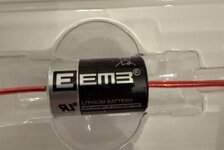
So I had this replacement 3.6v cell ready to go:

IMG_1374.jpeg

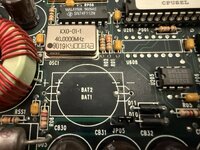
...when I thought, hmm — the GatorBox’s circuit board looks like it was designed to accommodate a coin cell:

IMG_1373.jpeg

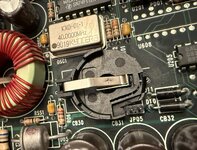
Although a little trim is required on the plastic holder to accommodate JP05, it does indeed fit:


IMG_1377.jpeg

I think this’ll result in 37% fewer battery explosions. (Running without a battery is, I think, not possible as the device needs to remember where to download the operating system upon boot).
 
Back
Top