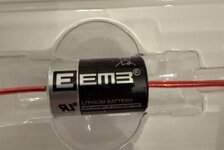
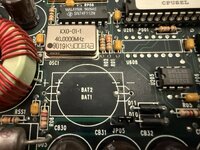
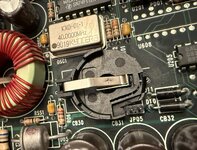
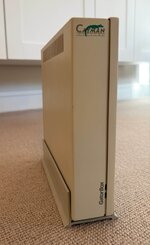
Unlike the newer model in @cheesestraws' thread, this earlier 1990 device holds a few modular surprises. Let's start off with a glamour shot:
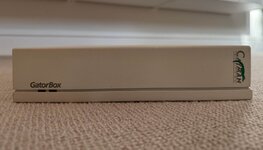
However, Strong Admonitions™ in the user manual warn against use in this orientation, despite how tempting it is for use in a rack.
Luckily mine came with the original stand:
Viewed from the back, we get a glimpse of some separation between LocalTalk/Serial and Ethernet:
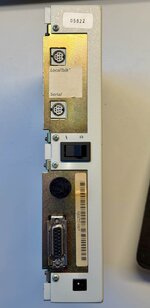
(The round plastic thing is a cap over the coaxial Ethernet jack.)
Opening it up, we find two prominent daughterboards obscuring our view of the motherboard:
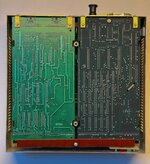
(I'm... not quite sure what the retaining device at the bottom is... perhaps fiberglass?)
Removing that odd brown bar gives us a peek at the motherboard beneath:
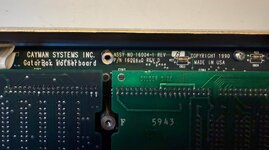
Let's remove the two smaller boards — we'll come back to them! — and see what's underneath:
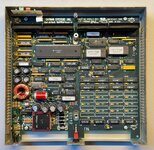
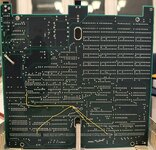
(Inserted learned conversation about insights revealed, etc). I do note some bodge wires at the top left, and a traditional fuse at the bottom center.
Also notice that unpopulated RAM chip area...
Let's take a look at the two boards -- Ethernet on the left, and Serial/LocalTalk on the right:
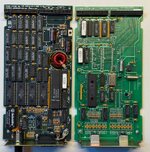
Interestingly, the manual details that Thin Ethernet is the default, unless the AUI option is selected in software. The modularity suggests there could have been a twisted-pair board, but even a later (1991) manual tells you to use a (Cayman-branded) thick-to-RJ45 adapter.
Another possibility is that earlier revisions shipped with DB-9 serial ports for LocalTalk, and when the SE/II shipped, they could update to this mini-DIN 8 board?
I believe this first model requires software to be loaded from a TFTP or proprietary Mac server upon every boot, so that'll be my next step towards getting this working...
However, Strong Admonitions™ in the user manual warn against use in this orientation, despite how tempting it is for use in a rack.
Luckily mine came with the original stand:
Viewed from the back, we get a glimpse of some separation between LocalTalk/Serial and Ethernet:
(The round plastic thing is a cap over the coaxial Ethernet jack.)
Opening it up, we find two prominent daughterboards obscuring our view of the motherboard:
(I'm... not quite sure what the retaining device at the bottom is... perhaps fiberglass?)
Removing that odd brown bar gives us a peek at the motherboard beneath:
Let's remove the two smaller boards — we'll come back to them! — and see what's underneath:
(Inserted learned conversation about insights revealed, etc). I do note some bodge wires at the top left, and a traditional fuse at the bottom center.
Also notice that unpopulated RAM chip area...
Let's take a look at the two boards -- Ethernet on the left, and Serial/LocalTalk on the right:
Interestingly, the manual details that Thin Ethernet is the default, unless the AUI option is selected in software. The modularity suggests there could have been a twisted-pair board, but even a later (1991) manual tells you to use a (Cayman-branded) thick-to-RJ45 adapter.
Another possibility is that earlier revisions shipped with DB-9 serial ports for LocalTalk, and when the SE/II shipped, they could update to this mini-DIN 8 board?
I believe this first model requires software to be loaded from a TFTP or proprietary Mac server upon every boot, so that'll be my next step towards getting this working...
Last edited: