I did! but apparently that trace was inserted while I was preparing the board for production? I have no idea how, I can't draw it again! This time to be sure I printed out the gerber file 


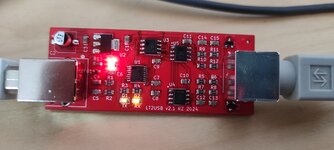

Ooo... nice & congrats! Will they be going in sale somewhere/time?New boards arrived ... they work very well!


Cool, congratulations! I'm looking forward to having another TashTalk product out there.New boards arrived this week and I'm Happy to report they work very well!
Yes! My plan is to produce some and sale them. The project is also on git so people can build their own if they want. I will look into having these built and the costs, now I soldered the ICs by hand but it takes a bit and it is a quite fiddly to test them.Ooo... nice & congrats! Will they be going in sale somewhere/time?
I remember this too, but I can't find it now... hrm.there was also a transceiver + transformer in a package IIRC mentioned in previous thread
No rush!Time for me is quite limited now, but I can have a look in a couple weeks.
bompAlright, where's the GitHub link or order form?
Comments are welcome and keep in mind this is just the first draft
Your read is correct: the CTS pin is a flow control output used to signal the other end of the connection whether or not it should hold off sending data to TashTalk, and if it isn't respected, TashTalk is virtually guaranteed to get into a bad state.by wiring the tashtalk's CTS to the FT230X's RTS, you're wiring two outputs together and nothing sensible will get done with the CTS signal, probably leading to buffer overflows.
I'm realizing that I likely helped to confuse this issue by labelling Tx and Rx on the TashTalk pinout as though it were a DTE (Tx as an output, Rx as an input) but labelling CTS as though it were a DCE (as an output). Sorry for that!
This is true. Still, maybe I ought to rebrand it to "flow control output" or something more generic, if for no other reason than "RTS" and "CTS" are also used by LocalTalk to refer to control frames, further muddying the waters...Well, while tashtalk pin labelling is perhaps non-optimal, it's just a drop in the sea of awful terminological decisions related to UARTs, so I don't think you need to be too apologetic...
Still, maybe I ought to rebrand it to "flow control output" or something more generic
0 = both feet on accelerator"I THIRST FOR BYTES", active-low? :-D