• Hello MLAers! We've re-enabled auto-approval for accounts. If you are still waiting on account approval, please check this thread for more information.

Trying to identify some old RAM...

I recently (well, last year :) ) acquired a bag full of old SIMMs, DIMMs and the like... I am slowly going thru them and trying to identify them based on number of pins, speed in ns, and size, if I can figure that part out, too.

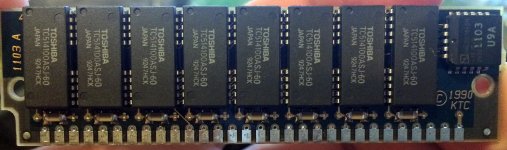
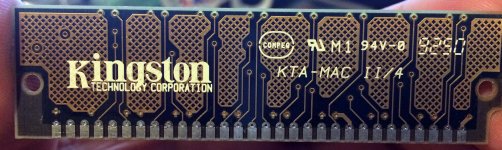
Usually, Kingston RAM is pretty easy to identify, but this little bugger eludes me. I THINK it's a 4mb 60ns 30-pin SIMM, but I'd like to be sure. Anybody have any ideas?
IMG_1281.JPG

IMG_1282.JPG

 
The TC514100 is a 4,194,304 word x 1-bit chip. (So it's a 4-megabit chip). Eight of them make 4 megabytes. The 60 at the end of the part number almost certainly indicates 60 ns. Looks like you're correct!

The chip in the upper-right corner is likely a PAL, probably to patch the problem that can cause 4 Mb and larger chips to go into test mode in the II and IIx (see near the end of this technote).

 
Thanks! I just found another one a few minutes ago. Yes, the small chip does say "PALCE 16V8H"

Does that mean these modules will only work in the II and IIx?

 
No prob! Based on my understanding, they should work in anything newer too. The PAL just ensures that a II and IIx will be able to use it safely. I doubt it would harm usage in newer machines, unless they explicitly wanted to put the RAM in test mode. I guess I don't know for sure, but I bet it'll be fine.

 
The part number KTA-MAC II/4 seems to further confirm this is a Mac II/IIx 4MB PAL SIMM.

I tried a set of four 4MB PAL 30-pin SIMMs from a Mac II in a couple PCs years and years ago.  The 386 PC recognized all 16MB and booted.  The 486 PC hung up during the POST.  I was puzzled at the time that the newer system didn't like the RAM.  I ended up finding some 8 chip 30-pin SIMMs without the PAL chip to discover the Mac didn't like those, but both 386 and 486 did.  My expectation is that your mileage may vary trying them in other systems.  They are probably somewhat less compatible than other 8 chip 4MB 30 pin SIMMs.  They are also probably somewhat more valuable than other 4MB 30-pin SIMMs.

The technote dougg3 links to states: "Consolation for SIMM manufacturers: SIMMs constructed with an on-board PAL are not necessarily Macintosh II-specific. SIMMs constructed in this manner should work without modification in any usage calling for 4 MB SIMMs (except in the unlikely event that the new test mode is required)."

 
After sorting all the SIMMs, it looks like I have 8 of the KTA-MAC II/4's. :)  32MB for a future II/IIx acquisition... or maybe I'll sell 'em. We'll see.

64-pin SIMMs

  • Found (6) 64-pin IIfx 80ns SIMMs. A quick search shows they're 1MB Hitachi SIMMs.
  • Then there are (4) SIMMs that have no brand name... the chips have a stylized "MT" logo and are numbered 4010240J-7. Guessing these are 70ns. Hopefully that means they're bigger than 1MB...
  • Also found (4) branded "KMS" (Kelly Micro Systems?) and the model number looks like KMA-000/FX. They are 80ns. Not sure what size they are. Eight Goldstar GM71C1000J80 chips on each.
  • Finally, there's a Texas Instruments TM024EAG8, but that looks like it might be a 100ns chip, and therefore probably a LaserWriter IINTX upgrade. 

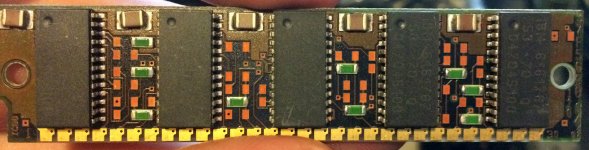
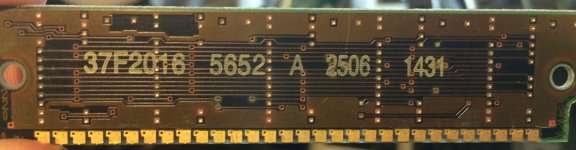
Then I found these colorful little guys. I have no idea what they are, other than being 30-pins.

IMG_1285.JPG

IMG_1286.JPG

 
Where the layout of the board doesn't scream IBM, the FRU on the back does.

That there should be a 256kb SIMM.

 
Last edited by a moderator:
I tried a set of four 4MB PAL 30-pin SIMMs from a Mac II in a couple PCs years and years ago.  The 386 PC recognized all 16MB and booted.  The 486 PC hung up during the POST.
Interesting! Maybe the 486's BIOS was actually trying to put the chips into test mode during the RAM test or something, and the PAL was blocking it...either that or the PAL screwed up the timings or something.

  • Then there are (4) SIMMs that have no brand name... the chips have a stylized "MT" logo and are numbered 4010240J-7. Guessing these are 70ns. Hopefully that means they're bigger than 1MB...
  • Also found (4) branded "KMS" (Kelly Micro Systems?) and the model number looks like KMA-000/FX. They are 80ns. Not sure what size they are. Eight Goldstar GM71C1000J80 chips on each.
  • Finally, there's a Texas Instruments TM024EAG8, but that looks like it might be a 100ns chip, and therefore probably a LaserWriter IINTX upgrade. 
Hmmm...could the number actually be something like MT4C10240J? I can't find very many datasheets for that though. MT4C1024 would be 1Mb chips implying a 1 MB SIMM. However, I'm not sure about the extra 0 at the end. Agreed about how the 7 probably means 70 ns.

GM71C1000 would be a 1Mb chip, so 1 MB SIMMs.

I'm having a harder time with the TI part number, but that might just be because I'm tired :)

 
That page was helpful too... and somewhere along the way, I managed to find a pretty decent Excel spreadsheet of a BUNCH of different RAM modules & their corresponding part #s, brands, and chip layouts. That helped me more than just about anything. 

Tonight I'll be going through the rest, all of which are 72-pin SIMMS and a few miscellaneous ones. There are two very long 84-pin modules that I don't recognize at all. I figure they're also PC memory. Then there are 3 or 4 "Apple 512K/2M" modules. Didn't find much on them either. Also found a couple 256k VRAM modules that I plan on putting in my Q840.

 
On those long modules, are there 84 pins on each side of the stick?  If so, they could be a 168-pin DIMM with FPM, EDO, or SDRAM.  If there are contacts on one side only, it could be some kind of weird SIMM in a DIMM package.

The "Apple 512K/2M" modules are part number 830-0316-01.  These should be a 512KiB 80ns 30-pin SIMM made up of four 2 megabit chips.  It's specified for the Mac IIci, IIvi, and IIvx.  I believe they are also compatible with the II, IIx, IIcx, and IIsi.

 
On those long modules, are there 84 pins on each side of the stick?  If so, they could be a 168-pin DIMM with FPM, EDO, or SDRAM.  If there are contacts on one side only, it could be some kind of weird SIMM in a DIMM package.
Yep, you're right... I only looked at them briefly last night. Flipped one over and there's a "168" on the back side. Chips are SEC brand # KM416C1200AJ-6.

The "Apple 512K/2M" modules are part number 830-0316-01.  These should be a 512KiB 80ns 30-pin SIMM made up of four 2 megabit chips.  It's specified for the Mac IIci, IIvi, and IIvx.  I believe they are also compatible with the II, IIx, IIcx, and IIsi.
Sounds like factory RAM that got upgraded at the first opportunity. :)

 
Yep, you're right... I only looked at them briefly last night. Flipped one over and there's a "168" on the back side. Chips are SEC brand # KM416C1200AJ-6.

These are 5V FPM 1k refresh 60ns DIMMS.  Each chip is 16 megabits, so an eight chip module would be 16MiB, a sixteen chip would be 32MiB.

These are probably a pull from or parts for a PCI Power Mac/Performa (but not a 4400 [3.3v] or TAM [64MB modules only]).  I expect they'd be compatible with your 6400, although some folks seem to prefer EDO ram in the Alchemy systems.  See: http://www.macgurus.com/products/ram/pcipowermacs.php

 
The part number KTA-MAC II/4 seems to further confirm this is a Mac II/IIx 4MB PAL SIMM.

I tried a set of four 4MB PAL 30-pin SIMMs from a Mac II in a couple PCs years and years ago.  The 386 PC recognized all 16MB and booted.  The 486 PC hung up during the POST.  I was puzzled at the time that the newer system didn't like the RAM.  I ended up finding some 8 chip 30-pin SIMMs without the PAL chip to discover the Mac didn't like those, but both 386 and 486 did.  My expectation is that your mileage may vary trying them in other systems.  They are probably somewhat less compatible than other 8 chip 4MB 30 pin SIMMs.  They are also probably somewhat more valuable than other 4MB 30-pin SIMMs.

The technote dougg3 links to states: "Consolation for SIMM manufacturers: SIMMs constructed with an on-board PAL are not necessarily Macintosh II-specific. SIMMs constructed in this manner should work without modification in any usage calling for 4 MB SIMMs (except in the unlikely event that the new test mode is required)."
I think probably because the PAL adds delay which the 386 tolerate but the 486 won't.

 
Back
Top