Troubleshooting GLUE, C32M, and C16M

obsolete

6502
I know this isn't unique to compact Macs because early Mac IIs also used GLUE, but I'm putting it in the Compact Mac subforum because it's related to my SE/30 reloaded build.

My reloaded board isn't working; no bong, no video. In my troubleshooting so far, I've confirmed that the reset circuit works, but I have no C16M, so the processor isn't running. Based on what I've read, the GLUE is supposed to generate C16M from C32M. I've verified that the GLUE has good 5V and GND, and I see C32M going into the the GLUE, but no C16M coming out. C32M looks the same as my working SE/30 board. I can post some pictures later.

So, does the GLUE need anything other than 5V, GND, and C32M in order to generate C16M? I am starting to worry that my GLUE is bad. I had it in an 84-pin PLCC socket, but as soon as I found this problem, I removed the socket and soldered the chip directly to the board, but unfortunately that did not improve anything.
 
By reading the schematic. It seems to me that C16M is generated by UI6 on pin 17
That's right, UI6 is just acting as a driver for the clock signal though and it needs the 16MHz input signal on pin 2 to generate it. And that input is fed by C16G which originates from the GLUE.
 
Thanks all, sorry for the confusion. On the schematic, pin 18 on the GLUE is labeled C16M, but the net is called C16G, which as Bolle said is fed into UI6 on pin 2. UI6 pin 17 drives a 16MHz clock on the net labeled C16M, which is the main 16MHz clock for the board. So I am actually talking about C16G; I would edit the original post if I could. I see C32M on pin 17 of the GLUE, but I do not see C16G on pin 18 of the GLUE.

I have tried swapping UI6s with my working board and it works there, so the PAL is good.
 
Been thinking about this problem again lately, and I did a little experiment. I pulled the GLUE off the board and soldered wires onto pins 1 and 84 for GND and +5V, and pins 17 and 18 for C32M and C16G.

Taking GND and +5V off the PDS slot, and C32M off pin 1 of UI6, behold, there's C16G on pin 18 of the GLUE.

So, what would cause it to work off the board, but not on the board? Maybe I need to take another look at the RESET circuit.

IMG_20240417_180132.jpg
 
Hi, while i am building my reloaded board i find out that it is very sensitive to what kind of surface it is on when testing. Good isolated surface is recommended. Also find out the 65c22 from WDT (Mouser) did not work.
 
Hi, while i am building my reloaded board i find out that it is very sensitive to what kind of surface it is on when testing. Good isolated surface is recommended. Also find out the 65c22 from WDT (Mouser) did not work.
Thanks for the info. You are using the W65C22N? I know that other reloaded board builders have had success with it; yours is the first report I've heard of it not working. What kind of problems did you have?
 
Hi, it pulls down the 1Hz Output from the RTC. After exchange with the originals from the doner board everything is OK.
 
Hi, it pulls down the 1Hz Output from the RTC. After exchange with the originals from the doner board everything is OK.
Interesting. The machine should still boot in that condition though, shouldn't it? Seems to me that the time just wouldn't advance.
 
Have you had any chances to chase this further, or try another GLUE? I am having this exact problem on a rev05 board, and worry mine could also be bad. Everything on the C16M line seems to have the expected continuity. However, I have a second donor board with the CPU removed, and the GLUE on that one similarly doesn't output the expected clocks when the board is powered up. Reset button works on both the reloaded and the scrap board. This makes me wonder if there's something else wrong we could be overlooking, or if some other component is interfering.

If only the break were somewhere between components, this would be much easier to diagnose...
 
No, sorry, I shelved that board and have not returned to it. I tried 2 GLUE chips and got the same results on and off the board, so I do not suspect GLUE was the problem. I agree with your theory that it's likely a problem somewhere else on the board, perhaps one of the other chips, or a soldering problem.
 
Ah, thanks for letting me know. At least this makes it less likely GLUE is toast, which would not be fun to desolder again. I tried looking for shorts around VIA1 and VIA2, since those are essential for bringing the machine up, but haven't yet found anything alarming. My PALs are all the original ones and I get the default VRAM pattern without any bad rows or columns.

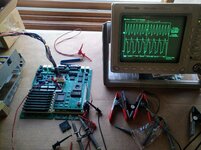
Did you ever try measuring Y1 or Y3's frequencies? My RTC ticks normally at 32.768hz with the board powered off and a battery inserted, but the frequencies on those lines go awry when I have the board powered up, like something else on that line is making a ton of noise and tripping up all the other chips. Unless anyone with deeper experience than me has any tips, I might have to put my board away as well, at least until I can afford an actual scope, as I'm sure a digits-only multimeter is not giving me the full picture.
 
Back
Top